
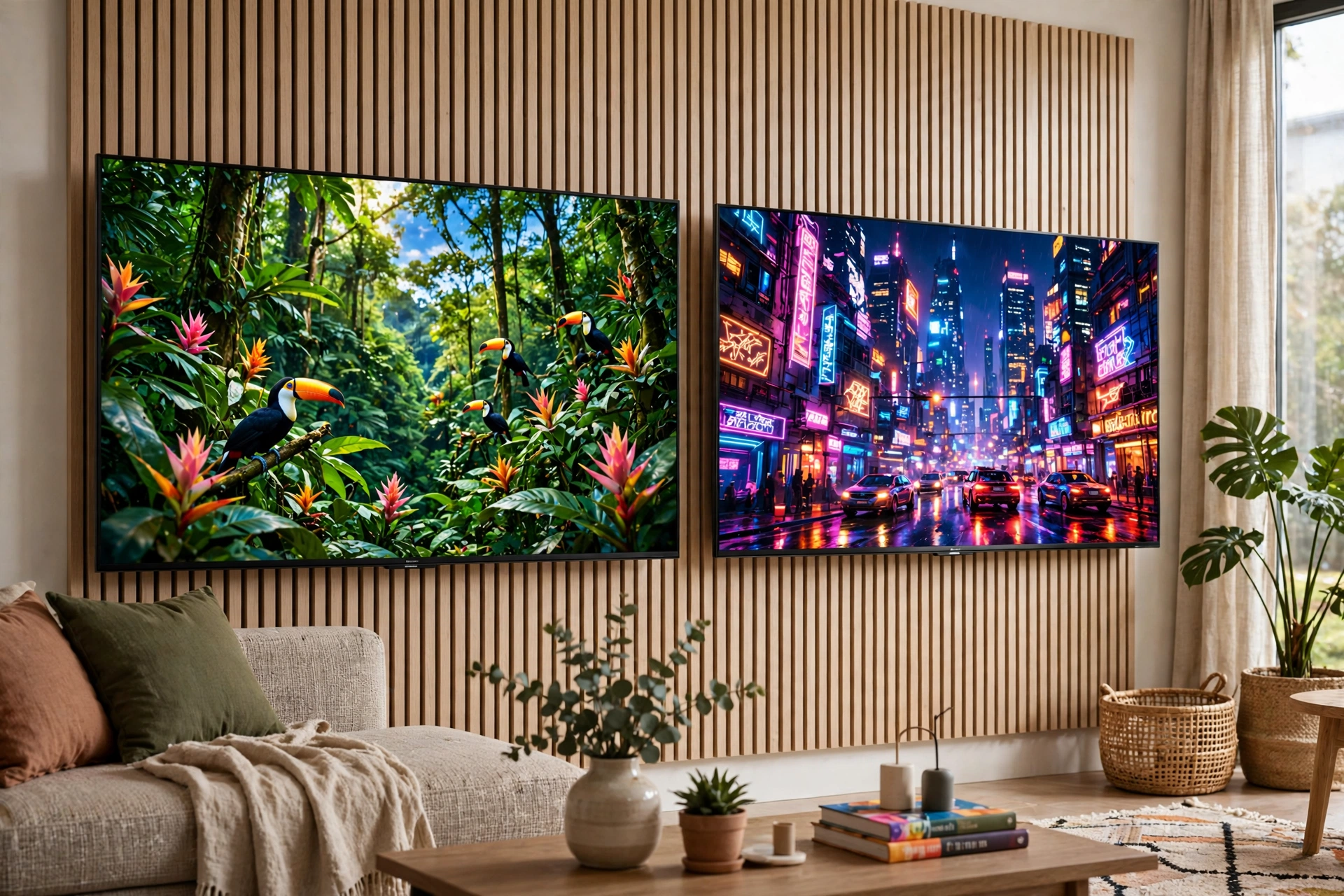
QLED vs OLED is the question everyone asks when buying a TV — and the shop floor makes it harder, not easier, because every TV there is showing the same bright demo reel. The real differences are about how each technology handles light, and they matter more in your living room than in the store. This guide explains both in plain language, compares them on the things that actually affect watching, and tells you which one to buy for your room and your budget in 2026.
- OLED wins on picture quality: perfect blacks, infinite contrast, and wide viewing angles.
- QLED wins on brightness and price: it handles bright rooms better and costs less at larger sizes.
- Burn-in is a real but small risk for OLED — mostly a concern if you leave static images on screen for hours daily.
- For a dark room and films, buy OLED. For a bright room and daytime TV, buy QLED.
- Both are big steps up from a basic LED TV, and either will be a huge upgrade if you are coming from an old set.
What Is QLED?
QLED is Samsung’s name for a type of LED TV with a quantum dot layer — tiny particles that produce purer colours when light passes through them. Underneath, it is still an LCD TV: a backlight shines through a liquid crystal panel, and the quantum dots improve the colour. The result is a very bright TV with vivid, punchy colours and a wide range of sizes and prices. Most QLEDs are made by Samsung, but other brands sell similar quantum-dot TVs under different names.
QLED’s strengths are brightness and value. It can get much brighter than OLED, which matters in a sunny living room, and it costs less — especially at 65 inches and above. Its weakness is black levels: because the backlight is always on to some degree, blacks look dark grey rather than truly black, and the picture can wash out a little when viewed from a sharp angle.
What Is OLED?
OLED is a different technology entirely. Each pixel produces its own light, so when a pixel needs to be black, it simply turns off. That gives OLED perfect blacks, infinite contrast, and a picture that looks three-dimensional in a dark room. It also means perfect viewing angles — the picture looks the same from the side as it does from the front. LG and Sony make most OLED TVs, and the panels are widely regarded as the best picture quality you can buy.
OLED’s weaknesses are brightness and burn-in. It does not get as bright as QLED, so in a very sunny room the picture can look dimmer. And because the pixels are organic, a static image left on screen for a very long time — a news channel logo, a game HUD — can leave a faint ghost image. Modern OLEDs have features that reduce this risk, and for most viewers it never becomes a problem, but it is the one thing to know before you buy.
QLED vs OLED: Head to Head
- Picture quality: OLED wins — perfect blacks and contrast are visible in every dark scene.
- Brightness: QLED wins — much brighter, better for sunny rooms and daytime viewing.
- Viewing angles: OLED wins — the picture stays accurate from the side; QLED fades and washes out.
- Colours: Both are excellent. QLED is punchier and more vivid; OLED is more natural and accurate.
- Gaming: Both are good. OLED has faster response times and better contrast; QLED is brighter and has no burn-in worry for static game interfaces.
- Burn-in risk: QLED has none; OLED has a small risk with static images over long periods.
- Price: QLED wins — usually cheaper at the same size, and much cheaper at 75 inches and above.
- Lifespan: Similar in practice. Both should last many years with normal use.
Which One Should You Buy in 2026?
Buy OLED if:
You watch films and prestige TV in a dark or dim room, you care about picture quality above all else, you watch from different angles, and your budget stretches to it. A 55-inch or 65-inch OLED is the best TV experience most people will ever have at home.
Buy QLED if:
Your room is bright, you watch a lot of daytime TV or sport, you want a very large screen without spending a fortune, or you leave the news on for hours. QLED is also the safer choice if burn-in worries you, and it is the better value at 75 inches and above.
What about Mini-LED?
Mini-LED is the middle ground: an LCD TV with thousands of tiny backlights that can dim in zones, giving much better blacks than regular QLED at a lower price than OLED. If you want OLED-like contrast with QLED brightness and no burn-in worry, a good Mini-LED TV is worth considering — it is the quiet third option that suits a lot of people.
What Size Should You Get?
Bigger than you think. The most common regret after buying a TV is buying too small — your eyes adjust to a big screen within a week, and a small one always looks small. For a typical living room, 55 inches is the minimum worth buying, 65 inches is the sweet spot, and 75 inches works if you sit more than about 3 metres away. Measure your viewing distance, check the stand fits, and remember that modern TVs have thin bezels — the screen is bigger than the old TV it replaces.
If you are setting up the room around the TV, our guide to packing a TV for moving is useful if you are relocating it, and our Apple TV deals roundup covers the streaming box that pairs well with either type. For the rest of your setup, our best gaming laptop guide covers the other screen in your life.
Frequently Asked Questions
Is OLED better than QLED?
For picture quality in a dark room, yes — OLED’s perfect blacks and contrast are visibly better. For brightness and value, QLED wins. The right choice depends on your room.
Does OLED burn-in still happen?
It can, but the risk is small for normal viewing. Modern OLEDs have pixel-refresh and screen-shift features that prevent it. It is mainly a concern if you display the same static image for many hours every day.
Which is better for gaming, QLED or OLED?
OLED has faster response times and better contrast, which looks amazing in games. QLED is brighter and has no burn-in risk from static game interfaces. Both support 120Hz and the latest consoles.
Is QLED worth it over a normal LED TV?
Yes — the quantum dot layer gives noticeably better colour and brightness than a basic LED TV, usually for a modest price increase.
How long do QLED and OLED TVs last?
Both should last 7–10 years or more with normal use. OLED’s organic pixels can dim over very long periods, but for most buyers this is not a practical concern.
QLED vs OLED is not really a fight — it is a choice between two good answers to different rooms. Dark room, films, and the best picture you can buy: OLED. Bright room, daytime viewing, and a big screen for the money: QLED. Pick the one that fits where you actually watch, and you will not regret it.