
They appear out of nowhere, they hover over the fruit bowl, and they seem impossible to get rid of. A fruit fly trap is the fastest way to deal with them, and the best ones are the ones you make yourself in two minutes from things already in your kitchen. This guide covers the traps that actually work, why fruit flies appear in the first place, and how to stop them coming back — because a trap without a fix is just a temporary solution, and the flies will return the moment you stop trapping them.
- The best DIY fruit fly trap is a jar with apple cider vinegar and a drop of washing-up liquid, covered with cling film with small holes poked in it.
- Traps work in hours, but they only catch adult flies — you must also remove the breeding source to stop them returning.
- Fruit flies breed in overripe fruit, drains, bins, and damp sponges, not just in the fruit bowl.
- Empty the trap every day or two, and keep trapping for a week after the last fly disappears.
- Store fruit in the fridge, clean drains, and take the bins out regularly to prevent a new infestation.
Fruit Fly Trap: The Apple Cider Vinegar Jar
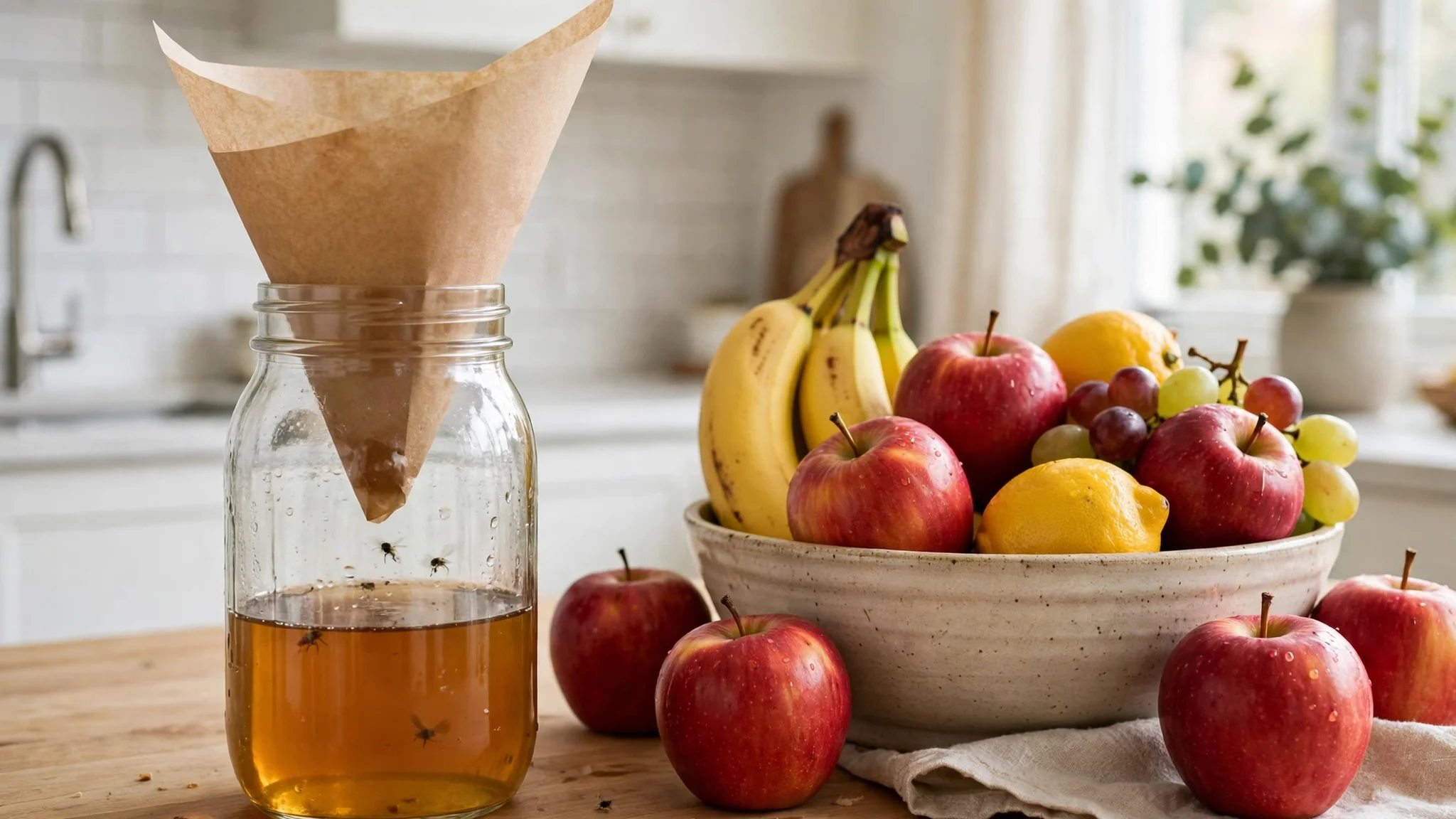
The most effective fruit fly trap is also the simplest. Take a small jar or a glass, pour in a few centimetres of apple cider vinegar, and add a single drop of washing-up liquid. The vinegar attracts the flies — they are drawn to the smell of fermentation — and the washing-up liquid breaks the surface tension of the liquid, so the flies sink instead of landing on the surface and flying away. Cover the jar with cling film, secure it with an elastic band, and poke a few small holes in the film with a toothpick. The flies crawl in through the holes, drawn by the smell, and cannot find their way out. Place the jar near the fruit bowl or wherever the flies are worst, and you will start catching them within hours.
The trap works because of the way fruit flies behave. They are attracted to the smell of fermenting fruit, which is why apple cider vinegar works better than white vinegar — it smells more like the fruit they are looking for. The holes in the cling film are important: without them, the flies can land on the surface and leave again, and without the washing-up liquid, they can stand on the vinegar and fly away. With both in place, the trap is remarkably effective. Empty it every day or two, because a jar full of dead flies stops attracting new ones, and the smell becomes unpleasant. Our fridge odour removal guide covers the same principle in a different place: the smell is the signal, and removing it is half the fix.
Other Fruit Fly Traps That Work
If you do not have apple cider vinegar, a trap made from red wine works the same way: a glass of red wine left out, with a drop of washing-up liquid, will attract and drown fruit flies just as effectively. Overripe fruit works too: put a piece of banana or a few grapes in a jar, cover it with cling film and poke holes, and the flies will go in for the fruit and not come out. A dish of beer or a little balsamic vinegar will also work. The principle is always the same: something fermented that attracts them, a way in, and a way to stop them leaving.
Commercial traps are also available, and they work on the same principle, with a pre-filled liquid and a funnel design. They are more convenient and less messy, but they cost money for something you can make in two minutes from kitchen supplies. If you have a severe infestation, or if you do not want to deal with a jar of vinegar on your counter, a commercial trap is a reasonable choice. But for most households, the DIY jar is faster, cheaper, and just as effective. The key, whichever trap you use, is placement: put it where the flies are, not where you wish they were. Near the fruit bowl, near the bin, or near the sink are the three places that matter. If your kitchen has other small pest problems, our flea treatment guide covers the pet side of the same battle, and our coffee maker cleaning guide is worth a read if your coffee machine is contributing to the damp, warm environment flies love.
Why traps alone are not enough
A trap catches adult flies, but it does not touch the eggs and larvae. A female fruit fly can lay hundreds of eggs, and they hatch in as little as 24 hours, in the same places the adults feed: overripe fruit, the drain, the bin, a damp sponge, a mop bucket, or a spill under the fridge. If you trap the adults but leave the breeding source, new flies will keep appearing for weeks. That is why the trap is only half the job. The other half is finding and removing the source, and that is where most people fail, because the source is not always obvious.
How to Stop Fruit Flies Coming Back
Start with the fruit. Store fruit in the fridge, not on the counter, until you are ready to eat it, and throw away anything overripe immediately. A single overripe banana can breed a whole infestation, and the flies will find it within hours. Next, clean the drains: pour boiling water down the kitchen sink drain, then a mixture of baking soda and vinegar, then more boiling water. Fruit flies breed in the organic matter that collects in drains, and a clean drain removes that breeding ground. Clean the bin, inside and out, and take it out regularly — a bin with old food at the bottom is a nursery for flies.
Then check the places you do not think about: the sponge, the dishcloth, the mop, the recycling, and the area under the fridge and the sink. A damp sponge left in the sink is a perfect breeding site, and it should be replaced regularly or microwaved to kill bacteria. Wipe down the counters every evening, and do not leave dirty dishes in the sink overnight. Keep trapping for a week after the last fly disappears, because eggs can still be hatching, and a single surviving female can restart the whole cycle. With the trap and the cleanup together, most infestations are gone within a week. If they are not, the breeding source is somewhere you have not found yet, and it is worth checking behind and under every appliance in the kitchen.
Frequently Asked Questions
What is the best homemade fruit fly trap?
A jar with apple cider vinegar and a drop of washing-up liquid, covered with cling film with small holes poked in it. The vinegar attracts the flies, the soap makes them sink, and the film stops them escaping.
How long does a fruit fly trap take to work?
You will start catching flies within a few hours. A full infestation usually takes about a week to clear, because you must also remove the breeding source.
Why do I have fruit flies if I have no fruit out?
Fruit flies also breed in drains, bins, damp sponges, mops, recycling, and spills under appliances. Check all of these, not just the fruit bowl.
Does white vinegar work as a fruit fly trap?
It works, but apple cider vinegar works better, because it smells more like fermenting fruit. Red wine, beer, and balsamic vinegar also work well.
How do I stop fruit flies coming back?
Store fruit in the fridge, throw away overripe fruit, clean the drains with boiling water, take the bins out regularly, and keep the trap out for a week after the last fly.
A fruit fly trap is the easiest pest control job in the house: a jar, some vinegar, a drop of soap, and a piece of cling film. It works in hours, it costs almost nothing, and it is satisfying in a way that few household jobs are. But the trap is only the treatment. The cure is the cleanup — the fruit in the fridge, the clean drain, the empty bin — and once you have done both, the flies will not come back. Until the next overripe banana, at least. And then you will know exactly what to do.