
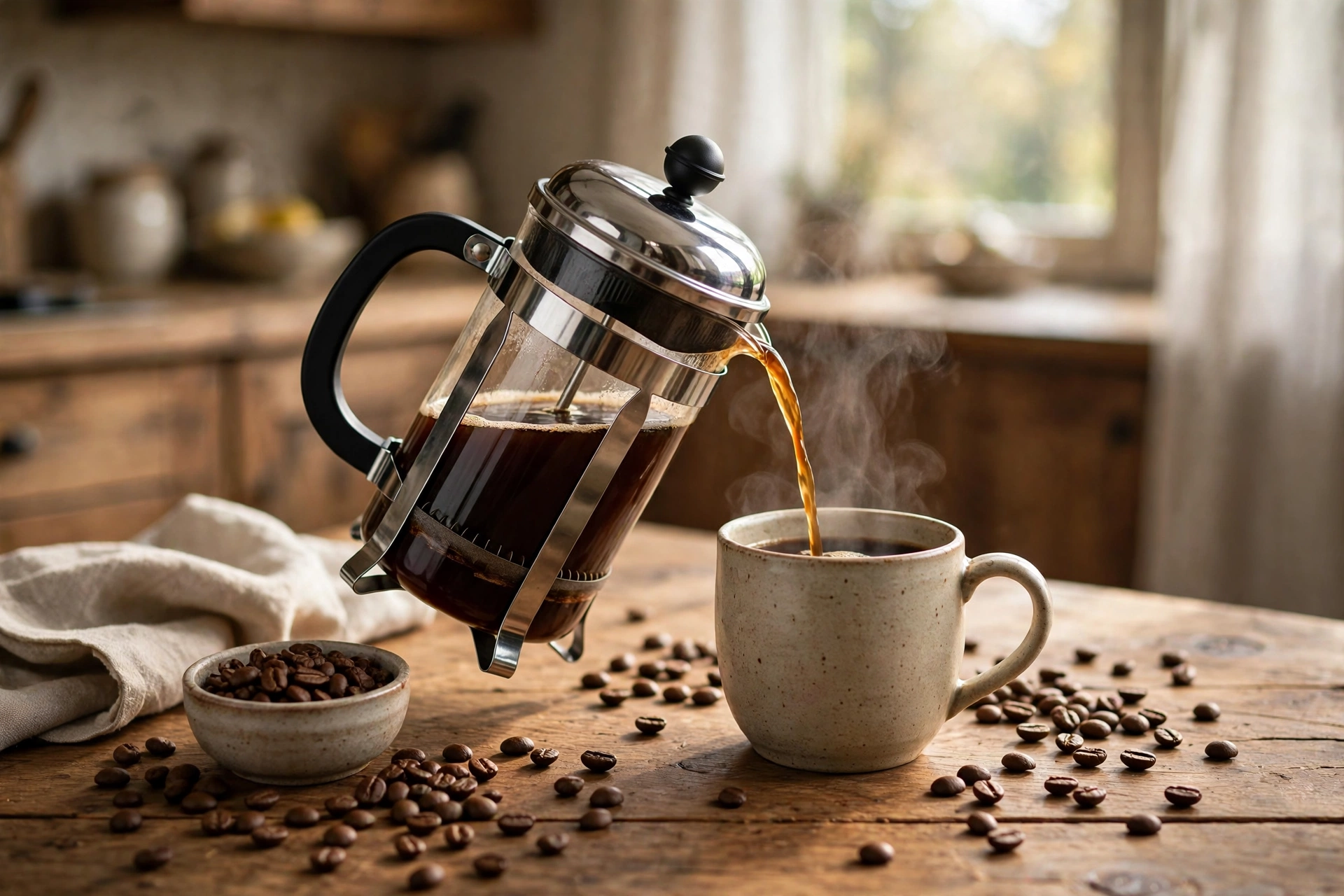

There is a reason the French press has survived every coffee trend of the last fifty years. It costs almost nothing, it has no parts to break, and it makes a cup of coffee that tastes richer than anything a drip machine produces. Learning how to make French press coffee takes about ten minutes the first time and about five minutes every time after that. The method is simple, but the details matter: the grind, the water temperature, the ratio, and the timing are what separate a great cup from a bitter, muddy one. This guide covers all of it, step by step.
- Use coarse-ground coffee, roughly the texture of breadcrumbs — fine grounds slip through the filter and make the coffee bitter.
- The ratio is about 1 gram of coffee to 15 grams of water (roughly 2 tablespoons per cup).
- Water should be just off the boil, around 93 to 96°C — boiling water scorches the coffee.
- Steep for 4 minutes, stir at the start, then press down slowly and pour immediately.
- Pour all the coffee out right away — coffee left sitting in the press keeps brewing and turns bitter.
How to Make French Press Coffee: Step by Step
Here is the whole method for how to make French press coffee in five steps. Start by heating your water. Bring it to a boil, then let it sit for about thirty seconds — you want it just off the boil, around 93 to 96°C. While the water heats, grind your beans coarse, about the texture of breadcrumbs or coarse sea salt. If you are buying pre-ground coffee, look for a bag labelled coarse or French press. Measure your coffee: the standard ratio is 1 part coffee to 15 parts water by weight, which works out to about 2 tablespoons of coffee per 250ml cup. For a standard 1-litre press, that is about 60 to 65 grams of coffee.
Put the grounds in the press and pour in about half the hot water. Give it a gentle stir with a spoon — wooden or plastic, not metal, which can crack the glass — and let it bloom for thirty seconds. You will see the grounds rise and bubble; that is the coffee releasing carbon dioxide, and it is a sign your beans are fresh. Then pour in the rest of the water, put the lid on with the plunger pulled up, and wait four minutes. When the time is up, press the plunger down slowly and steadily. Pour the coffee into your mug or a carafe immediately. Do not leave it sitting in the press, because the grounds are still in contact with the liquid and it will keep brewing, getting bitterer by the minute. If you are setting up a dedicated coffee corner, our home coffee station ideas will help you make it look as good as the coffee tastes.
The Grind: Why Coarse Is Non-Negotiable
The grind is the single most important variable in French press coffee, and it is the one most people get wrong. A French press steeps the grounds directly in the water with no paper filter, so the grind has to be coarse enough that the metal mesh can hold it back. Fine grounds slip straight through the mesh and into your cup, where they keep brewing and turn the coffee bitter and gritty. They also clog the filter, which makes pressing harder and can crack the glass if you force it.
Coarse grounds — roughly the size of breadcrumbs — give you a clean cup and an even extraction. If you are grinding at home, a burr grinder is worth the investment because it produces a consistent grind; a blade grinder chops unevenly, leaving a mix of fine dust and big chunks, which brews unevenly. If you do not own a grinder, buy your beans from a shop that will grind them coarse for you, or buy a bag labelled for French press. And if your coffee still tastes muddy after you have fixed the grind, the culprit is usually the beans themselves — stale beans make flat coffee no matter what you do. Our best coffee beans guide covers what to look for when buying, and the same freshness rules apply here.
Water temperature and ratio
Water that is too hot scorches the coffee and brings out bitter flavours; water that is too cool under-extracts and leaves the coffee sour and weak. The sweet spot is 93 to 96°C, which is water that has just come off the boil and sat for about thirty seconds. If you do not have a thermometer, that thirty-second wait is a reliable rule of thumb. The ratio is just as important: too little coffee and the cup is thin and watery, too much and it is overpowering. Start at 1:15 — one gram of coffee to fifteen grams of water — and adjust from there. If the coffee tastes weak, add more coffee, not more time. If it tastes bitter, use slightly less coffee or a slightly coarser grind.
Common French Press Mistakes (and How to Fix Them)
The most common mistake is leaving the coffee in the press after plunging. The grounds are still sitting in the liquid, and they keep extracting, so a cup poured five minutes late tastes completely different — bitter, heavy, and muddy. Always decant into a mug or carafe the moment you press. The second mistake is pressing too hard or too fast, which forces fine grounds through the mesh and can crack the glass. Press slowly, with steady, even pressure, and stop if you feel resistance — it usually means the grind is too fine.
The third mistake is using old coffee. French press brewing is honest: it shows you exactly what your beans taste like, with no paper filter to hide anything. Beans that were roasted more than three or four weeks ago will taste flat and dull. Buy small bags, use them within two weeks of opening, and store them in an airtight container away from light. And clean the press properly — old coffee oils go rancid and make every cup taste stale. Take the mesh filter apart once a week, wash all the parts with hot soapy water, and dry them fully. If your coffee maker needs a deeper clean, our coffee maker cleaning guide and our descaling guide cover the same principles for machines.
French Press vs Pour Over vs Drip: Which Is Right for You?
The French press makes the richest, fullest cup of the three, because the metal filter lets the coffee’s natural oils through, while a paper filter traps them. That is why French press coffee tastes heavier and more textured. A pour over makes a cleaner, brighter cup that shows off the subtle flavours of a good single-origin bean, but it needs more technique and more equipment. A drip machine is the most convenient, but it makes the thinnest, least interesting coffee of the three.
For most people, the French press is the best place to start: it is cheap, it is forgiving, and it teaches you the fundamentals — grind, ratio, temperature, time — that apply to every other method. Once you can make a great French press cup, you can make great coffee any way you like. And if you take your coffee on the go, our best coffee thermoses guide will keep that perfect cup hot for hours.
Frequently Asked Questions
How much coffee do I put in a French press?
Use a ratio of about 1 gram of coffee to 15 grams of water — roughly 2 tablespoons per 250ml cup, or 60 to 65 grams for a 1-litre press.
How long should French press coffee steep?
Four minutes is the standard. If it tastes bitter, try three and a half; if it tastes weak or sour, try four and a half. Change one variable at a time.
Why is my French press coffee bitter?
Usually the grind is too fine, the water was boiling, or the coffee sat in the press after plunging. Use coarse grounds, water just off the boil, and pour the coffee out immediately after pressing.
Can I use pre-ground coffee in a French press?
Yes, if it is coarse ground. Most supermarket ground coffee is too fine and will slip through the mesh. Look for bags labelled coarse or French press, or ask a coffee shop to grind beans coarse for you.
How do I clean a French press?
Take the mesh filter apart, wash all parts in hot soapy water, and dry fully. Do this after every use, and deep-clean the mesh weekly to stop old coffee oils going rancid.
Learning how to make French press coffee is one of those small skills that pays you back every single morning. Coarse grounds, water just off the boil, four minutes, a slow press, and pour it out straight away. Get those five things right and you will wonder why you ever made coffee any other way.