
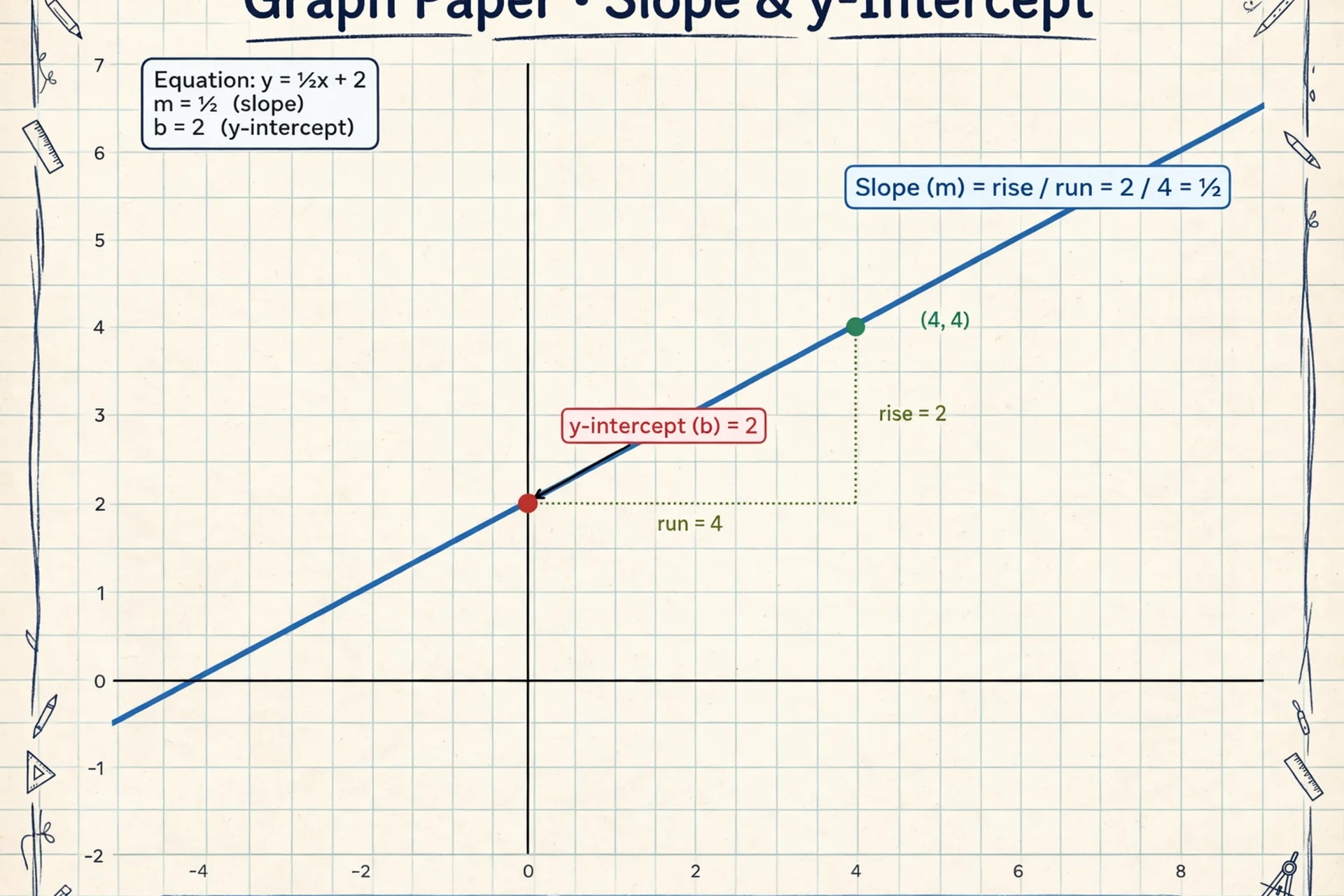
If you have ever stared at y=mx+b on a whiteboard and wondered what the letters are doing there, you are not alone. It looks like alphabet soup, but it is actually one of the simplest and most useful ideas in all of maths: it is the recipe for drawing any straight line on a graph. Once you know what m and b mean, you can read the equation like a sentence — and you can use it for everything from phone bills to speed, savings, and science. Here is the plain version, with no jargon left unexplained.
- y=mx+b is called slope-intercept form, and it describes any straight line on a graph.
- m is the slope: how steep the line is, and whether it goes up or down.
- b is the y-intercept: where the line crosses the vertical axis.
- x and y are the coordinates of any point on the line.
- You can use it to model real things: costs, savings, speed, and anything that changes at a steady rate.
What Does y=mx+b Mean?
Let us take it piece by piece. The equation y=mx+b describes a straight line on a graph, where x is the horizontal axis (left to right) and y is the vertical axis (up and down). Every point on the line has an x value and a y value, and the equation tells you how they relate. Pick any x, multiply it by m, add b, and you get the y that sits on the line. That is the whole trick.
The letters are not random. m stands for the slope — how steep the line is. b stands for the y-intercept — the point where the line crosses the y-axis, which is where x equals zero. Once you know m and b, you know everything about the line: where it starts, how steep it is, and which direction it goes. It is a small equation with a big job, and it shows up everywhere once you start looking: in science, in economics, in engineering, and in everyday maths. If you are building study habits alongside the maths, our how to study effectively guide will help the ideas stick.
What Is m, the Slope?
The slope, m, tells you how fast y changes when x changes. If m is 2, then every time x goes up by 1, y goes up by 2 — the line climbs steeply. If m is 0.5, y goes up by half a unit for every unit of x, and the line climbs gently. If m is negative, the line goes down as x increases: m = -3 means y drops by 3 for every step of x. And if m is 0, the line is flat — y never changes, no matter what x does.
Slope is often described as “rise over run”: how much the line rises (the change in y) divided by how far it runs (the change in x). Pick any two points on the line, subtract their y values, subtract their x values, and divide. That number is m, and it is the same no matter which two points you pick, because a straight line has the same steepness everywhere. That is the difference between a line and a curve: a curve changes steepness as you go along, and a line does not. If you like learning new skills step by step, our learn to code guide uses the same idea — small, steady steps that add up.
What is b, the y-intercept?
The y-intercept, b, is where the line crosses the y-axis — the vertical line where x equals zero. It is the starting point of the line. In real-life problems, b is usually the starting value: the fixed cost before you buy anything, the amount in your savings account on day zero, the height of a plant when you first measure it. In the equation y = 2x + 5, b is 5, which means the line crosses the y-axis at 5. Plot the point (0, 5), then use the slope to find the next points: m = 2 means go right 1, up 2, and you are on the line again.
That is the fastest way to draw any line from its equation. Plot b on the y-axis, then use m to step along: right 1, up or down by m, mark the point, repeat. Three points and a ruler, and you have the line. No table of values needed, no calculator required. Once you can do that, you can sketch any straight-line graph in under a minute.
y=mx+b in Real Life
The equation is not just for exams. It is how the world models anything that changes at a steady rate. A taxi charges a fixed pickup fee plus a rate per mile: the fee is b, the rate per mile is m, the miles are x, and the total fare is y. A phone plan costs $20 a month plus $0.10 per minute: b is 20, m is 0.10. Savings work the same way: start with $100 in the bank and add $25 a week, and your balance after x weeks is y = 25x + 100. Same equation, different story.
Science uses it constantly. Distance travelled at a steady speed is y = mx + b, where m is the speed and b is the starting position. Temperature conversion, currency exchange, and even the way a spring stretches under a weight all follow straight-line relationships. Whenever something changes by the same amount every time, y=mx+b is hiding underneath. If you are preparing for exams or interviews and want to present what you know clearly, our interview answers for students guide covers how to talk about your strengths — including the maths ones.
Frequently Asked Questions
What is y=mx+b called?
Slope-intercept form. It is called that because m is the slope of the line and b is the y-intercept — the two pieces of information you need to draw the line.
How do I find the slope from two points?
Subtract the y values, subtract the x values, and divide: m = (y2 – y1) / (x2 – x1). That gives you the slope, and you can then use one of the points to find b.
What does a negative slope mean?
The line goes down as x increases. For every step right, y drops by the size of m. A negative slope means the two quantities move in opposite directions.
What if m is zero?
The line is flat and horizontal. y stays equal to b no matter what x is. The equation becomes y = b.
Can every straight line be written as y=mx+b?
Almost every one. The only exception is a vertical line, like x = 3, which has no slope at all and cannot be written in this form.
y=mx+b looks complicated until someone tells you the secret: m is the steepness, b is the starting point, and the rest is arithmetic. Learn those two letters, and a whole branch of maths opens up — one straight line at a time.