
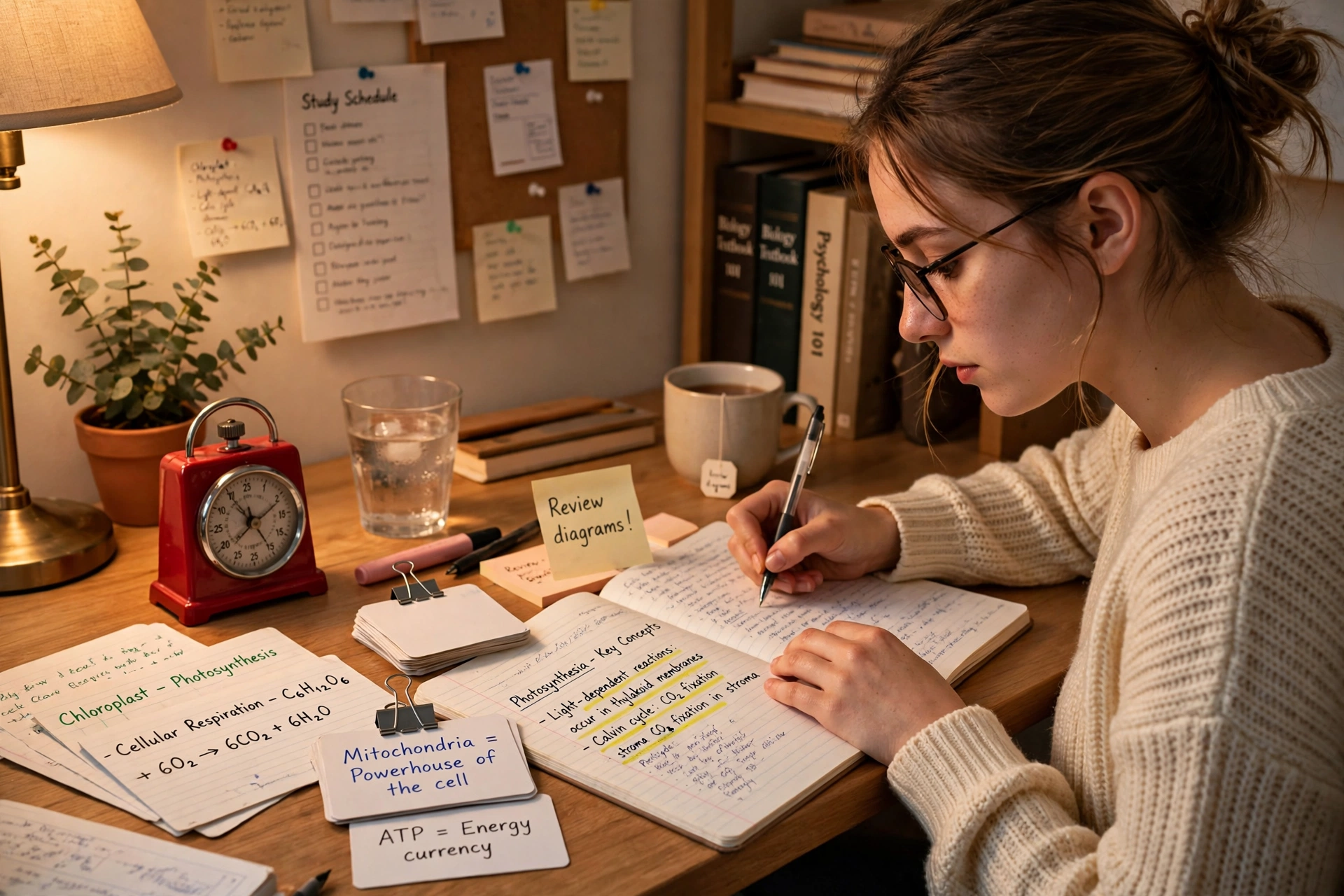
Most students study the wrong way: re-reading notes, highlighting whole pages, and cramming the night before an exam. Research on learning is clear — those methods feel productive but produce weak, short-lived memories. The real question is not how long you study, but how to study effectively: which techniques build durable understanding, and how do you organise your time so knowledge sticks? This guide covers twelve evidence-backed methods, how to build a study routine that survives real life, and the mistakes that quietly waste your effort.
- Active recall — testing yourself from memory — beats re-reading by a wide margin in every major study.
- Spaced repetition (reviewing at increasing intervals) is the single most powerful technique for long-term retention.
- Study in focused 25–50 minute blocks with real breaks, not in marathon sessions.
- Sleep is part of studying: memories consolidate overnight, so an all-nighter costs more than it saves.
- Interleave topics and practise with real exam-style questions instead of only reviewing notes.
How to Study Effectively: Start With Active Recall
Active recall means pulling information out of your memory instead of putting it in. Close the book, write down everything you remember about a topic, then check what you missed. It feels harder than re-reading — and that difficulty is exactly why it works. Every time you successfully retrieve something, the memory gets stronger. Flashcards are the classic tool, but the principle works with anything: explain a concept aloud to an empty chair, write a summary from memory, or answer practice questions without looking at your notes.
A simple routine: after each lecture or chapter, spend ten minutes writing down the key points from memory. The gaps you find are your real study list — they show you precisely what you do not know yet. Students who switch from re-reading to active recall typically see their test scores rise within a few weeks, even with the same total study time. If your study space is part of the problem, our study table design ideas for small rooms show how to build a focused corner even in a tiny bedroom.
Use Spaced Repetition Instead of Cramming
Spaced repetition is the practice of reviewing material at increasing intervals — after one day, then three days, then a week, then a month. It works because of the forgetting curve: we lose new information quickly at first, then more slowly, and each review resets the curve at a higher level. Cramming the night before an exam can work for a test the next morning, but the knowledge is usually gone within a week. Spaced review builds knowledge that lasts months.
Apps like Anki automate the scheduling for you, but a simple system works too: keep a box of flashcards divided into “daily,” “every three days,” and “weekly” piles, and move cards between piles as you master them. The key is starting early. Spaced repetition needs time to work, so begin reviewing from the first week of a course, not the last. Even fifteen minutes a day of spaced review beats a five-hour cram session for long-term retention.
Study in Focused Blocks, Not Marathons
Attention is a limited resource. Most people can focus deeply for 25–50 minutes before their concentration drops sharply, which is why marathon study sessions produce diminishing returns. The Pomodoro technique — 25 minutes of focused work, a 5-minute break, repeated four times, then a longer break — is popular because it matches how attention actually works. Longer blocks of 50 minutes with 10-minute breaks suit people who need more time to get into a topic.
Breaks matter as much as the work. A real break means stepping away from the desk: walk, stretch, get water, look out a window. Scrolling social media is not a break — it drains the same attention you need for studying. And protect your phone: put it in another room during study blocks. Research consistently shows that even a phone sitting face-down on the desk reduces working memory. If focus is your main struggle, our guide on how to stop procrastinating has practical techniques for starting — starting is usually the hardest part.
Interleave Topics and Practise Like the Exam
Interleaving means mixing topics within a study session instead of studying one topic for hours. Instead of doing fifty algebra problems in a row, do ten algebra, ten geometry, ten statistics, then repeat. It feels harder in the moment, but it forces your brain to practise choosing the right method — which is exactly what an exam asks you to do. Blocked practice feels fluent because you already know which method to use; interleaving builds the discrimination skill that exams actually test.
Similarly, practise in exam conditions. If your exam is timed and written by hand, practise timed and by hand. If it is multiple choice, do multiple-choice practice questions. If it involves problem-solving, solve problems — do not just read solved examples. Reading a solution and understanding it is not the same as producing it yourself under pressure. Past papers are the best study material that exists for most courses, so start with them early and use them to find your weak areas.
Sleep, Exercise, and the Study Environment
Sleep is not the opposite of studying; it is part of it. During sleep, your brain consolidates the day’s learning into long-term memory. Students who sleep 7–9 hours after studying remember significantly more than those who stay up late, and an all-nighter before an exam typically reduces performance despite the extra hours. If you must choose between one more hour of review and one more hour of sleep, choose sleep.
Exercise helps too — even a 20-minute walk improves attention and memory for hours afterwards. And your environment matters: study in the same quiet, organised place each day, with everything you need within reach, so your brain associates that place with focus. Keep the space tidy and well-lit; a cluttered, dim desk makes concentration measurably harder. For a calmer workspace, our best decor ideas for home office apply to study spaces as well — a room that feels good is a room you will actually sit in.
Frequently Asked Questions
What is the most effective way to study?
Active recall combined with spaced repetition is the most evidence-backed approach: test yourself from memory, and review at increasing intervals. Add focused study blocks and exam-style practice for the best results.
How many hours a day should I study?
Quality beats quantity. Two to four focused hours a day is more effective than eight distracted hours. Use 25–50 minute blocks with real breaks, and stop when your concentration is gone — pushing through exhausted hours teaches almost nothing.
Is it better to study in the morning or at night?
Most people focus best in the late morning, but the best time is the time you can protect consistently. What matters most is a regular schedule, a quiet space, and enough sleep afterwards.
Does highlighting help you study?
On its own, no — highlighting feels useful but produces weak memories. It helps only when combined with active recall: highlight sparingly, then close the book and test yourself on what you highlighted.
How do I stop procrastinating when studying?
Shrink the first step: commit to just five minutes. Set a timer, put your phone in another room, and start with the easiest task. Momentum usually takes over within minutes, and our procrastination guide covers the full system.
4 thoughts on “How to Study Effectively: 12 Science-Backed Tips”