
How to Descale a Coffee Maker: The Complete Homeowner’s Guide
If your morning cup tastes flat or faintly metallic — and the machine brews slower than it used to — limescale is the likely culprit. Descaling dissolves that mineral buildup from the inside out, reviving a sluggish machine and restoring day-one flavor.
Below: what descaling is, how to pick between vinegar, citric acid, and commercial descalers, step-by-step processes for drip machines and pod brewers, and a descale schedule matched to your water hardness.
Key Takeaways
- Descaling dissolves calcium and magnesium buildup that clogs heating elements, narrows water lines, and dulls flavor.
- Vinegar is cheapest, citric acid is the cleanest-smelling DIY option, and commercial descalers are safest for warranty coverage.
- Drip machines need two solution passes with a soak; pod brewers need cup-sized cycles plus a long soak.
- Hard-water homes should descale every 1–2 months; soft-water homes can stretch to every 3–4 months.
- Always finish with at least two fresh-water rinse cycles — and never mix descaler with bleach or detergent.
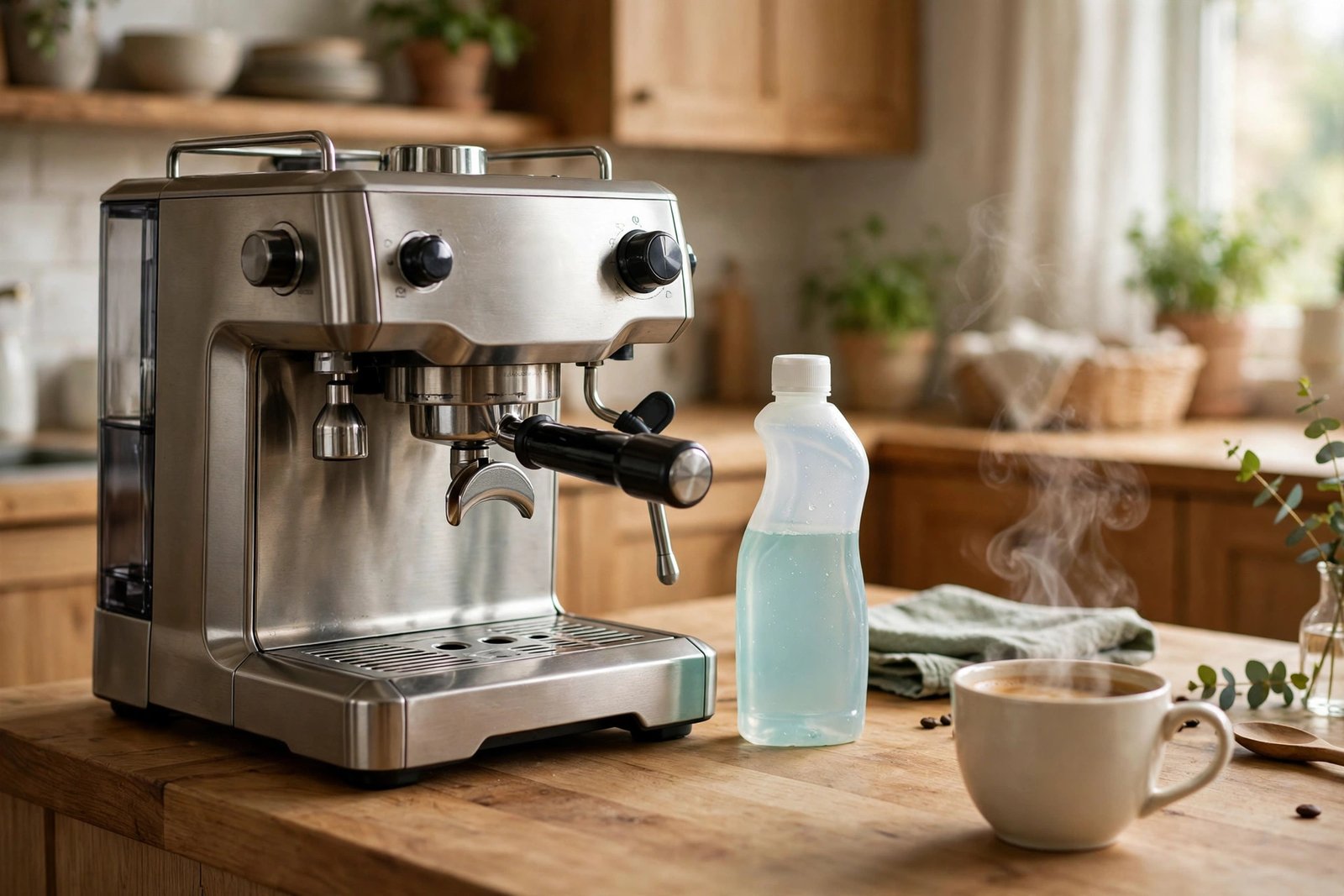
What Descaling Actually Is (and Why Your Coffee Tastes Off)
Every brew carries dissolved minerals — mostly calcium and magnesium — from tap water into the machine. Heated, they precipitate as a hard, chalky coating called limescale, building up invisibly inside the boiler, tubing, and shower head.
Limescale hurts performance three ways. It insulates the heating element, so the machine brews below the temperature where flavor extracts — producing sour, under-extracted coffee. It narrows internal water passages, stretching brew times and causing sputtering. And it can flake into the brew basket, leaving white sediment and a chalky taste.
This is different from general cleaning: washing the carafe removes coffee oils, while descaling circulates a mild acid to dissolve minerals from the inside out. A neglected machine does not just make worse coffee — it dies younger, since the heating element is the priciest part and the most stressed by scale. Our guide on how long home appliances last shows how habits like descaling separate a three-year coffee maker from an eight-year one.
Vinegar vs. Citric Acid vs. Commercial Descalers
All three work by the same chemistry — an acid that dissolves calcium carbonate scale — but they differ in cost, smell, and gentleness on seals and warranties.
White Vinegar: The Budget Workhorse
Plain distilled white vinegar (5% acidity) is genuinely effective on light to moderate scale at a 1:1 mix with water, or stronger for a machine neglected for years. It costs almost nothing — but the smell lingers in plastic and rubber parts, so plan on two to three full fresh-water rinse cycles. Some manufacturers warn it can degrade rubber seals over time, and it may not satisfy a warranty that requires an approved descaler.
Citric Acid: The Odorless Upgrade
Citric acid powder, dissolved at one to two tablespoons per liter of warm water, descales as well as vinegar with no smell to rinse out — one or two rinse cycles and you are done. It is food-grade, inexpensive, and easy to find in the canning aisle or online. For routine maintenance, it is the best all-around choice.
Commercial Descalers: The Warranty-Safe Option
Bottled descalers — usually citric- or lactic-acid based — dissolve scale without harming seals, and many are the only method a warranty accepts. They cost a few dollars per treatment with precise dosing. If your machine is still under warranty, buy here — and choose one made for coffee equipment, not bathroom or kettle products that can be too harsh inside.
How to Descale a Drip Coffee Maker, Step by Step
Set aside about an hour — most of it is waiting while the solution works.
- Empty and prep the machine. Discard old coffee and the used filter, then wash the carafe, brew basket, and permanent filter in hot soapy water so the acid attacks minerals, not old grime.
- Mix your descaling solution. Fill the reservoir with equal parts vinegar and water, two tablespoons of citric acid per liter of water, or a commercial descaler dosed per its label.
- Brew half, then pause and soak. Brew about half the solution through, then switch the machine off and let it sit 30 to 60 minutes. This soak is the most important step — it gives the acid time to dissolve scale on the heating element that a quick pass would miss.
- Finish the brew cycle. Switch the machine back on and finish the cycle. Sputtering or cloudy flow at first is dissolved scale leaving the system.
- Rinse twice, minimum. Empty the carafe, refill the reservoir with fresh cold water, and run a full brew cycle — twice. With vinegar, do a third rinse and taste-test before brewing coffee again.
The difference is immediate: faster brewing, quieter operation, hotter coffee, cleaner flavor. If the machine has not been descaled in a year or more, run the whole process twice — the second pass dissolves what the first loosened.
How to Descale a Single-Serve Pod Brewer
Pod brewers scale up faster than drip machines because their water lines are narrower — the same deposit causes proportionally more blockage. That is why the “descale” light exists, and why ignoring it leads to half-filled cups. The process below uses cup-sized cycles instead of a half carafe.
- Prepare the brewer. Power on, remove any pod, and empty the drip tray and reservoir. Take out the water filter cartridge if your model has one — descaling solution ruins it; install a fresh one afterward.
- Fill with descaling solution. Use citric acid (one tablespoon per liter) or a commercial descaler — vinegar odor clings stubbornly to pod-brewer tubing.
- Run the descale cycle — or improvise one. With a dedicated descale mode, start it and follow the prompts. Otherwise, run the largest cup-size brew with no pod into a mug, dump it, and repeat until the reservoir is nearly empty — pausing 20 to 30 minutes with the machine on every third cycle so the hot solution soaks the lines.
- Soak, then flush the reservoir. With a quarter of the solution left, power off and soak for 30 minutes. Then empty and rinse the reservoir thoroughly.
- Rinse with a full reservoir of fresh water. Refill with clean water and run the largest cup size repeatedly, dumping each mug, through at least one full reservoir. Pod brewers hold onto descaler taste — do not stop at three or four cycles.
Afterward, clear the exit and pod-puncture needles with a paperclip — scale and grounds cake around those tiny openings, and a quick poke restores full flow.
How Often to Descale: Match the Schedule to Your Water
Frequency depends almost entirely on water hardness. Hard water can scale a machine in weeks; soft water may take months to leave a trace.
- Hard water (scale visible on faucets): descale every 1 to 2 months. If your kettle furs up fast, so does your coffee maker.
- Moderately hard water: descale every 2 to 3 months. This covers most municipal supplies.
- Soft or filtered water: descale every 3 to 4 months. Even soft water leaves some deposit, so do not skip it.
Your machine also signals when it is overdue: slower brewing, louder pumping, cooler coffee, smaller cups, or a flat, chalky taste. Treat those as late warnings — the machine has been struggling for a while by then. Put descaling on your calendar like any maintenance task, and pair it with the rest of your appliance upkeep: the same hard water furring your coffee maker coats your dishwasher’s heating element and your washing machine’s drum. See how to clean a dishwasher and how to clean a washing machine to protect all three at once.
6 Descaling Tips That Save Your Machine
Some manufacturers void the warranty if you use vinegar. Two minutes with the manual tells you which descaler keeps your coverage intact.
Acids plus bleach create dangerous fumes. Descale with acid only, then rinse with plain water.
Filters absorb descaling solution and release it slowly afterward. Remove, descale, then install a fresh one.
A pitcher filter cuts the minerals that cause scale, so you descale far less often.
Solution run straight through cleans tubes but barely touches the heating element — the 30-to-60-minute soak does the real work.
Waiting until coffee tastes bad means scale is already severe. Calendar reminders beat taste tests.
Frequently Asked Questions
Is it safe to descale a coffee maker with vinegar?
Yes, for most machines — white vinegar diluted 1:1 with water is an effective, food-safe descaler when followed by thorough rinsing. Two exceptions: some brands warn against vinegar for their seals and warranties, and vinegar can corrode aluminum boilers.
Can I use baking soda to descale my coffee maker?
No. Baking soda is alkaline, and descaling requires an acid to dissolve mineral scale. It deodorizes carafes well, but it will not touch limescale — use vinegar, citric acid, or a commercial descaler instead.
Why does my coffee still taste like vinegar after descaling?
Vinegar clings to plastic and rubber parts — one rinse cycle is rarely enough. Run two to three full fresh-water cycles. If the tang persists, brew one cycle with a tablespoon of baking soda dissolved in the water to neutralize the acidity, then rinse once more.
How do I know when my coffee maker needs descaling?
Watch for slower brewing, louder pumping, cooler coffee, smaller cup volumes, white flakes in the carafe, or a flat, chalky taste. A descale indicator light is a minimum, not a target — schedule ahead of it.
Does descaling really make coffee taste better?
Noticeably. Scale insulates the heating element, so a scaled machine brews below the ideal 195–205°F range and under-extracts. After descaling, full temperature returns, extraction normalizes, and clean, balanced flavor comes back.
Your Next Descale Day
Descaling is one of the highest-return kitchen chores: about an hour of mostly waiting, a few times a year, for better coffee and a machine that lasts years longer. Pick your descaler, set a calendar reminder matched to your water hardness, and make it routine.
Ready to start? Mix up your solution this weekend and give your machine the fresh start it deserves. One maintenance afternoon — coffee maker, dishwasher, and washing machine together — keeps every hardworking appliance running at its best.