
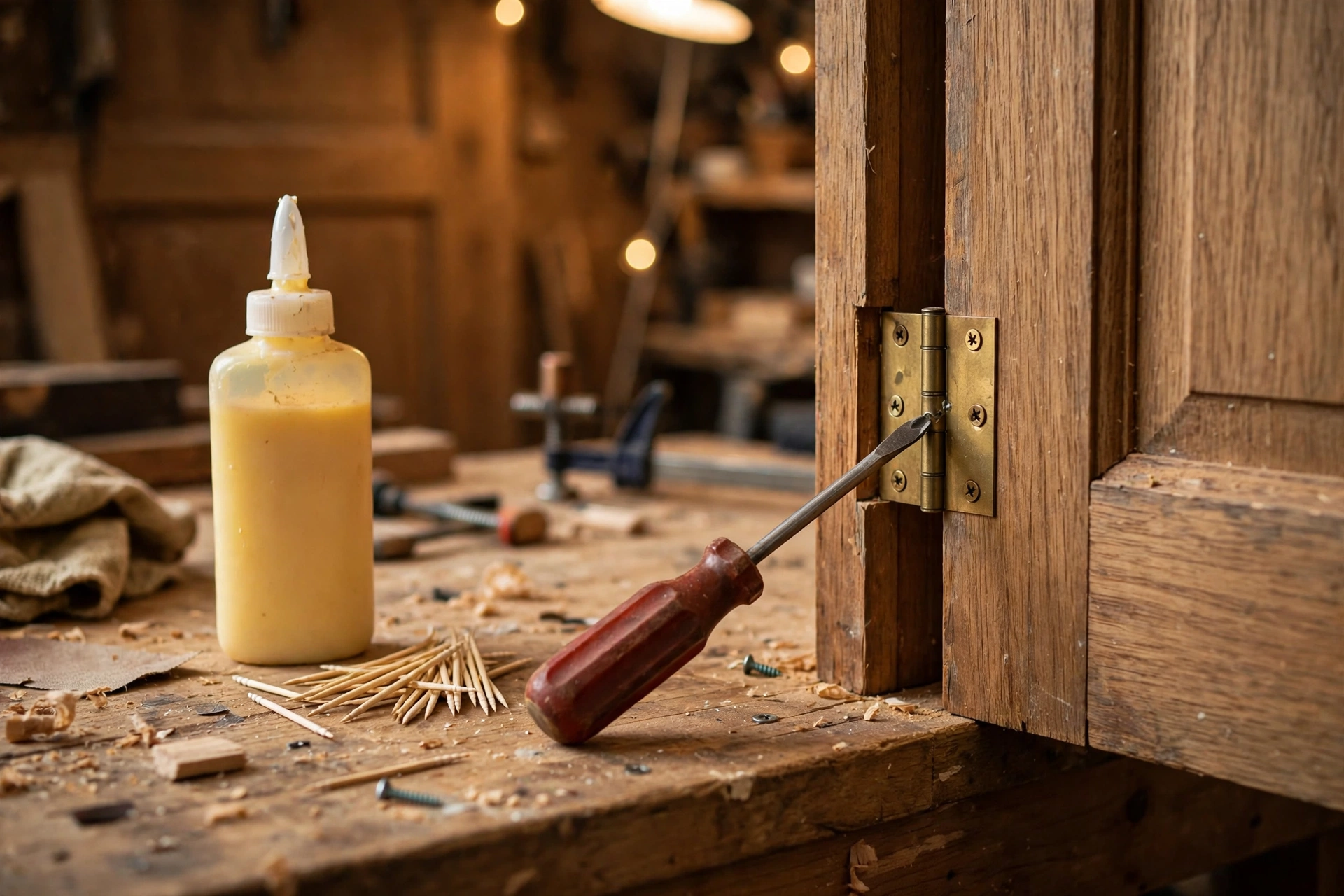
It happens to everyone: you go to tighten a screw in a wooden door, a hinge, or a piece of furniture, and it just spins. The threads have nothing left to bite into. The good news is that how to fix a stripped screw hole wood is one of the easiest repairs in the house — no new parts, no special tools, and in most cases the fix is stronger than the original wood. Here are five methods, from the quickest to the strongest, so you can pick the right one for the job.
- The toothpick-and-glue method fixes most stripped holes in under 10 minutes and holds well.
- For a stronger fix, fill the hole with a wooden dowel or a golf tee glued in place.
- Always let wood glue dry fully — at least a few hours — before driving the screw back in.
- A longer or thicker screw works when there is solid wood behind the hole.
- For hinges and heavy doors, a hardwood dowel is the most reliable long-term fix.
Why Screw Holes Strip in the First Place
A screw holds because its threads cut into the wood fibres around it. When a screw is removed and put back repeatedly — a door hinge that gets adjusted, a handle that gets tightened every few months — the threads wear the fibres away until there is nothing left to grip. Softwoods like pine strip faster than hardwoods, and screws driven into end grain (the cut end of a board) hold poorly from the start because the fibres run parallel to the screw.
Over-tightening is the other cause. A screw only needs to be snug. Cranking it past snug crushes the fibres, and the next time you tighten it, there is nothing left. If a screw in your house is spinning freely, do not keep turning it — you are only making the hole bigger. Take the screw out, look at the hole, and pick one of the fixes below. If the problem is a door that will not stay shut, our how to fix a running toilet guide covers a different common household repair with the same step-by-step approach.
Method 1: Toothpicks and Wood Glue (Quickest)
This is the fix most people should start with. Dip a few wooden toothpicks or matchsticks in wood glue and push them into the stripped hole until it is packed. Snap or cut off the ends flush with the surface, and let the glue dry for a few hours — overnight is best. Then drive the original screw back into the hole. The screw cuts new threads into the toothpicks and the glue, and the grip is usually better than the original wood.
For a slightly bigger hole, use wooden golf tees instead of toothpicks. A golf tee is tapered, so it wedges into the hole tightly, and it is made of hardwood, which holds threads well. Coat it in glue, tap it in with a hammer, cut it flush, let it dry, and drive the screw in. This method works for hinges, handles, brackets, and most furniture repairs. It is the one professional woodworkers reach for first, because it is fast and it works.
Method 2: Wooden dowel (strongest)
For a hole that needs to hold real weight — a door hinge, a heavy shelf bracket, a gate — a dowel is the proper fix. Drill the stripped hole out to the next standard dowel size, usually 6 mm or 8 mm, and cut a piece of hardwood dowel to the depth of the hole. Coat the dowel and the hole with wood glue, tap the dowel in, let it dry overnight, and cut it flush. Then drill a small pilot hole in the centre of the dowel and drive the screw in. The screw is now biting into solid hardwood, and the repair is stronger than the wood around it.
The key detail is the pilot hole: drill it slightly smaller than the screw’s core, so the threads still have something to cut into. Skip the pilot hole and the dowel can split. If you are refinishing the piece as well, our how to refinish hardwood floors guide covers the sanding and finishing side of woodwork.
Method 3: A Longer or Thicker Screw
Sometimes the simplest fix is a different screw. If the hole is stripped near the surface but there is solid wood deeper in, a longer screw of the same thickness will reach fresh wood and hold. If the hole is stripped all the way through, a slightly thicker screw — one size up — will cut new threads into the wood around the old hole. Both fixes take seconds and need no glue or drying time.
The limits are obvious: the screw has to fit the hinge or bracket, and it cannot be so long that it pokes out the other side. Check the thickness of the wood first. This method is best for light-duty jobs — a small bracket, a cabinet handle, a picture hook — rather than a heavy door hinge, where a dowel is the safer choice. For more on choosing the right wood for a job, our best wood for a bed frame guide explains how different woods hold screws.
Method 4: Wood Filler and Method 5: Threaded Inserts
Wood filler is the weakest option, but it has its place. For a small, light-duty hole — a screw that holds a lightweight hook or a decorative bracket — fill the hole with two-part wood filler, let it harden fully, and drive the screw in. It will hold for light loads, but it is not as strong as wood, and it will strip again if the screw is removed often. Use it for cosmetic fixes, not structural ones.
Threaded inserts are the heavy-duty option. A threaded insert is a metal sleeve with threads on the outside and the inside: you drill a hole, screw the insert in, and then the screw goes into the insert. The result is a metal thread in a wooden hole, which will never strip again. Inserts are the right choice for furniture that gets assembled and disassembled often — flat-pack furniture, workbenches, anything with bolts that come in and out. They cost a few dollars and need a drill, but they are a permanent fix. For the finishing touch on repaired wood, our types of wood polish for furniture guide covers what to use once the repair is done.
Frequently Asked Questions
What is the easiest way to fix a stripped screw hole in wood?
Toothpicks and wood glue. Pack glue-coated toothpicks into the hole, let it dry, and drive the screw back in. It takes ten minutes of work and holds well for most jobs.
Can I use wood filler to fix a stripped screw hole?
Yes, for light-duty holes. Wood filler holds a screw for lightweight items, but it is not as strong as wood. For hinges, doors, or heavy loads, use a dowel or a golf tee instead.
How long does wood glue take to dry before I can drive the screw in?
A few hours at minimum, and overnight is best. Driving a screw into wet glue pushes the filler out and weakens the repair. Patience is the whole trick.
Will a bigger screw fix a stripped hole?
Sometimes. A screw one size thicker will cut new threads into the wood around the old hole, and a longer screw can reach fresh wood deeper in. It only works if there is solid wood for the new screw to bite into.
How do I stop screw holes from stripping?
Do not over-tighten screws, drill a pilot hole before driving a screw into hardwood, and avoid removing and refitting the same screw repeatedly. A screw only needs to be snug, not crushed into the wood.
How to fix a stripped screw hole wood is a short list: toothpicks and glue for most jobs, a dowel for heavy ones, a bigger screw for a quick fix, and a threaded insert when it must never strip again. Pick the method that matches the load, let the glue dry, and drill a pilot hole. The screw will hold — and this time, it will stay held.
1 thought on “How to Fix a Stripped Screw Hole in Wood (5 Ways)”