
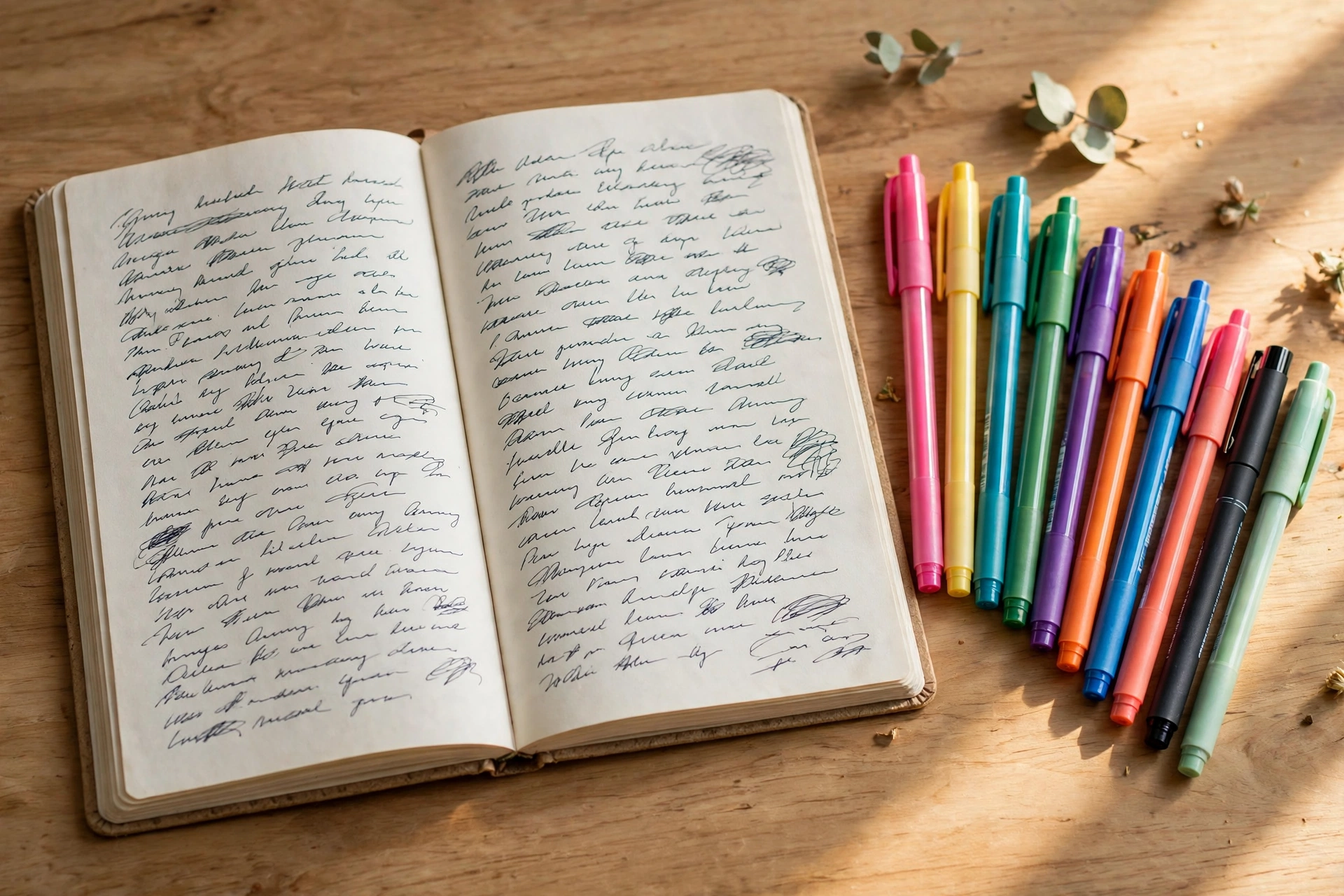
A journal lives or dies by the pen. The wrong one skips, smudges, bleeds through the page, and makes you not want to write. The right one glides, dries fast, and makes even a rushed morning page look good. The best pens for journaling are not the most expensive ones — they are the ones that match your paper, your handwriting, and how you actually use a journal. Here is how to choose, by pen type, with the models that journalers keep coming back to.
- Match the pen to your paper: thin paper needs a fine, quick-drying pen; thick paper handles anything.
- Gel pens are the best all-rounders for journaling — smooth, colourful, and affordable.
- Fineliners are best for small handwriting, lists, and drawing in the margins.
- Fountain pens are the most enjoyable to write with, but they need the right paper to avoid bleed-through.
- Always test a new pen on the back page of your journal before using it on a fresh spread.
First, Know Your Paper
Every pen choice starts with the paper, because the paper decides what the pen can do. Cheap, thin journal paper — the kind in most budget notebooks — will bleed and ghost with anything wet. A juicy gel pen or a fountain pen will show through to the other side and ruin the next page. Thick paper, like the 100 gsm paper in a Leuchtturm1917 or a Moleskine, handles almost any pen without bleeding.
If you do not know your paper’s weight, test it. Draw a line with your wettest pen on the back page, wait ten seconds, and check the other side. If you can see the line, that pen is too wet for your journal. This one test saves more frustration than any review ever will. And if you love to sketch as well as write, our what to draw list has prompts for the days when the words will not come.
Gel Pens: The Best All-Rounders
For most journalers, a gel pen is the right answer. They write smoothly with very little pressure, they come in every colour, and they are cheap enough to keep a set of them. The Pilot G2 is the classic — reliable, comfortable, widely available, and the 0.5 mm tip is the sweet spot for most handwriting. The Uni-ball Signo is the smoother option, with a slightly wetter ink that glides beautifully and dries fast enough not to smudge for most writers. The Sakura Gelly Roll is the favourite for colour and decoration: the white and metallic versions write on dark paper, which opens up a whole style of journaling.
Gel pens have two weaknesses: they can skip if the ink flow is interrupted, and the wettest colours can bleed on thin paper. Store them tip-down or flat so the ink stays at the tip, and test bright colours on your paper before committing to a full page. A set of 12 to 24 colours is plenty — more than that and you will spend more time choosing a colour than writing. If you enjoy making things by hand in general, our Christmas crafts for kids use the same gel pens for a different kind of page.
Fineliners: for small writing and detail
If your handwriting is small, or your journal is full of lists, trackers, and tiny notes, a fineliner is the better tool. The Sakura Pigma Micron is the standard — archival ink that does not fade, a needle tip that stays sharp, and sizes from 005 (very fine) to 08 (bold). The 0.5 mm Micron is the most useful single size. Staedtler Pigment Liners are the close rival, slightly cheaper and just as good for everyday writing. Fineliners dry fast, almost never bleed, and make small handwriting legible. Their weakness is pressure: press too hard and the tip bends. Write lightly and let the pen do the work.
Fountain Pens: The Most Enjoyable Way to Write
A fountain pen changes journaling from a habit into a pleasure. The nib glides with almost no pressure, the ink flows evenly, and the writing looks better — even your normal handwriting improves, because the pen rewards a light, steady hand. The Pilot Kakuno is the best starter fountain pen: cheap, friendly, and forgiving. The Lamy Safari is the step up — sturdy, comfortable, and available with different nib sizes. The Platinum Preppy is the cheapest way to try one, and it is surprisingly good for the price.
Fountain pens need the right paper. On thin paper they bleed and feather, which is why they have a reputation for being fussy. On good paper they are the best writing experience available. Use a fine or extra-fine nib to start, and a well-behaved ink — Pilot Iroshizuku and Diamine are safe choices that do not clog. A fountain pen is not the fastest way to fill a page, but it is the most satisfying. If you read as much as you write, our best book to movie adaptations list is a good source of journal prompts for the days you finish a book.
Ballpoints, Brush Pens, and the Rest
A good ballpoint still has a place. The Uni-ball Jetstream writes more smoothly than any other ballpoint, dries instantly, and never skips — it is the best pen for quick notes, lists, and writing on the move. It will not make your journaling beautiful, but it will never let you down. Keep one in your bag for the days you do not have your good pens with you.
Brush pens are for decoration and headings: the Tombow Dual Brush Pen has a brush tip on one end and a fine tip on the other, and it is the standard for journal headers, hand lettering, and habit trackers. The Pentel Sign Pen is the cheaper alternative and does the same job well. Neither is a daily writing pen — the brush tip is for art, not paragraphs — but one or two in your set will make your journal look like you meant it. For more creative prompts, our things to draw list pairs well with a brush pen and a blank page.
Frequently Asked Questions
What is the best pen for journaling?
For most people, a gel pen like the Pilot G2 or Uni-ball Signo in 0.5 mm. It is smooth, affordable, and works on most paper. If you write small, a fineliner like the Sakura Pigma Micron is better.
Do gel pens bleed through journal paper?
On thin paper, yes. On thick paper (100 gsm or more), usually not. Test any new pen on the back page of your journal first, and use a finer tip if bleeding is a problem.
Are fountain pens good for journaling?
Yes, on the right paper. A fountain pen is the most enjoyable way to write, but it needs good, thick paper to avoid bleed-through. Start with a Pilot Kakuno or a Lamy Safari and a fine nib.
What pen does not smudge for left-handed writers?
Quick-drying pens: the Uni-ball Jetstream ballpoint, the Sakura Pigma Micron fineliner, and the Uni-ball Signo gel pen all dry fast. Avoid wet gel inks and fountain pens with slow-drying ink.
How many pens do I need for journaling?
Three is enough to start: one black gel pen or fineliner for writing, one coloured pen for headings, and one brush pen for decoration. Add colours as you find your style, not before.
The best pens for journaling are the ones that make you want to pick up the journal tomorrow. Start with a good gel pen, test it on your paper, add a fineliner for detail and a brush pen for headings, and try a fountain pen when you are ready. The journal does not care about the price of the pen. It cares that you keep writing.