
How to Fix a Running Toilet: A Homeowner’s Step-by-Step Guide
That constant trickle inside your toilet tank is not just background noise — it is money draining away. A running toilet can waste over 200 gallons of water a day, inflating every water bill until someone investigates.
Here is the good news: fixing a running toilet is one of the simplest repairs a homeowner can do. No plumbing experience needed, almost no tools required, and about 30 minutes of your time. This guide covers diagnosing the exact cause — worn flapper, faulty fill valve, tangled chain, or misadjusted water level — and fixing each one in order of likelihood.
Key Takeaways
- A worn flapper, a bad fill valve, a tangled chain, or a water level set too high causes nearly every running toilet.
- You can diagnose the cause in minutes by lifting the tank lid and watching between flushes.
- Most fixes need only a sponge, an old towel, and a part that costs under $15.
- A running toilet can waste 200 gallons of water a day — fixing it can save $50 to $200 a year.
- Call a plumber if water leaks from the tank base or onto the floor, or if new parts do not stop the running.
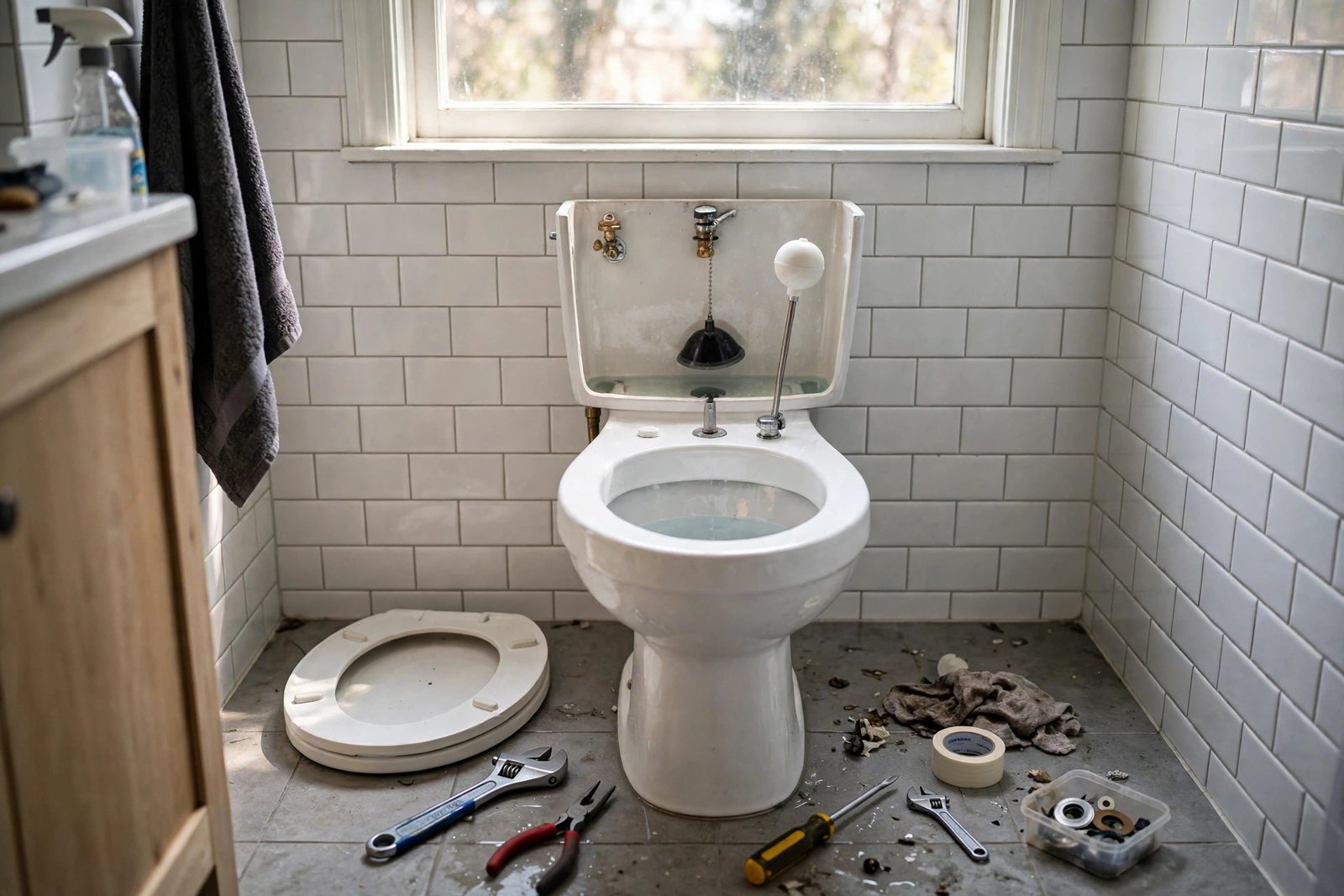
First, Know What’s Inside Your Toilet Tank
Lift off the tank lid and set it somewhere safe — porcelain chips easily. Despite the water, very few parts can cause running. Here are the suspects.
The flapper is the rubber disc at the bottom of the tank that seals the flush valve. Pressing the handle lifts it via the chain, water rushes into the bowl, and the flapper settles back to seal the tank. Over time rubber warps or gets mineral-coated and stops sealing — the tank refills endlessly, and you hear running. This is the number-one cause.
The fill valve is the tall column on one side, fed by the supply line underneath. It refills the tank after a flush, then shuts off. Its float — a ball on an arm or a cup sliding on the valve — rises with the water and tells the valve when to stop. If the float is set too high or the valve’s seal wears out, water flows forever. The overflow tube is the open pipe in the tank’s center that sends excess water into the bowl. Water spilling into it means a water-level or fill-valve problem. Finally, the chain connects the flush handle to the flapper and needs about half an inch of slack. If it is tangled, caught under the flapper, or holding the flapper open, the tank can never seal.
Diagnosing the Cause in Under Five Minutes
Do not guess — run these four checks. Flush once, let the tank refill, then watch and listen.
Check 1: Is water flowing into the overflow tube?
If water is trickling into the tube continuously, the level is too high or the fill valve is not shutting off. If the level sits an inch below the tube’s top, move on.
Check 2: The food-coloring test for a leaking flapper
Drop a few drops of dark food coloring into the tank water — not the bowl — and do not flush. Wait 15 to 20 minutes. Color in the bowl means water is leaking past the flapper seal: a ten-minute fix.
Check 3: Jiggle the handle and inspect the chain
If jiggling the handle stops the running, check the chain: kinked, wrapped around the flush arm, or wedged under the flapper? Zero slack holds the flapper open; too much length can snag beneath it. Both are free fixes.
Check 4: Lift the float by hand
If the toilet runs with no water entering the overflow tube, gently lift the float. Running stops? The valve is fine but the level is too high. Still running? The fill valve’s seal is worn and the valve needs replacing.
Tools and Parts You’ll Need
- Universal toilet flapper ($5–$10) — the adjustable type fits most toilets.
- Replacement fill valve ($10–$15) — the height-adjustable universal kind fits nearly every tank.
- A sponge and an old towel — for soaking up tank water before you swap parts.
- Adjustable wrench or pliers — only needed for a fill-valve swap.
- Food coloring — for the leak test, if you have not done it yet.
Total for the most common repairs: under $15, versus $150 to $350 for a plumber’s service call. Like any item on your home maintenance schedule, this small job rewards the homeowner who tackles it directly.
Fixing a Running Toilet: The Repairs in Order of Likelihood
Work through these in order — about 8 in 10 running toilets are fixed by step one or two.
Step 1: Replace the flapper
Shut off the water at the valve behind the toilet — clockwise until it stops. Flush, sponge the remaining water into a bucket, unhook the chain, and slide the flapper’s ears off the posts. Slide the new flapper on, re-hook the chain with half an inch of slack, and turn the water on. Running stopped? Confirm with the food-coloring test after an hour.
Step 2: Adjust or untangle the chain
If the flapper looked fine but jiggling the handle stopped the running, re-clip the chain with roughly half an inch of slack when closed — enough to seat fully, not so much that it slips underneath. Replace a kinked or corroded chain for a few dollars. Flush and check that the flapper lifts cleanly and drops flat.
Step 3: Lower the water level
The correct level is about one inch below the top of the overflow tube — many tanks have a fill line marked inside. On a cup-style valve, pinch the float clip and slide it down; on a ball-arm valve, turn the adjustment screw or bend the arm down. Flush and confirm the water shuts off before reaching the tube.
Step 4: Replace the fill valve
If water keeps flowing even when you lift the float, the valve’s seal is shot. Shut off the water, flush, and sponge out the tank. Disconnect the supply line underneath (towel beneath — a little water will spill), unscrew the lock nut, and lift the old valve out. Set the new valve’s height to the tank’s fill line, tighten the nut by hand plus a quarter-turn — overtightening cracks porcelain — reconnect the line, and flush twice to confirm shutoff.
Step 5: Check the flush valve seat
Rare, but worth knowing: if a brand-new flapper still leaks, the rim it seals against may be pitted or mineral-coated — scrub it gently with a scouring pad until smooth. If the seat is cracked or warped, the whole flush valve must be replaced — that means removing the tank, a job for a plumber.
How Much Water and Money a Running Toilet Wastes
A worn flapper typically leaks 200 or more gallons per day — roughly 6,000 gallons a month. At average water and sewer rates, that is $50 to $200 extra per year. One running toilet can quietly double a small household’s water bill.
A half-hour repair with a $10 part is one of the highest-return fixes in the house, right alongside learning how to flush a water heater: small maintenance that protects your wallet year after year.
6 Pro Tips to Keep Your Toilet Running Right
In-tank bleach destroys rubber flappers, cutting their lifespan from years to months.
Even good flappers harden with age. A scheduled swap beats a month of silent leaking.
Stand quietly in the bathroom for 30 seconds. Hear refilling with no flush? Run the dye test.
Hand-tight plus a quarter-turn for valve nuts and supply lines — porcelain cracks first.
A few dollars turns a future midnight leak into a ten-minute fix.
When to Call a Plumber Instead
DIY covers flappers, chains, floats, and fill valves — but know the line. Call a licensed plumber if water leaks from the toilet’s base or pools on the floor (a failed wax ring or cracked tank), if the toilet rocks, or if new parts did not stop the running.
Also call for help if the shutoff valve behind the toilet is frozen or corroded; forcing it can cause a flood. Knowing when a job has outgrown the DIY toolbox is part of being a capable homeowner — as our guide on how to patch drywall explains.
Frequently Asked Questions
Why does my toilet keep running after I flush?
Usually the flapper is not sealing, so water leaks into the bowl and the tank refills endlessly. Other causes: a fill valve that will not shut off, a tangled chain, or a level spilling into the overflow tube. The food-coloring test finds a flapper leak in minutes.
How much does it cost to fix a running toilet?
DIY costs $5 to $15 for a flapper or $10 to $15 for a fill valve, with no special tools. A plumber charges $150 to $350 for the same job. Unless the tank is cracked or water leaks at the base, the repair takes about 30 minutes.
Can a running toilet increase my water bill?
Yes, dramatically. A running toilet can waste 200 gallons or more per day — about 6,000 gallons a month — adding $50 to $200 a year to your bill, and more in high-rate cities.
How do I know if the flapper or the fill valve is the problem?
Put food coloring in the tank and wait 15 minutes without flushing. Color in the bowl means the flapper is leaking. Water in the overflow tube — or running even when you lift the float — means the fill valve. If jiggling the handle stops it, suspect the chain.
Is it safe to keep using a toilet that runs constantly?
The toilet still flushes safely — this is a water-waste problem, not a health hazard. But do not ignore it: the constant flow wastes thousands of gallons and wears out the fill valve. Every part you need is at any hardware store.
Stop the Drip and Keep the Savings
Fixing a running toilet is the rare repair that is cheap, quick, beginner-friendly, and pays you back monthly. Run the five-minute diagnosis, work the fixes in order, and a $10 flapper will most likely have you done before lunch.
Then keep the momentum: listen for phantom refills once a month, stash a spare flapper under the sink, and keep building your DIY confidence.
3 thoughts on “How to Fix a Running Toilet: Step-by-Step DIY Guide”