
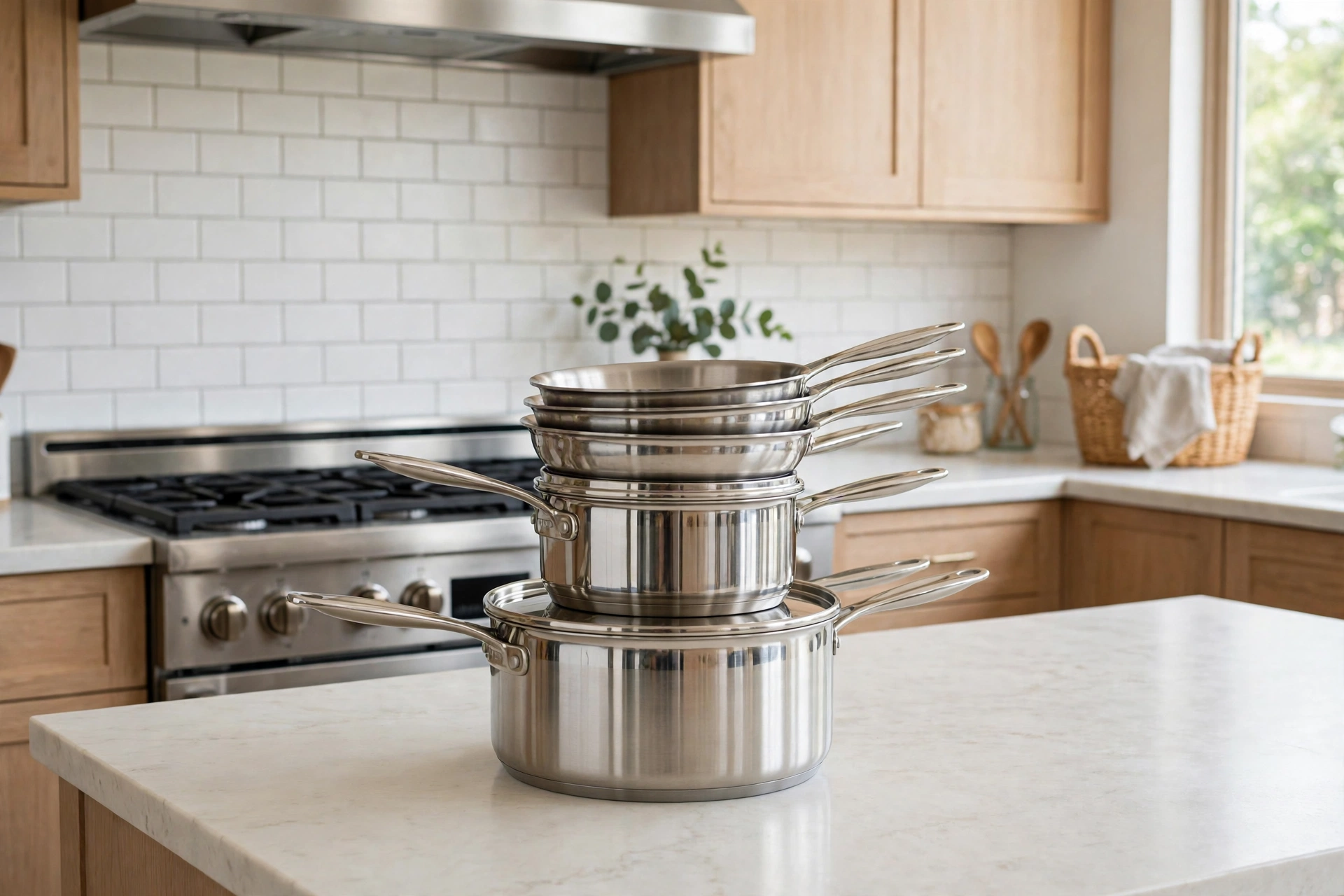
Stainless steel is the pan that professional kitchens actually use, and there is a reason for that: it lasts forever, it does not react with food, and it can take real heat without warping or shedding a coating into your dinner. The best stainless steel cookware is not the cheapest set on the shelf, and it is not the most expensive either. It is the set with the right construction, the right pieces, and a weight that tells you it will still be in your kitchen in twenty years.
- Look for tri-ply or multi-ply construction — a layer of aluminium sandwiched between steel — for even heating.
- 18/10 stainless steel (18 percent chromium, 10 percent nickel) is the quality mark to look for.
- A good starter set is a saucepan, a sauté pan, a stockpot, and a frying pan — skip the sets with pieces you will never use.
- Stainless steel is not non-stick: preheat the pan, then add oil, then add food.
- Expect to pay more upfront; a good set lasts decades, so the cost per year is low.
What Makes Stainless Steel Cookware Good?
The single most important thing is the construction. Cheap stainless steel pans are a single thin layer of steel, and they heat unevenly — hot in the middle, cool at the edges — which is why food sticks and burns in spots. Good pans are tri-ply: a layer of aluminium, which conducts heat well, sandwiched between two layers of stainless steel, which are durable and non-reactive. Some premium pans add more layers, but tri-ply is the sweet spot for most kitchens. The ply should run all the way up the sides, not just across the base, or the sides will stay cool while the base overheats.
The steel itself matters too. Look for 18/10 stainless steel, which means 18 percent chromium and 10 percent nickel — it resists rust and staining better than the cheaper 18/0 or 18/8 grades. The handles should be riveted, not welded, and they should stay cool enough to hold without a mitt for short periods. Lids should fit tightly and be made of the same steel, not thin glass that fogs up. And the base should be flat — a pan that wobbles on your hob will never heat evenly. If you are comparing cookware types, our best induction cookware guide covers which sets work on induction hobs, since not all stainless steel does.
The Best Stainless Steel Cookware Sets
All-Clad is the name every cook knows, and its D3 tri-ply range is the benchmark other sets are measured against. It is expensive, but it heats beautifully, it is made well, and it comes with a lifetime warranty. If you want the best and you cook every day, it is hard to beat. Tramontina’s tri-ply range is the value pick: it performs very close to the premium brands for about half the price, and it is the set most cooking experts recommend to people who want quality without the top price. Made In and Misen are the newer direct-to-consumer brands — good construction, honest pricing, and no department store markup.
For a first set, a five-piece is usually the right size: a small saucepan, a large saucepan or sauté pan, a stockpot, and a frying pan, with lids. The big ten and twelve-piece sets look like a bargain, but half the pieces rarely get used, and the money is better spent on fewer, better pans. If you only buy one piece, make it a 30cm sauté pan with a lid — it does the work of a frying pan, a saucepan, and a shallow casserole dish, and it is the pan you will reach for most. For the other half of the kitchen, our best coffee maker guide covers the appliance that sits next to the pans.
What about non-stick vs stainless steel?
Non-stick is easier for eggs and fish, and stainless steel is better for almost everything else. Stainless steel sears meat properly — the brown crust that non-stick cannot make — and it goes from hob to oven without worrying about the coating. It also lasts: a non-stick pan needs replacing every two to three years, while a stainless steel pan can last a lifetime. Most good cooks keep both: a non-stick pan for eggs and delicate fish, and stainless steel for everything else. If you are replacing a non-stick pan, keep the old one for eggs and buy stainless steel for the rest.
How to Cook With Stainless Steel (Without Everything Sticking)
The complaint everyone has about stainless steel is sticking, and it is almost always a technique problem, not a pan problem. The rule is simple: preheat the pan first, then add the oil, then add the food. Put the empty pan on a medium heat for two or three minutes. Add a little oil and wait until it shimmers. Then add the food — and do not move it. Let it sit until it releases naturally. Meat that sticks is meat that is not ready to move yet; when the crust forms, it lets go on its own.
Use medium heat, not high. Stainless steel holds heat well, so you need less flame than you think, and high heat is what burns food onto the surface. Pat meat dry before it goes in — wet meat steams instead of searing. And deglaze the pan after cooking: pour a splash of water, wine, or stock into the hot pan and scrape up the brown bits. Those bits are flavour, and they become the base of a sauce in thirty seconds. For the pan that goes with your new cookware, our how to use a slow cooker guide covers the other workhorse that sits next to it in the kitchen.
Cleaning Stainless Steel: Easier Than You Think
Cleaning is where stainless steel wins over every other material. Most pans are dishwasher-safe, though hand washing keeps them looking better for longer. For everyday cleaning, hot water and washing-up liquid with a soft sponge is enough. For stuck-on food, fill the pan with hot water and a spoonful of bicarbonate of soda, leave it for twenty minutes, and it wipes clean. For the rainbow-coloured heat stains that appear on stainless steel, a splash of white vinegar on a cloth removes them in seconds.
Bar Keepers Friend is the classic stainless steel cleaner, and it works on burnt-on food and discolouration that nothing else will shift. Use it with a soft cloth, not a scouring pad, and rinse well afterwards. Avoid steel wool and harsh abrasives — they scratch the surface, and scratched steel stains more easily. And never put a hot pan under cold water: the thermal shock can warp it. Let it cool first, then wash it. Treated well, a stainless steel pan looks as good in twenty years as it does on the day you buy it. For the rest of your kitchen cleaning, our how to clean a glass stovetop guide keeps the hob looking as good as the pans.
Frequently Asked Questions
Is stainless steel cookware worth the money?
Yes, if you cook regularly. A good tri-ply set lasts decades, does not shed coating into food, and sears better than non-stick. The cost per year of use is lower than replacing non-stick pans every few years.
What is the best stainless steel cookware brand?
All-Clad is the benchmark for quality. Tramontina offers very similar performance for about half the price. Made In and Misen are strong direct-to-consumer options.
Why does food stick to my stainless steel pan?
Usually because the pan was not hot enough before the food went in, or the food was moved too soon. Preheat the pan, add oil, wait for it to shimmer, then add dry food and let it release naturally.
Is stainless steel safe for induction hobs?
Most tri-ply stainless steel works on induction, but not all of it — the outer layer needs to be magnetic. Check the box for an induction symbol, or test it with a fridge magnet: if the magnet sticks to the base, it will work.