
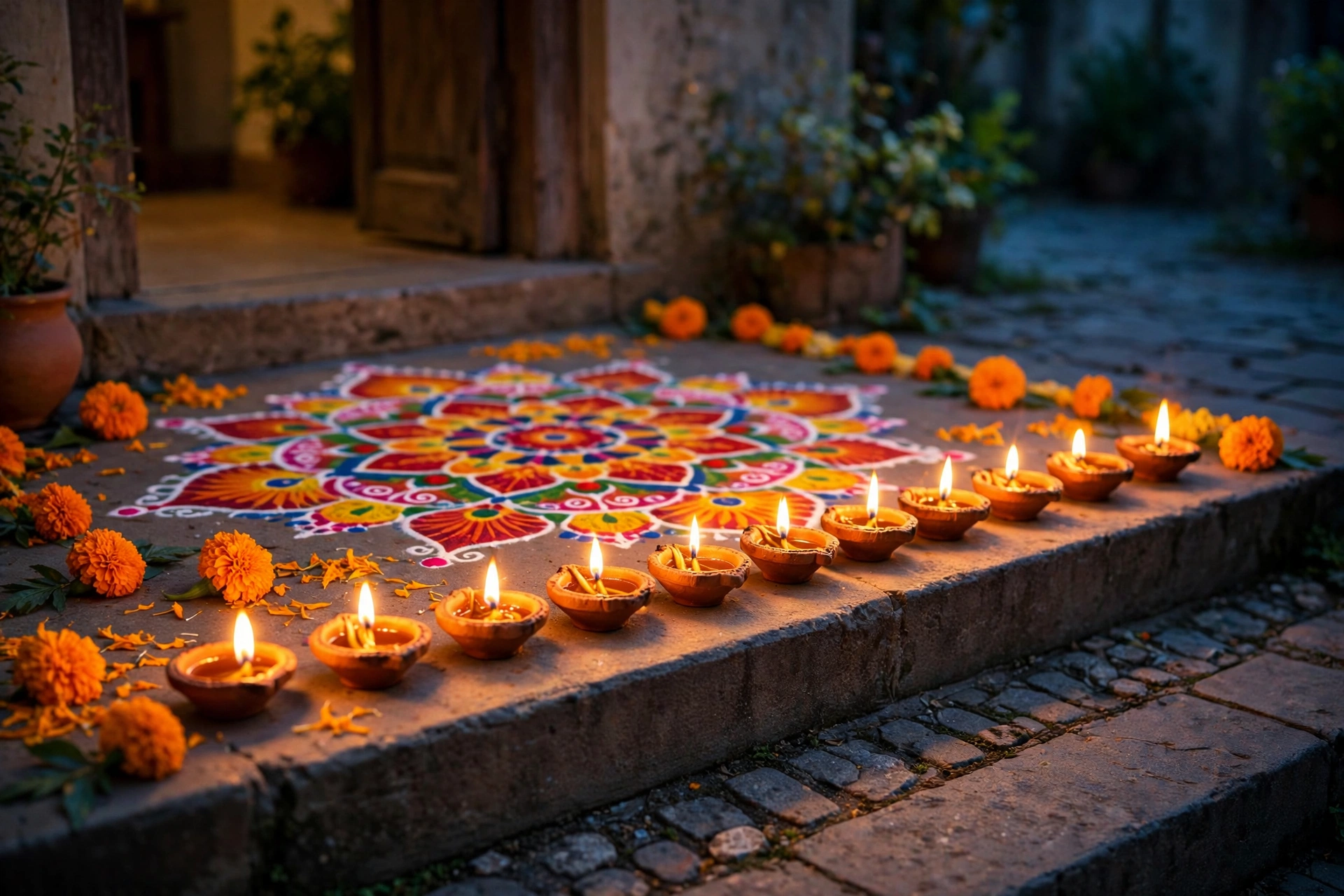
Choti Diwali — also called Naraka Chaturdashi — is the small Diwali, and it is often the most loved day of the whole festival. It falls on Saturday 7 November 2026, the day after Dhanteras and the day before the main Lakshmi Puja, and it has its own rituals, its own story, and its own gentle glow: fewer fireworks, more diyas, and an evening that belongs to the home.
Many families say Choti Diwali is their favourite day precisely because it is quieter. The cleaning is done, the shopping is mostly finished, and the evening is for lighting lamps, sharing sweets and preparing for the big day. This guide explains what Choti Diwali is, the story behind it, the rituals and timings, how to celebrate it at home, and how it fits into the five days of Diwali 2026. For the full festival calendar, see our Diwali 2026 dates guide, and for yesterday’s festival, our Dhanteras guide.
- Choti Diwali 2026 falls on Saturday 7 November, between Dhanteras (6 Nov) and Lakshmi Puja (8 Nov).
- It is also called Naraka Chaturdashi, marking Lord Krishna’s victory over the demon Narakasura.
- The main rituals are an early-morning oil bath (abhyanga snan), lighting diyas in the evening, and worship of Lord Krishna and Goddess Kali in some traditions.
- It is a quieter, family-centred evening — ideal for diyas, rangoli and sweets before the main day.
1. What Is Choti Diwali?
Choti Diwali means “small Diwali”, and the name is affectionate rather than dismissive. It is the second day of the five-day Diwali festival, observed on the fourteenth day (Chaturdashi) of the dark fortnight in the month of Kartik. In 2026 it falls on Saturday 7 November, and it is celebrated across India and by Hindu communities worldwide.
The day is also known as Naraka Chaturdashi, after the story at its heart: Lord Krishna’s defeat of the demon king Narakasura, who had imprisoned thousands of people. Krishna’s victory freed them, and the lamps lit on this day celebrate the defeat of darkness and evil. In some regions the day is also associated with Goddess Kali, and in South India it is often the main day of Deepavali itself, celebrated with an early-morning oil bath and fireworks.
2. The Morning Ritual: Abhyanga Snan
The day begins before dawn with abhyanga snan — a ritual oil bath. Family members massage their bodies with warm sesame or coconut oil, sometimes mixed with ubtan (a paste of turmeric, gram flour and milk), and then bathe with warm water. The ritual is believed to cleanse the body and the spirit, to ward off evil, and to bring health and prosperity for the year ahead.
Traditionally the bath is taken before sunrise, and in many homes the eldest member applies the oil to the younger ones — a small, tender ceremony that children remember. After the bath, people wear new clothes, apply a tilak, and begin the day fresh. It is a ritual worth keeping even in a simplified form: a warm oil massage, a hot shower, and new clothes are enough to mark the morning as special.
3. Lighting Diyas in the Evening
As evening falls, the lamps come out. On Choti Diwali, families light diyas — traditionally fourteen, one for each day of the dark fortnight, or one for each of the fourteen worlds in Hindu belief — and place them around the home: at the door, on windowsills, along the balcony, and in the prayer room. The fourteen lamps are the day’s signature: they are lit to guide the ancestors and to keep evil away through the night.
Use clay diyas with ghee or oil for the traditional look, or LED diyas where safety demands them. Our diya decoration ideas cover both, with safe ways to arrange them. Light the diyas at dusk, keep them away from curtains and children’s reach, and let them burn as the family gathers. The evening is quieter than the main Diwali night — fewer fireworks, more conversation — and that is its charm.
4. Rangoli, Sweets and Gifts
Choti Diwali is a perfect day for rangoli. A small, simple design at the entrance — marigolds, coloured powders, or a beginner-friendly rangoli — welcomes the festival into the home without the pressure of the main day’s grand display. Children can help, and the design can be as simple as a circle of flowers around a diya.
Sweets are shared, but modestly — the big feasting waits for Lakshmi Puja. Offer homemade laddoos, barfi or kheer to neighbours and family, and keep a few gifts ready for the next day. If you are still choosing presents, our Diwali gift ideas cover family and friends. The mood of Choti Diwali is preparation with pleasure: the house is ready, the lamps are lit, and tomorrow is the main event.
5. Choti Diwali Across India
Choti Diwali is celebrated differently across India, and the differences are worth knowing. In North India it is a quieter prelude to the main day, with the oil bath and the fourteen diyas. In South India, Naraka Chaturdashi is often the main day of Deepavali, celebrated with the early oil bath, new clothes, fireworks at dawn, and a festive breakfast — the celebrations there are bigger and earlier in the day.
In West Bengal the day connects with Kali Puja, and in Maharashtra it is part of a five-day sequence with its own customs, including the ritual bath and the lighting of lamps to honour ancestors. Whatever the regional form, the heart of the day is the same: a ritual cleansing in the morning, lamps in the evening, and the victory of light over darkness.
6. How to Celebrate Choti Diwali at Home
A simple home celebration takes an evening. Start with the house: finish the cleaning, put out the rangoli, and arrange the diyas. In the morning, take the oil bath and wear something new. In the evening, light the fourteen diyas, say a short prayer to Lord Krishna, share sweets with the family, and call the relatives you will not see tomorrow.
Keep fireworks minimal — save them for the main night, and check your local rules. Keep the evening calm: a family meal, a few sparklers for the children, and an early night, because tomorrow is the biggest day of the year. Choti Diwali is the deep breath before the celebration, and it deserves to be enjoyed slowly.
Choti Diwali and the Five Days of Diwali 2026
Choti Diwali sits in the middle of a five-day festival: Dhanteras on Friday 6 November, Choti Diwali on Saturday 7 November, Lakshmi Puja (the main Diwali) on Sunday 8 November, Govardhan Puja on Monday 9 November, and Bhai Dooj on Wednesday 11 November. Each day has its own story and rituals, and each one builds on the last.
Understanding the sequence is what turns Diwali from a single night of fireworks into a week of meaning — and Choti Diwali, the quiet day in the middle, is where the meaning is easiest to feel. Light the fourteen lamps, share the sweets, and enjoy the calm before the brightest night of the year.
Frequently Asked Questions
When is Choti Diwali 2026? Saturday 7 November 2026, the day after Dhanteras and the day before Lakshmi Puja, the main Diwali day.
What is the story of Choti Diwali? It marks Lord Krishna’s victory over the demon Narakasura, freeing thousands of prisoners. The lamps celebrate the defeat of darkness and evil.
How many diyas are lit on Choti Diwali? Traditionally fourteen diyas, one for each day of the dark fortnight, placed around the home to guide ancestors and keep evil away.
What is abhyanga snan? A ritual oil bath taken before dawn on Choti Diwali, believed to cleanse body and spirit and bring health and prosperity for the year ahead.
Choti Diwali is the small Diwali with a big heart: an oil bath at dawn, fourteen lamps at dusk, and an evening of calm before the brightest night of the year. Light the diyas, share the sweets, and let the festival glow.