
What Temperature Should I Set My Thermostat in Summer?
Ask ten homeowners what temperature they set their thermostat in summer and you will get ten different answers — and ten different power bills. Some swear by a chilly 72 degrees, others barely touch the dial and live happily at 80. So which one is actually right? The honest answer is that there is no single perfect number, but there is a science-backed sweet spot, and a handful of small adjustments can keep you comfortable while shaving real money off your energy bill.
In this guide you will learn the ideal summer thermostat settings for when you are home, sleeping, and away; how humidity and ceiling fans change what a temperature actually feels like; and the common thermostat mistakes that quietly inflate your cooling costs.
Key Takeaways
- The U.S. Department of Energy recommends 78°F as the baseline summer setting — the best balance of comfort and savings for most households.
- Every degree you raise your thermostat can cut cooling costs by roughly 3 percent; bumping 72 to 78 can save you up to 18 percent.
- Set sleeping temperatures a little cooler (72–75°F) since your body sleeps better in a cool room, and set it 7–10 degrees higher when you are away.
- Humidity and air movement change comfort more than the number on the dial — a ceiling fan lets you raise the setting 2–4 degrees with no loss in comfort.
- Use a programmable or smart thermostat to automate day, night, and away schedules so you never have to think about it.
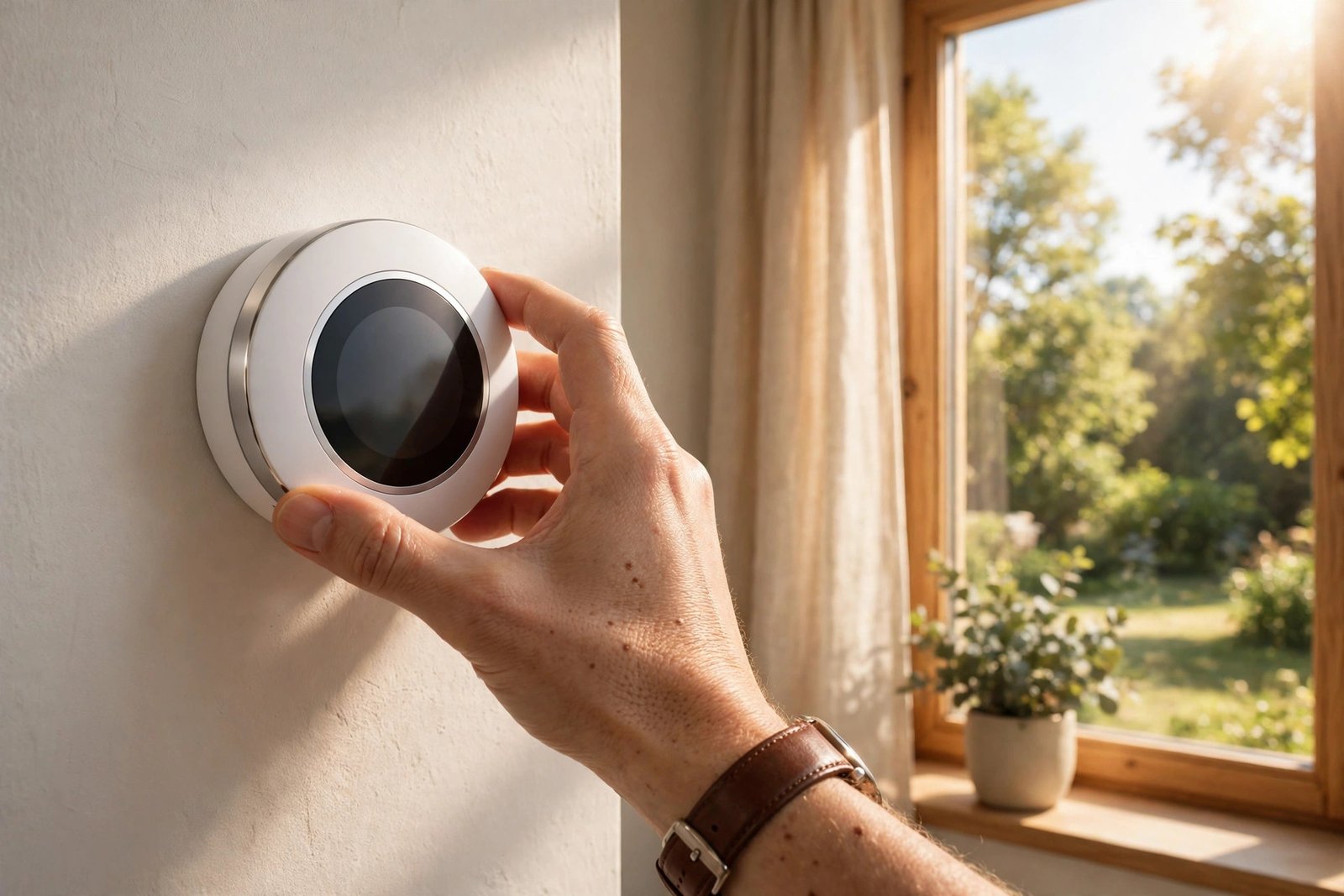
The Short Answer: 78°F Is the Magic Number
If you want one number and you want it now, set your thermostat to 78 degrees Fahrenheit when you are home and awake. This is the figure the U.S. Department of Energy has recommended for years, and it is not arbitrary. Around 78°F is where the energy your air conditioner consumes and the comfort most people feel strike their best balance.
Here is the math that makes this recommendation so compelling: the DOE estimates that you can save roughly 3 percent on cooling costs for every degree you set your thermostat above 72°F. Move from 72 to 78 and that is about an 18 percent reduction in cooling energy — on a summer electric bill of $200, that is $36 back in your pocket every month.
Now, 78°F sounds warm on paper. But in practice, 78 with moving air and reasonable humidity feels surprisingly pleasant. Part of that is acclimation — your body adapts to slightly warmer indoor temperatures within a week or two. The rest is about controlling the factors around the number, which is exactly what the rest of this guide covers.
The Best Thermostat Settings for Each Part of Your Day
The single biggest mistake homeowners make is treating the thermostat as a set-it-and-forget-it device stuck on one temperature all summer. Your comfort needs change through the day, and your thermostat setting should change with them. Here is a schedule that balances comfort and savings.
When You Are Home and Awake: 76–78°F
During the day, aim for 76 to 78 degrees. If 78 feels too warm at first, try 76 for a week while you run ceiling fans and let your body adjust — then try nudging it up one degree at a time. Most people discover that 78 with a fan feels just as comfortable as 74 without one.
When You Are Sleeping: 72–75°F
Your body naturally cools down as you fall asleep, and a cooler room supports that process. A practical compromise: set the thermostat to 72 to 75 degrees at night. You get genuinely better rest than you would at 78, without the bill of running 68 degrees all night. A programmable thermostat can handle this shift automatically about 30 minutes before your usual bedtime.
When You Are Away: 82–85°F
There is no reason to cool an empty house to 75 degrees. The DOE recommends setting the thermostat 7 to 10 degrees higher than your at-home setting when you leave for more than a couple of hours — so if you are at 78 while home, set 85 while away. A smart thermostat can follow your work schedule and cool back down before you return, so you walk into a comfortable home.
One caveat: do not turn the AC off entirely on very hot days. Keeping it at 85 still protects against extreme indoor humidity, which can encourage mold growth and warp wood furniture and flooring. You still save substantially — you just avoid the damage and the monster recovery load of cooling a 95-degree house back down.
Why Humidity Matters More Than the Number on the Dial
Two homes can both read 78°F and feel completely different. The difference is humidity. High indoor humidity makes air feel warmer and stickier because your sweat cannot evaporate efficiently — and sweat evaporation is your body’s main cooling mechanism.
Ideally, keep indoor humidity between 30 and 50 percent in summer. Your air conditioner naturally dehumidifies as it cools, but running bathroom exhaust fans during and after showers helps. If your AC runs but the air still feels clammy, low refrigerant or a dirty coil could be reducing its dehumidifying power — a classic sign described in our guide to why your AC might be blowing warm air.
Ceiling Fans: The Cheapest Comfort Upgrade You Own
Ceiling fans do not lower a room’s temperature — they cool the people in the room. Moving air speeds up sweat evaporation and creates what researchers call a wind-chill effect indoors, making you feel 2 to 4 degrees cooler than the thermostat says. That means a room set to 80°F with a ceiling fan can feel like 76.
Two rules make this work. First, fans only cool people, not rooms — turn them off when you leave. Second, make sure your fan is spinning counterclockwise in summer (stand under it; you should feel a distinct breeze downward). Most fans have a small direction switch on the motor housing. Combined with the thermostat at 78, ceiling fans are the easiest way to get the comfort of 74 at the cost of 78.
It also pays to keep your whole system running efficiently so the 78 degrees it delivers is real, even cooling. Our HVAC maintenance checklist walks through the seasonal tasks — filter changes, coil cleaning, duct checks — that keep every degree of cooling actually reaching your rooms.
What About Kids, Elderly Family Members, and Pets?
The standard settings assume a typical healthy adult. Adjust if your household includes more vulnerable occupants. Babies and toddlers regulate body temperature poorly, so keep nursery rooms closer to 72 to 74 degrees and never above 78 during sleep. Elderly family members can be more sensitive to heat but also to cold drafts — aim for 75 to 77 with gentle, indirect airflow rather than a fan blowing directly on them.
Pets deserve consideration too. Dogs and cats generally tolerate the same range as humans, but flat-faced dog breeds and small animals are more heat-sensitive — keep their areas at 78 or below and always leave fresh water.
4 Thermostat Habits That Save You Money
A programmable or smart thermostat pays for itself by automating your day/night/away schedule. The EPA estimates smart scheduling can save about 8 percent of annual heating and cooling costs with almost no effort from you.
Setting the thermostat to 65 to cool down faster does not work — the AC runs at the same speed regardless. It just overshoots and wastes energy. Set your target temperature and let the system get there.
Blocked supply vents and return grilles force your system to work harder for the same result. Walk your house once per season and move furniture, rugs, and curtains away from every vent.
A dirty filter alone can raise energy use by 5 to 15 percent. Change filters every 1 to 3 months in summer, and fold cooling tasks into your regular home maintenance routine so the system delivers what the thermostat asks for.
Frequently Asked Questions
Is 78 degrees really comfortable in summer?
For most people, yes — once they adjust. Give it a week with ceiling fans running and light clothing, and 78°F starts to feel normal. If it genuinely does not work for you, 76 is a fine compromise that still saves meaningfully compared to 72.
Should I turn off my AC when I leave for the day?
No — set it 7 to 10 degrees higher instead (around 82–85°F). Turning the system fully off on hot days lets humidity climb, encourages mold, and forces the AC to run much longer to recover when you return, often erasing any savings.
What temperature should I set the thermostat at night in summer?
Between 72 and 75 degrees is the sweet spot for most sleepers — cool enough for quality rest without the cost of running 68 all night. Program the change to start about 30 minutes before bed.
Does setting the thermostat lower cool my home faster?
No. An air conditioner cools at a fixed rate no matter how low you set the target. Setting it to 65 when you want 75 just makes the system overshoot and waste energy. Always set the actual temperature you want.
How much can I actually save by raising my thermostat?
Roughly 3 percent on cooling costs per degree above 72°F, according to the Department of Energy. Going from 72 to 78 can cut cooling energy by up to 18 percent — often $25 to $40 a month.
Why does my house still feel hot at 78 degrees?
The usual culprits are high indoor humidity, no air movement, poor insulation, or an underperforming AC. Check humidity first (aim for 30–50 percent), run ceiling fans, and make sure filters and coils are clean before assuming the setting itself is wrong.
Putting It All Together
The best summer thermostat setting is not a single number — it is a simple schedule: 78°F when you are home, a cooler 72–75 for sleep, and 82–85 when the house is empty. Pair that with ceiling fans, sensible humidity, and a well-maintained system, and you will stay comfortable all summer while keeping a healthy chunk of your energy budget intact.
Start tonight: program 78 for the day, 74 for bedtime, and 84 for when you leave tomorrow morning. Within a week you will barely notice the difference — except on your energy bill.
1 thought on “What Temperature Should I Set My Thermostat in Summer?”