
How to Keep Your House Cool Without AC: A Homeowner’s Guide to Natural Cooling
Learning how to keep your house cool without AC can slash summer energy bills and keep you comfortable even when the compressor quits on the hottest day of the year. With the right mix of shading, ventilation, and heat-blocking habits, most homes can stay noticeably cooler using nothing but airflow and smart timing.
This guide covers the passive cooling strategies that actually work: blocking heat before it enters, flushing trapped heat out at night, using fans correctly, tackling attics and windows, and knowing where AC-free cooling reaches its limits.
Key Takeaways
- Stop heat before it enters: shading and closed curtains on sun-facing windows can cut indoor heat gain by up to half.
- Flush heat at night: open windows on opposite sides after sunset to purge the day’s trapped heat, then seal up in the morning.
- Fans cool people, not rooms: run ceiling fans counterclockwise and only in occupied rooms.
- The attic is a heat radiator: ventilation and insulation stop a 150°F attic from baking the rooms below.
- Passive cooling has limits in extreme heat and high humidity — know when your home needs mechanical help.
Why Your House Overheats Without AC
About three-quarters of unwanted summer heat comes from the sun hitting your windows and roof, with the rest sneaking in through walls, air leaks — and your own activities. Cooking, showering, and electronics all add warmth to indoor air. The result is a familiar cycle: the house soaks up heat all day, holds it through the evening, and starts the next morning warmer than the air outside. AC-free cooling breaks that cycle by keeping heat out during the day and letting it escape at night.
The Greenhouse Effect Inside Your Windows
Glass is the weakest link in your home’s thermal armor. Sunlight passes through easily, but once it warms your floors and furniture, that heat cannot radiate back out as efficiently. A single west-facing window can act like a small radiator all afternoon. That is why shading is always step one — and why anything that intercepts sunlight before it passes through glass, like awnings or a leafy tree, outperforms curtains every time.
Your Attic Is a Heat Battery
On a 90°F day, an unventilated attic can climb past 150°F, radiating heat downward into your living space through the ceiling. If upstairs bedrooms feel like a sauna while the ground floor is tolerable, the attic is the culprit. Soffit vents pulling cool air in at the eaves, paired with a ridge vent or attic fan exhausting hot air at the peak, keep that heat off your ceilings — and good attic insulation slows whatever remains.
Block the Heat: Shading That Works During the Day
The golden rule of passive cooling: every degree of heat you keep out is a degree you never have to remove. Focus first on south- and west-facing windows, which catch the most punishing sun.
Exterior Shading Beats Interior Curtains
Once sunlight has passed through glass, its heat is already inside — curtains can only slow its spread, not stop it. Retractable awnings over south and west windows can reduce solar heat gain by up to 65 percent. If awnings are too pricey, exterior solar screens or bamboo roll shades hung outside the frame deliver much of the same benefit for far less, and roll away in winter.
Smart Curtain Habits Still Matter
Close blinds or thermal curtains on sun-facing windows before the sun hits them, not after the room is already hot. East-facing windows go shut by mid-morning, west-facing by early afternoon. Light-colored coverings with reflective backings perform best, and the simple habit of drawing curtains on the sunny side while leaving shaded-side windows open can drop indoor temperatures several degrees.
Flush the Heat: Night Ventilation Done Right
Even well-shaded homes absorb heat during the day, and it lingers in walls and furniture after sunset. Night flushing — opening the house to cool evening air — is the most powerful free cooling technique available, and it works whenever outdoor air is cooler than indoor air, which is most summer nights.
Cross-Ventilation: Open on Opposite Sides
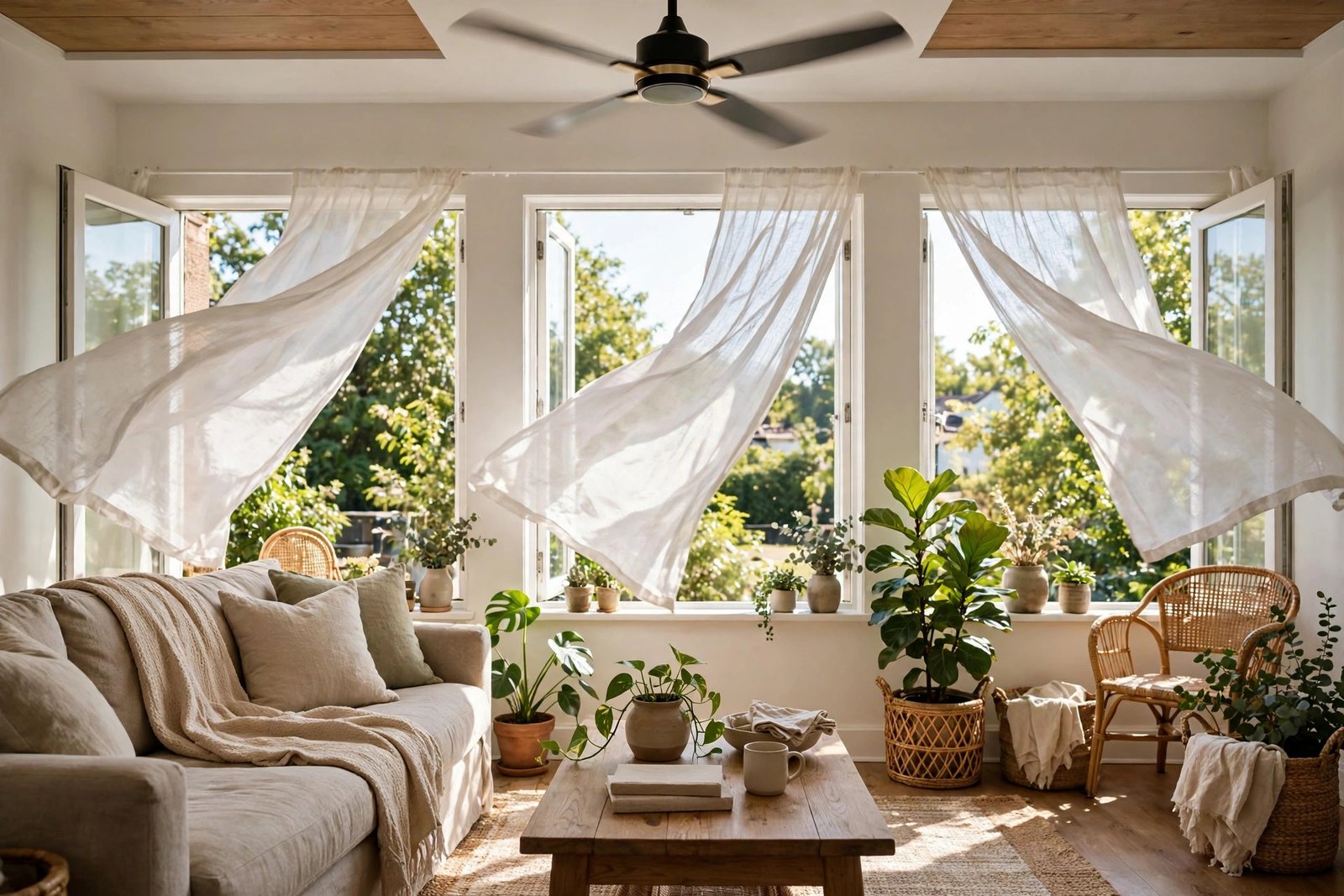
A single open window barely moves air; two open windows on opposite sides create a breeze highway. Open lower windows on the shaded side and upper windows on the opposite side — cool air enters low, warm air exits high. Window fans multiply the effect: place one blowing outward upstairs on the leeward side, and let intake windows feed it from the shaded side.
The Night-Flush Routine
An hour or two after sunset, when outdoor air drops below indoor temperature, open everything you safely can. After a few hours, close it all — windows, curtains, blinds — before the morning sun climbs. Your home starts the day at the overnight low instead of yesterday’s high, and stays comfortable well into the afternoon.
Fan Techniques: Getting the Most From Air Movement
Fans do not lower air temperature — they cool people by speeding up sweat evaporation from skin. A fan in an empty room is pure waste, while a well-placed fan can make an 80°F room feel like 76°F to the person in its breeze. Fans also pair well with cooling equipment: with ceiling fans running, your thermostat temperature in summer can be set a few degrees higher.
Ceiling Fan Direction and Speed
In summer, ceiling fans should spin counterclockwise when viewed from below, pushing air straight down onto the people below. Most fans have a small direction switch on the motor housing — flip it once in spring and leave it. Use the highest speed that feels comfortable, and switch fans off when you leave the room.
Strategic Fan Placement
Box fans and window fans shine when they support your ventilation strategy. A box fan blowing outward in a leeward window actively exhausts hot air while an intake fan on the shaded side pulls in cooler air. In bedrooms, a fan blowing across the bed with breathable cotton sheets can make sleep comfortable on still, heavy nights.
Cut the Heat Your Home Makes Itself
The oven is the worst internal offender: on the hottest days, cook with a microwave, slow cooker, or outdoor grill instead of heating the kitchen to 400°F. Run the dishwasher and clothes dryer at night so their heat vents while the house is open for night flushing. Swap old incandescent bulbs for LEDs, which produce a fraction of the heat, and line-dry laundry on hot days — dryers dump enormous heat and humidity into the home, and clothes dry fast in summer air anyway.
7 No-AC Cooling Tips You Can Start Today
East windows shut by mid-morning, west windows by early afternoon — before the sun hits, not after the room is hot.
Open opposite-side windows after sunset, then seal up before morning. Your house starts the day at the overnight low.
Flip the ceiling fan switch in spring, run it only in occupied rooms, and use the highest comfortable speed.
Grill, slow-cook, or microwave on the hottest days. If you must bake, do it in the early morning.
Bamboo roll shades or solar screens intercept sunlight before it passes through glass — far more effective than interior curtains.
Skip the dryer on hot days to keep its heat and humidity out of the house.
LEDs run cool, cut your lighting bill, and remove heat your cooling strategy would otherwise fight.
When AC-Free Cooling Reaches Its Limits
Passive cooling is powerful, but honesty matters. When temperatures stay above roughly 95°F for days or humidity climbs past 70 percent, evaporation slows, night air never cools enough to flush the house, and every strategy here delivers diminishing returns. If indoor temperatures refuse to drop below the mid-80s — especially overnight — your home needs mechanical help.
There is also a safety dimension: heat exhaustion and heat stroke are real risks for the elderly, infants, and anyone with health conditions. A house stuck above 85°F is not safe for them, and even a single window unit in a bedroom can make the difference. If you do have an AC that is underperforming, check whether your AC is blowing warm air — the culprit is often a clogged filter or low refrigerant. And a simple AC reset can resolve a control glitch and restore cold air in minutes.
Frequently Asked Questions
How can I cool my house fast without AC?
Create cross-ventilation by opening windows on opposite sides, place a box fan blowing outward in an upstairs window to exhaust hot air, and close curtains on every sun-facing window. A cool shower helps your body while the house catches up.
Do fans actually cool a room without AC?
No — fans cool people, not rooms. Airflow speeds sweat evaporation on your skin, but the room’s air temperature stays the same. Run fans only where people are, and switch them off in empty rooms.
Should I open windows or keep them closed on a hot day?
Keep them closed during the heat of the day and open them at night. Opening windows when outdoor air is hotter just imports heat — wait until evening air drops below indoor temperature, then open up.
Can curtains alone keep a house cool without AC?
They help but are not enough alone. Once sunlight passes through glass, its heat is already inside. Pair curtains with exterior shading, night ventilation, and fans for a complete no-AC strategy.
Why is my upstairs so much hotter than downstairs?
Heat rises, and a hot attic radiates warmth downward through the ceiling all night. Better attic ventilation and insulation, plus flushing the upstairs with open windows after sunset, usually closes most of the gap.
Start Cooling Tonight
Keeping your house cool without AC is a system, not one magic trick: shade the sunny windows before heat arrives, flush the day’s heat out after sunset, aim fans at people instead of empty rooms, and starve the house of its own internal heat sources. Those four habits keep most homes genuinely comfortable through all but the most extreme heat waves.
Tonight is the perfect time to begin: check the evening temperature, open windows on opposite sides of your home, and set ceiling fans to counterclockwise. When the real heat wave hits, your home will be ready — no compressor required.