
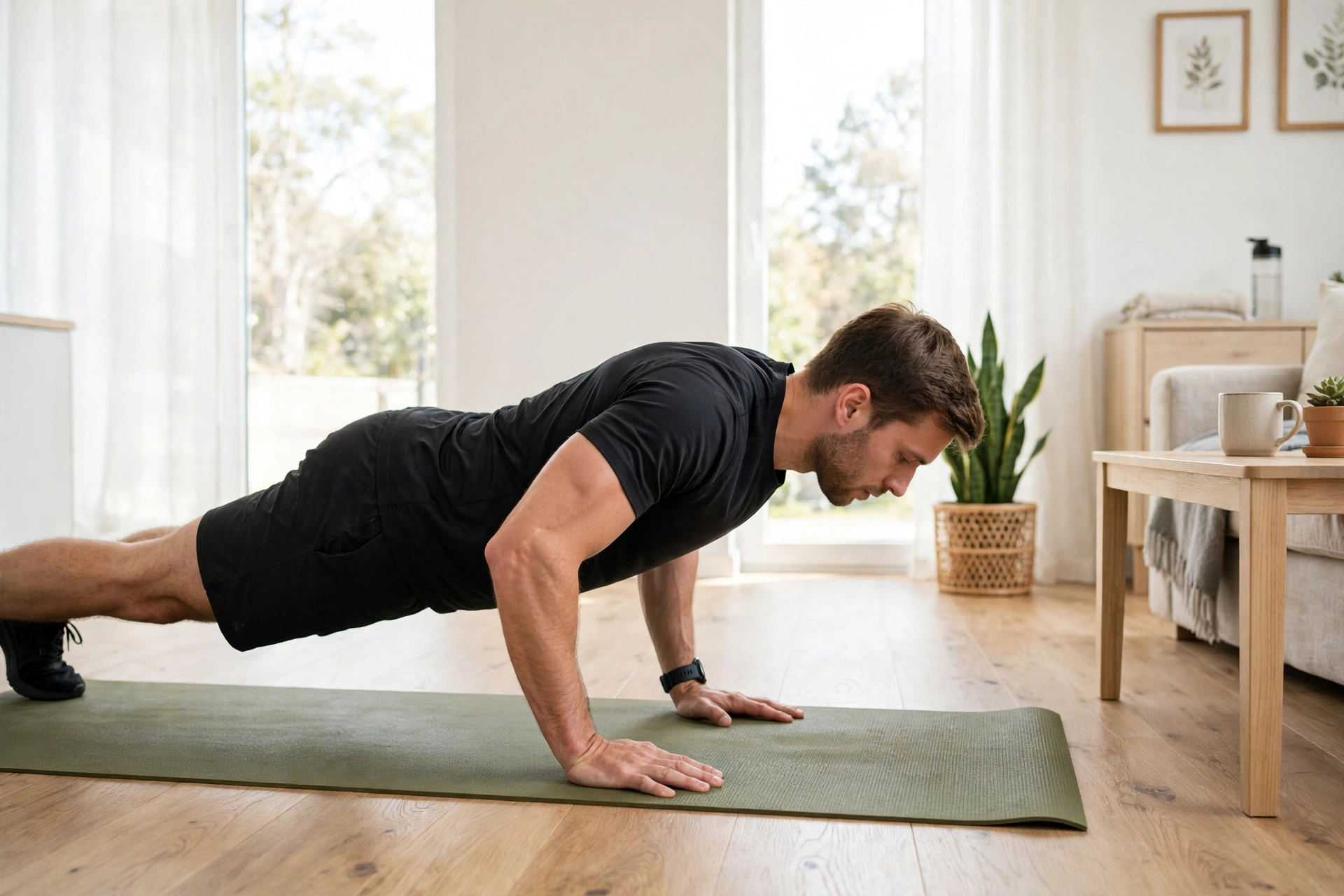

The pushup is the most famous exercise in the world, and it is also one of the most badly done. Most people have been doing them since school, which means most people have been doing them wrong for years — sagging hips, flared elbows, half reps that count for nothing. Learning how to do a pushup properly is worth the effort, because a good pushup builds your chest, shoulders, triceps, and core all at once, with no equipment, no gym, and no excuses. This guide covers the form, the mistakes, the progressions for beginners, and how to build up to real numbers.
- Hands under your shoulders, body in a straight line from head to heels, core braced.
- Lower your chest to just above the floor, elbows at about 45 degrees — not flared out wide.
- Full range of motion matters more than the number of reps; half pushups build half the strength.
- Beginners should start with wall or knee pushups and progress gradually.
- Three sets of 8 to 12 good pushups, three times a week, is a solid routine.
How to Do a Pushup: Proper Form Step by Step
Here is how to do a pushup with correct form. Start in a high plank: hands flat on the floor, directly under your shoulders, fingers spread, arms straight. Your body should form a straight line from your head to your heels — no sagging hips, no piking your backside up in the air. Brace your core like someone is about to poke you in the stomach, squeeze your glutes, and look at the floor a little ahead of your hands, not straight down. That is your starting position, and it is half the exercise.
Lower yourself by bending your elbows, keeping them at about 45 degrees from your body — not tucked tight against your ribs, and not flared out to 90 degrees like a T. Your chest should come down to just above the floor, or touch it lightly. Pause for a beat at the bottom, then push the floor away from you, extending your arms fully, until you are back in the starting position. Breathe in on the way down, breathe out on the way up. That is one rep. The whole movement should take about two seconds down and one second up — slow and controlled, not a bounce. If you are setting up a home workout space, our home office decor ideas are about a different room, but the same principle applies: a dedicated space makes a habit much easier to keep.
The Most Common Pushup Mistakes
The first mistake is the sagging hip. When your core gets tired, your hips drop toward the floor, your lower back arches, and the exercise stops working your chest and starts straining your back. The fix is to stop the set when your form breaks — a set of eight good pushups is worth more than a set of twenty bad ones. The second mistake is flared elbows. When your elbows stick out wide, your shoulders take all the strain, and over time that causes pain. Keep them at roughly 45 degrees, and think about screwing your hands into the floor — that cue naturally pulls your elbows into the right position.
The third mistake is the half rep: lowering yourself a few inches and calling it a pushup. It feels easier because it is easier — you are skipping the hardest part of the movement, which is also the part that builds the most strength. If you cannot do a full rep, do an easier variation properly instead of a hard variation badly. The fourth mistake is speed: bouncing up and down uses momentum instead of muscle, and it is how people hurt their wrists and shoulders. Slow down, control the lowering phase, and your pushups will get harder — which is the point. If your wrists hurt, try pushups on your fists or on pushup handles, which keep the wrist straight. And if you want a complementary habit for recovery days, our meditation guide covers the other half of training that most people skip — the calm, focused rest that lets your body actually recover.
How many pushups should I do?
It depends on where you are starting from, and the honest answer is that the number matters less than the form. A good target for most people is three sets of 8 to 12 pushups, with a minute or two of rest between sets, three times a week. If you can do 12 good reps in every set, make the exercise harder — slow the lowering phase to three seconds, elevate your feet, or add a backpack with books. If you cannot do 8 good reps, use an easier variation and build up. The goal is not a number, it is a progression: a little harder this week than last week, every week.
Pushup Progressions: From Zero to Twenty
If you cannot do a single full pushup yet, that is completely normal, and the fix is a progression, not willpower. Start with wall pushups: stand arm’s length from a wall, hands on the wall at shoulder height, and do the same movement. When you can do 15 wall pushups easily, move to knee pushups on the floor, with your knees on the ground and your body in a straight line from knees to head. When you can do 12 knee pushups, try incline pushups with your hands on a chair or a sturdy table — the higher the surface, the easier the pushup. Lower the surface over time until you are on the floor, and you will be doing full pushups.
Another trick is the negative pushup: start in the high plank, lower yourself as slowly as you can — aim for five seconds — then drop to your knees to push back up. The lowering phase builds the strength you need for the pushing phase, and most people can do negatives long before they can do a full pushup. Do three sets of five negatives, three times a week, and full pushups usually arrive within a few weeks. The key is consistency: a few minutes, three times a week, beats an hour once a month.
Pushup Variations to Try Once You Have the Basics
Once you can do 15 good pushups, variations keep the exercise challenging. Wide pushups, with your hands further apart, work the chest more. Diamond pushups, with your hands together under your chest, hammer the triceps. Decline pushups, with your feet on a chair, shift the work to the upper chest and shoulders. Archer pushups, where you shift your weight to one arm at a time, are a step toward one-arm pushups. And slow pushups — three seconds down, one second pause, one second up — make even a basic pushup brutally hard.
The point of variations is not to show off; it is to keep progressing. Your body adapts to whatever you do repeatedly, so the same three sets of ten will stop making you stronger after a few weeks. Changing the variation, the tempo, or the range of motion is what keeps the gains coming. That is also why rest matters: muscles grow on rest days, not on training days, so do not do pushups every day. Three sessions a week, with a day off between them, is the sweet spot. If you want a complementary exercise for the other side of your upper body, our best budget office chairs guide is about sitting, not training — but good posture at your desk is what lets you recover properly between sessions.
Frequently Asked Questions
How many pushups should a beginner do?
Start with what you can do with good form — even if that is 3 or 4. Aim for three sets of 8 to 12 over time, three times a week, and use easier variations like knee or incline pushups to build up.
What muscles do pushups work?
Mainly the chest, shoulders, and triceps, plus the core, glutes, and even the legs, which work to hold your body in a straight line. It is a full upper-body exercise, not just a chest exercise.
Why do my wrists hurt when I do pushups?
Pushups bend the wrist back sharply, which strains it. Try pushups on your fists or on pushup handles to keep the wrist straight, and stretch your wrists before and after.
How long does it take to learn a pushup?
Most people go from zero to their first full pushup in 4 to 8 weeks with three short sessions a week, using wall, knee, and incline progressions plus negative pushups.
Are pushups every day a good idea?
No. Muscles need rest to grow, so three sessions a week with rest days between them works better than daily pushups, and it is easier on your shoulders and wrists.
Learning how to do a pushup properly is one of the best investments you can make in your body: no equipment, no gym, five minutes a day, and an exercise that builds real strength you can feel in everything else you do. Start where you are, keep your body in a straight line, and do one more good rep than you did last week.