
Energy Efficient Home Improvements That Actually Pay Back
Every homeowner has heard the same advice: change your light bulbs, turn down the thermostat, and your bills will fall. That advice is not wrong, but it misses the upgrades that genuinely move the needle. The best energy efficient home improvements are the ones that stop heat escaping in winter, stop it entering in summer, and make your heating and cooling system work less hard for the same comfort. Done in the right order, they can cut a typical household energy bill by 20 to 40 percent — and the most valuable ones often pay for themselves in just a few years.
This guide ranks the highest-payback energy upgrades by what they cost, what they save, and how quickly they repay you. You will learn where to start, which jobs are worth doing yourself, which ones need a professional, and which popular upgrades are overrated. Costs below are typical ranges for an average three-bedroom home; your exact figures will depend on house size, climate, and local labour rates, but the ranking holds in almost every home.
Key Takeaways
- Start with the building envelope — air sealing and attic insulation give the fastest payback of any major upgrade.
- A programmable or smart thermostat typically pays for itself within one heating season.
- LED lighting is the cheapest upgrade of all, using about 75 percent less energy than old incandescent bulbs.
- Replace windows only after sealing and insulation are done; they are the most expensive upgrade with the slowest payback.
- Right-size heating and cooling upgrades: a heat pump or high-efficiency furnace only shines in a well-sealed, well-insulated home.
Start With an Energy Audit, Not a Shopping List
Before spending a single dollar, find out where your home is actually losing energy. A professional energy audit, typically costing $300 to $500, uses a blower-door test and thermal imaging to measure air leakage and spot missing insulation. Many utilities offer audits at a discount or even free, and some will rebate the cost if you complete the recommended work. If a full audit is not available, you can do a useful DIY version: on a cold day, hold a lit incense stick near windows, doors, outlets on exterior walls, and attic hatches, and watch where the smoke wavers. Check your attic insulation depth with a ruler — less than 10 inches of fibreglass or cellulose usually means you are under-insulated.
The order below follows building science: seal first, insulate second, then upgrade systems and equipment.
1. Air Sealing: The Cheapest Big Win
Air leakage is the invisible energy thief. The average home loses the equivalent of a hole the size of a basketball through all its small cracks combined — around windows, doors, plumbing penetrations, recessed lights, and the junction between walls and the attic floor. Sealing those gaps with caulk, foam, and weatherstripping typically costs $200 to $1,000 for materials if you do it yourself, or $1,000 to $2,500 professionally, and it can cut heating and cooling costs by 10 to 20 percent on its own.
Start in the attic, sealing around chimney chases, plumbing vents, wiring holes, and wall top plates with fire-rated caulk or expanding foam, keeping insulation at least three inches from hot flues. Then weatherstrip exterior doors, add door sweeps, caulk window frames, and foam the basement rim joists. One caution: a very tight home needs controlled ventilation, so discuss trickle vents or a heat-recovery ventilator with your contractor before sealing aggressively.
2. Attic and Wall Insulation: The Highest Payback
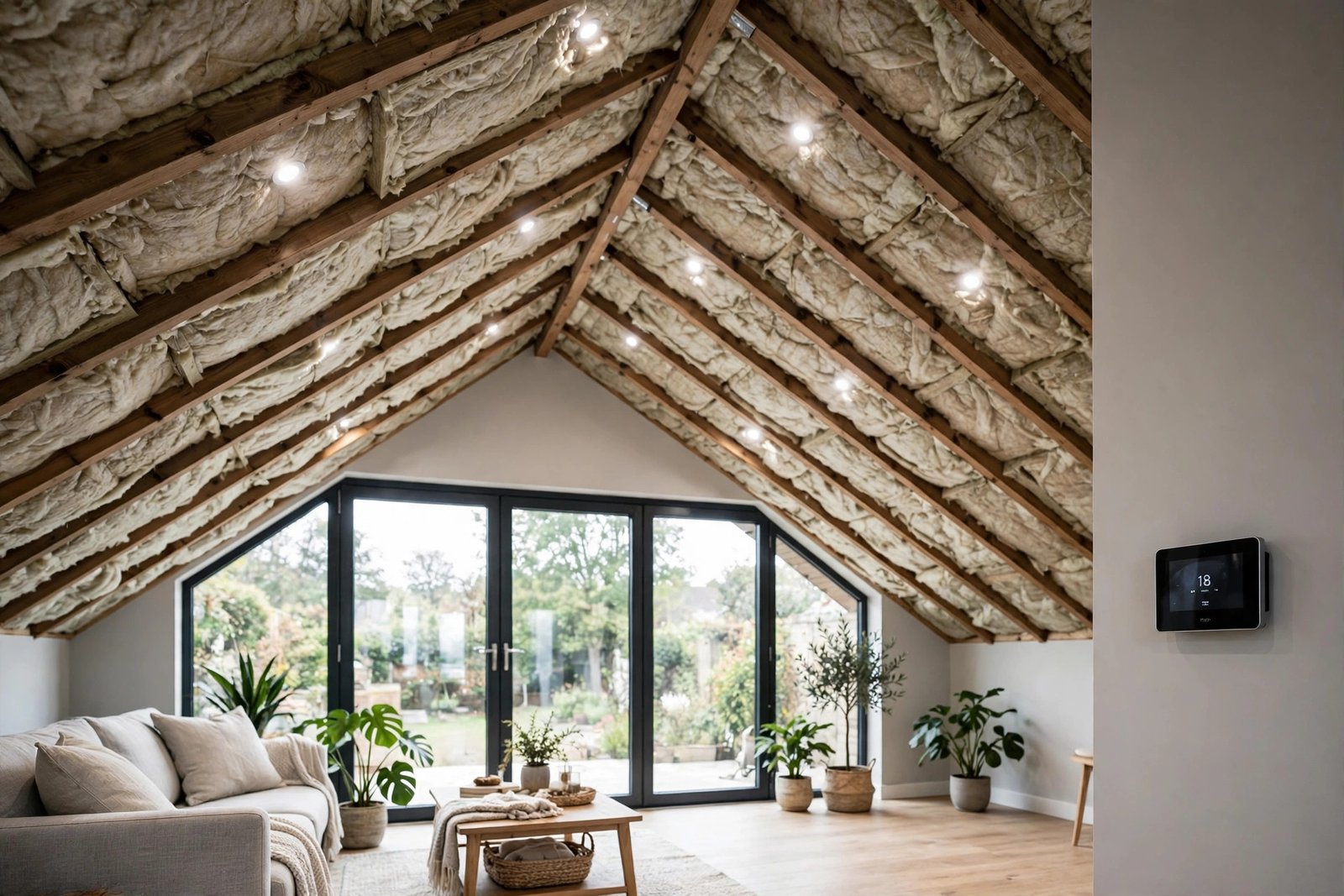
If air sealing is the cheapest win, insulation is the biggest one. Heat rises, so an under-insulated attic is the single largest source of winter heat loss. Topping up attic insulation to R-38 to R-49 (roughly 12 to 16 inches of fibreglass batts or 10 to 14 inches of blown cellulose) typically costs $1,500 to $3,500 for an average home and can save $200 to $600 a year, paying back in three to seven years. Blown-in cellulose or fibreglass is usually the best choice for attics because it fills awkward gaps around joists and wiring that batts leave open.
Wall insulation costs $2,000 to $5,000 for blown-in cellulose or foam, while floor insulation over an unheated garage or crawl space costs $1,000 to $2,500. Insulate in this order: attic first, then floors, then walls. If you only have budget for one job this year, choose the attic.
3. Smart Thermostats and Heating Controls
A smart thermostat costs $150 to $300 including installation, and independent studies consistently show savings of 8 to 15 percent on heating and cooling — roughly $130 to $145 a year for an average household. That is a payback of about one to two years, and it requires no disruption at all. The savings come from simple automation: setback temperatures while you sleep or are at work, learning schedules that adapt to your routine, and room sensors that stop the system heating an empty upstairs.
Set a winter daytime temperature of 68°F (20°C) and a night setback of 60 to 62°F; each degree lowered for eight hours a day saves roughly 1 percent on heating. In summer, 78°F is the efficient sweet spot. For room-by-room guidance, see our thermostat temperature in winter guide.
4. LED Lighting: Small Change, Guaranteed Saving
Swapping every bulb in your home to LED is the lowest-risk energy upgrade there is. An LED uses about 75 percent less energy than an incandescent bulb and lasts 15,000 to 25,000 hours — roughly 15 to 25 times longer. Replacing 40 bulbs costs $80 to $200, and the average household saves $75 to $100 a year, so the payback is often under two years. The savings are even better in rooms where lights stay on for hours, such as kitchens and living rooms.
Choose 2700K warm-white LEDs for living spaces and 3000K to 4000K for kitchens. For enclosed fixtures, buy LEDs rated for enclosed use, or heat will shorten their life.
5. Heating and Cooling: Upgrade When the Old System Fails
Heating and cooling account for roughly half of most home energy bills, so equipment efficiency matters enormously — but timing matters even more. Replacing a working furnace purely for efficiency rarely pays back quickly, because a new high-efficiency gas furnace costs $4,000 to $8,000 and a heat pump system $8,000 to $20,000. The smart move is to plan the upgrade for the moment your old system needs major repair or replacement, and to seal and insulate first so you can buy a smaller, cheaper system.
A modern air-source heat pump delivers two to four units of heat for every unit of electricity and provides cooling in summer, replacing both furnace and air conditioner. In very cold climates, a cold-climate heat pump or dual-fuel system is safer. Insist on a proper load calculation — an oversized unit short-cycles and wastes energy — and keep filters clean, since a clogged filter can raise energy use by 5 to 15 percent. Our HVAC filter guide explains how often to change them.
Also seal ductwork if you have forced-air heating: leaky ducts in an attic or crawl space can waste 25 to 30 percent of heated or cooled air. Sealing joints with mastic sealant and insulating ducts to R-6 or R-8 costs $1,000 to $3,000 and typically pays back in three to five years.
6. Windows and Doors: Worth It, But Last in Line
New double- or triple-glazed windows are the upgrade homeowners ask about most, and the one with the slowest payback. Replacing all windows in an average home costs $8,000 to $20,000 or more, while the energy saving is typically $150 to $450 a year — a payback of 15 to 30 years. That does not make windows a bad investment; they transform comfort, cut outside noise, eliminate condensation, and add resale value. It simply means they should come after sealing, insulation, and controls, not before.
If full replacement is out of reach, interior storm windows cost $100 to $300 per window and cut heat loss through single glazing by roughly half, while cellular shades with side tracks can reduce it by up to 40 percent. When you do replace windows, look for a U-factor below 0.30, and replace the worst offenders first — north-facing windows in cold climates, west-facing windows in hot ones.
7. Water Heating, Appliances, and the Rest
Water heating is the second-largest energy user in most homes, about 18 percent of the bill. A heat-pump water heater uses roughly 60 percent less electricity than a standard electric tank, costs $1,500 to $3,000 installed, and typically pays back in three to six years, especially in warm basements or garages where it also dehumidifies. Cheaper wins include insulating an older tank with a $25 jacket, insulating the first six feet of hot-water pipe, and dropping the tank temperature to 120°F — hot enough for comfort and safety, cool enough to cut standby losses by 3 to 5 percent per 10 degrees.
When appliances fail, replace them with Energy Star models, and tackle phantom loads with a $25 to $40 smart power strip, which can save $50 to $100 a year in a media-heavy household.
Your Priority Order, Ranked by Payback
$200–$2,500, saves 10–20% on heating and cooling. Always the first job — every other upgrade works better in a sealed home.
$1,500–$3,500, pays back in 3–7 years. The single biggest comfort and bill improvement for most homes.
$150–$300, pays back in 1–2 years. No mess, no disruption, and it keeps saving every single day.
$80–$200 for a whole house, pays back in under 2 years. The easiest upgrade on this list.
$1,000–$3,000, pays back in 3–5 years. Fixes the far-room problem and cuts system runtime.
$1,500–$3,000, pays back in 3–6 years. Best timed with the replacement of an ageing tank.
$4,000–$20,000, best at end of life. Insulate first so you can buy a smaller system.
$8,000–$20,000+, payback 15–30 years. Do it for comfort, noise, and value — not for quick savings.
3 Mistakes That Waste Energy-Upgrade Money
Buying equipment before fixing the envelope. A bigger furnace in a leaky house just heats the outdoors faster. Seal and insulate first, then size equipment to the improved home — you may find you need a smaller, cheaper system than you expected.
Over-insulating without ventilation. Insulation without air sealing leaves draughts; air sealing without ventilation traps moisture and indoor pollutants. The two must be planned together, with trickle vents, extractor fans, or a heat-recovery ventilator as needed.
Chasing the newest gadget. Solar panels, battery storage, and smart home systems are exciting, but they pay back far slower than basic sealing and insulation in most homes. Get the fundamentals right first, then add renewables to a home that is already efficient — your solar array can be smaller, and your battery will go further.
Frequently Asked Questions
What is the single best energy efficient home improvement?
For most homes it is the combination of air sealing and attic insulation. Together they typically cost $1,700 to $6,000, cut heating and cooling bills by 15 to 30 percent, and pay back in three to seven years — faster than any equipment upgrade.
How much can energy efficient home improvements save per year?
A home that seals air leaks, tops up attic insulation, switches to LEDs, and installs a smart thermostat typically saves $400 to $1,000 a year on a $2,000 to $3,000 annual energy bill. Adding a heat pump or heat-pump water heater can push savings higher, especially in homes with old electric heating.
Are new windows worth it for energy savings alone?
Rarely, if savings are the only goal. Full window replacement usually pays back in 15 to 30 years. Cheaper options such as interior storm windows, cellular shades, and draught-proofing deliver much of the comfort benefit for a fraction of the cost.
Should I get a heat pump or a high-efficiency furnace?
In mild to moderate climates, a heat pump usually wins because it heats and cools efficiently and runs on electricity. In very cold climates, a cold-climate heat pump or dual-fuel system is safer. Either way, seal and insulate first so the system can be sized correctly.
Can I do air sealing and insulation myself?
Yes, for accessible jobs: caulking, weatherstripping, and laying attic batts are solid DIY projects. Blown-in insulation, wall injection, and duct sealing in tight crawl spaces are usually better left to professionals with the right equipment and safety gear.
Where to Start This Month
Pick the two cheapest wins this weekend: swap old bulbs for LEDs and walk the house with caulk and weatherstripping. Then book an energy audit or measure your attic insulation depth.
Once the envelope is sorted, keep the momentum going with our guide to keeping your house cool without AC for summer comfort. An efficient home is not a one-time project — it is a house that is sealed, insulated, and maintained, season after season.
1 thought on “Energy Efficient Home Improvements That Pay Back”