
How to Increase Shower Water Pressure
A weak shower turns a two-minute rinse into a ten-minute chore: shampoo that will not wash out, a dribble that goes cold before it reaches your shoulders, and the daily irritation of standing under what feels like a leaking watering can. Before you spend money on a plumber or a new shower system, know this: most low shower pressure is caused by something small, cheap, and fixable — a clogged showerhead, a half-closed valve, a flow restrictor, or a filter choked with limescale. Work through the diagnosis in this guide first, cheapest fix first, and you will often restore full pressure in under an hour.
This guide covers how to increase shower water pressure step by step: how to measure your pressure and flow so you are not guessing, the quick showerhead and valve fixes that solve most cases, the mid-level checks for filters, diverters, and pressure regulators, and the clear signs that the problem is in your home’s main supply and needs a professional. It also explains what not to do — because removing parts blindly or cranking up a pressure valve can damage pipes, void warranties, or flood a bathroom.
Key Takeaways
- Measure first: good shower pressure is roughly 40 to 60 psi, with flow of 6 to 9 litres per minute.
- A clogged showerhead is the most common cause — soak it in vinegar and it often fixes itself.
- Check that shut-off valves are fully open; a valve turned only halfway cuts flow dramatically.
- Removing a flow restrictor helps only if it is actually the bottleneck — test before you modify.
- Call a plumber for whole-house low pressure, a faulty pressure regulator, or corroded pipes.
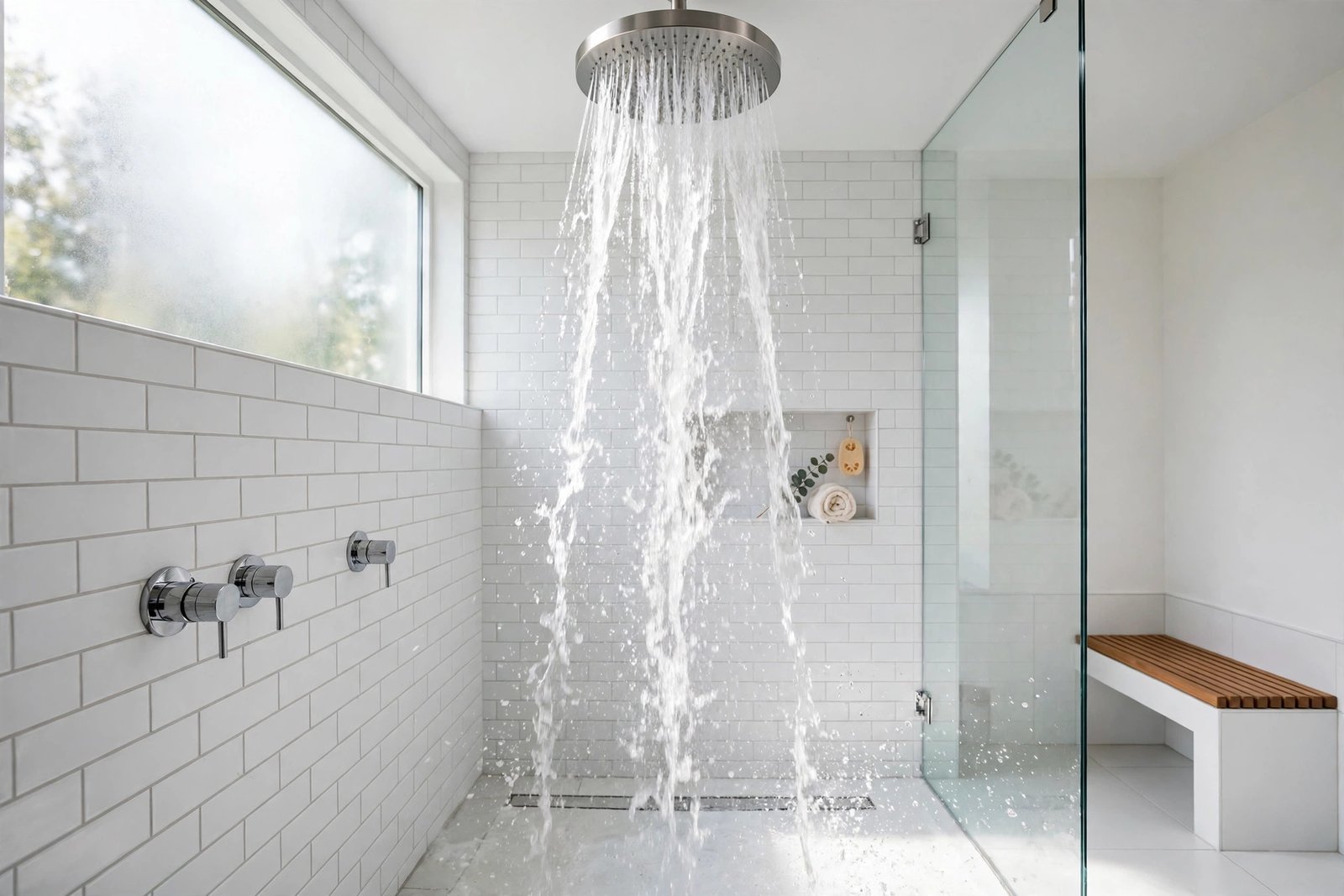
Step 1: Diagnose Before You Fix Anything
Diagnosis takes ten minutes and prevents you from replacing parts that were never the problem. Start with the simplest comparison: is the pressure low only in the shower, or everywhere? Run the bathroom sink tap and the kitchen tap. If both are strong and only the shower is weak, the problem is in the shower itself — the head, the hose, the mixer, or the valve feeding it. If every tap in the house is weak, the problem is upstream: the main shut-off, the pressure regulator, or the supply itself. If only the hot water is weak, suspect the water heater or a hot-water valve; if only the cold is weak, suspect a cold-feed restriction. Write down what you find, because each pattern points to a different fix.
Next, measure. A screw-on pressure gauge costing 10 to 20 dollars fits an outdoor tap and gives a real number: normal residential pressure is 40 to 60 psi. Below 30 psi, showers feel weak; above 80 psi, you risk pipe damage. For flow, time a 1-litre jug under the showerhead: a healthy shower fills it in 7 to 10 seconds (6 to 9 litres per minute). Twenty seconds or more means flow is genuinely low. Also check whether pressure drops when another tap runs — that points to undersized pipes or a supply that cannot meet peak demand.
Check the Obvious Valves First
Before touching the showerhead, find the valves. Many showers have isolation valves on the hot and cold feeds behind an access panel, under the bath, or in an adjacent cupboard, and these are sometimes left half-closed after previous plumbing work. Turn each one fully counter-clockwise until it stops — a gate valve that feels stiff or gritty may be corroded and worth replacing rather than forcing. Also check the main house shut-off near the water meter: if it was recently turned off for work and not fully reopened, the whole house will suffer. A quarter-turn ball valve should sit parallel to the pipe when fully open. This single check takes two minutes and is embarrassingly often the whole fix, so do it before you buy anything.
Step 2: Clean or Replace the Showerhead
The showerhead is the culprit in most weak-shower complaints, especially in hard-water areas. Limescale builds up inside the tiny nozzle holes, narrowing each jet until the spray turns into a patchy dribble. Unscrew the head from the arm — by hand if possible, or with an adjustable wrench protected by a cloth so you do not scratch the chrome. If it will not budge, wrap a cloth soaked in white vinegar around the joint for 20 minutes to loosen the scale. Once removed, shake out any loose debris, then submerge the head in a bowl of undiluted white vinegar for 4 to 8 hours, or overnight for heavy buildup. For a fixed rainfall head that cannot be removed, fill a sturdy plastic bag with vinegar, tie it over the head so the nozzles are submerged, and leave it overnight.
After soaking, clear each nozzle with a toothpick or old toothbrush, rinse, and refit with fresh PTFE tape — three to four wraps clockwise — to prevent drips. Run the shower for a minute to flush debris. If the head is over 8 to 10 years old, has cracked nozzles, or still sprays unevenly, replace it: a good head costs 20 to 60 dollars, and a high-pressure air-mix design can feel dramatically stronger on the same supply. If the new head performs no better, the problem lies deeper — and you have proved it cheaply.
What About Removing the Flow Restrictor?
Most modern heads contain a flow restrictor — a plastic disc or mesh washer where the head meets the arm — limiting flow to about 9.5 litres per minute. Removing it can help, but treat it as a test, not a default. If your jug test shows well under 9 litres per minute with a clean head, the restrictor may be the bottleneck; if flow is already at that level, removal changes little and wastes water. Keep the part to refit it, check local regulations, and note removal can void the warranty. Never drill out nozzles instead: that creates uneven spray and cannot be undone.
Step 3: Check the Hose, Filter, and Mixer
If you have a handheld shower, the hose is the next suspect. Disconnect it at both ends and run water through it into a bucket — a kinked, internally scaled, or partly collapsed hose can halve flow while looking fine from outside. Replacement hoses cost 10 to 25 dollars and take five minutes to fit. Many mixers and thermostatic valves also contain small inlet filters, fine mesh screens where the hot and cold pipes enter the valve body. Turn off the water, remove the valve trim according to the manufacturer’s instructions, pull out each filter with pliers, rinse it under running water, and brush away debris. In hard-water homes, these filters clog every 12 to 18 months, and cleaning them restores pressure that no showerhead swap will fix.
Thermostatic cartridges deserve attention too. If pressure is fine on cold but weak or fluctuating on hot, the cartridge may be scaled or worn. Cartridges are model-specific, cost 30 to 80 dollars, and are usually replaceable with basic tools — photograph the old cartridge and valve brand before ordering. Also check the diverter on a bath-shower combination: one that does not fully switch sends half your flow to the bath spout, which feels exactly like low pressure. A slow drain can also make a weak shower feel worse; our guide to unclogging a shower drain covers that fix separately.
Step 4: Whole-House Causes — Regulator, Pipes, and Supply
When every tap is weak, look upstream. The pressure regulator, also called a pressure-reducing valve, is a bell-shaped fitting on the main supply line where it enters the house, and it is designed to hold pressure steady at around 50 psi. Regulators fail after 10 to 15 years, often by drifting low, so a house that gradually lost pressure over months may simply need a regulator adjustment or replacement. Adjustment is a bolt on top of the valve — turning it clockwise increases pressure — but adjust in small quarter-turns, rechecking with your gauge, and never exceed 70 psi. Replacement costs 150 to 350 dollars professionally fitted, and it is worth paying a plumber for, because a mis-set regulator can either leave you still weak or expose pipes to damaging high pressure.
Old galvanised steel pipes are the other classic whole-house cause. They corrode and narrow over decades until flow is a fraction of the original, and no cleaning restores them — the fix is repiping, a major job costing thousands. Rule out cheaper explanations first: ask a neighbour if their pressure is also low, and check with your supplier for street works. Also check a softener or whole-house filter — an overdue cartridge can strangle flow for the entire house. Change the filter or bypass the softener temporarily as a test before calling anyone.
Boosting Pressure: Pumps and When They Make Sense
A vinegar soak costs almost nothing and solves the most common weak-shower cause.
A 10-dollar gauge and a jug test tell you whether pressure or flow is the real problem.
Half-closed isolation or main valves are a free fix — check them before buying parts.
Mixer inlet filters and whole-house cartridges clog silently; put them on an annual reminder.
A high-pressure head is a cheap diagnostic: no improvement means the fault is deeper.
Over-pressurising damages seals and joints; a regulator protects the whole system.
If diagnosis shows genuinely low mains pressure — common in top-floor flats or homes fed by a gravity tank — a shower pump is the standard solution. A single-impeller pump boosts one shower for 150 to 300 dollars plus fitting; a twin-impeller pump boosts hot and cold together for 250 to 500 dollars. Pumps usually need a tank-fed system, and boosting mains directly is restricted in some areas, so check local rules and get a professional quote first. Raising a gravity tank also helps: each extra metre of height adds about 0.1 bar. A pump is noisy and needs power, so treat it as a last resort. Fix known faults first: a constantly running toilet wastes water and can depress pressure elsewhere, as our guide to fixing a running toilet explains.
Frequently Asked Questions
What is good water pressure for a shower?
Most homes feel comfortable at 40 to 60 psi, with flow of 6 to 9 litres per minute. Below 30 psi usually feels weak, while above 80 psi risks damage to pipes and fittings.
Will a new showerhead increase water pressure?
It can feel like it, especially a high-pressure or air-mix design, but a new head cannot create pressure your supply does not have. It helps most when the old head is scaled, damaged, or overly restrictive.
Is it safe to remove the flow restrictor from a showerhead?
Usually it is physically safe, but it increases water use, may breach local regulations, and can void the warranty. Keep the restrictor so you can refit it, and only remove it if flow tests show it is the bottleneck.
Why is my shower pressure low only in the morning?
Peak demand is the likely cause: neighbours showering at the same time, or your own household running taps, washing machines, and showers together, can temporarily drop pressure on a shared or undersized supply.
When should I call a plumber for low shower pressure?
Call one if every tap is weak, the regulator needs replacing, pipes are old galvanised steel, pressure drops suddenly with leaks or damp patches, or you are considering a pump. Those are supply-level problems, not showerhead problems.
Work Cheapest First, and You Will Usually Win
Low shower pressure feels like a big plumbing problem, but it usually ends up being a small one: a scaled head, a half-closed valve, or a clogged filter. Measure your pressure, clean the head, open the valves, and check the filters — in that order — and most showers come back to life for the price of a bottle of vinegar and an hour of your time. If those steps do not help, you have still done the plumber a favour: you can describe exactly what you tested, what the gauge read, and whether the problem is shower-only or whole-house, which means a faster diagnosis and a smaller bill. For the remaining drain-side annoyances that make a weak shower feel worse, the same methodical approach pays off — as our guide to unclogging a drain without chemicals shows, most bathroom fixes reward patience and diagnosis over brute force.