
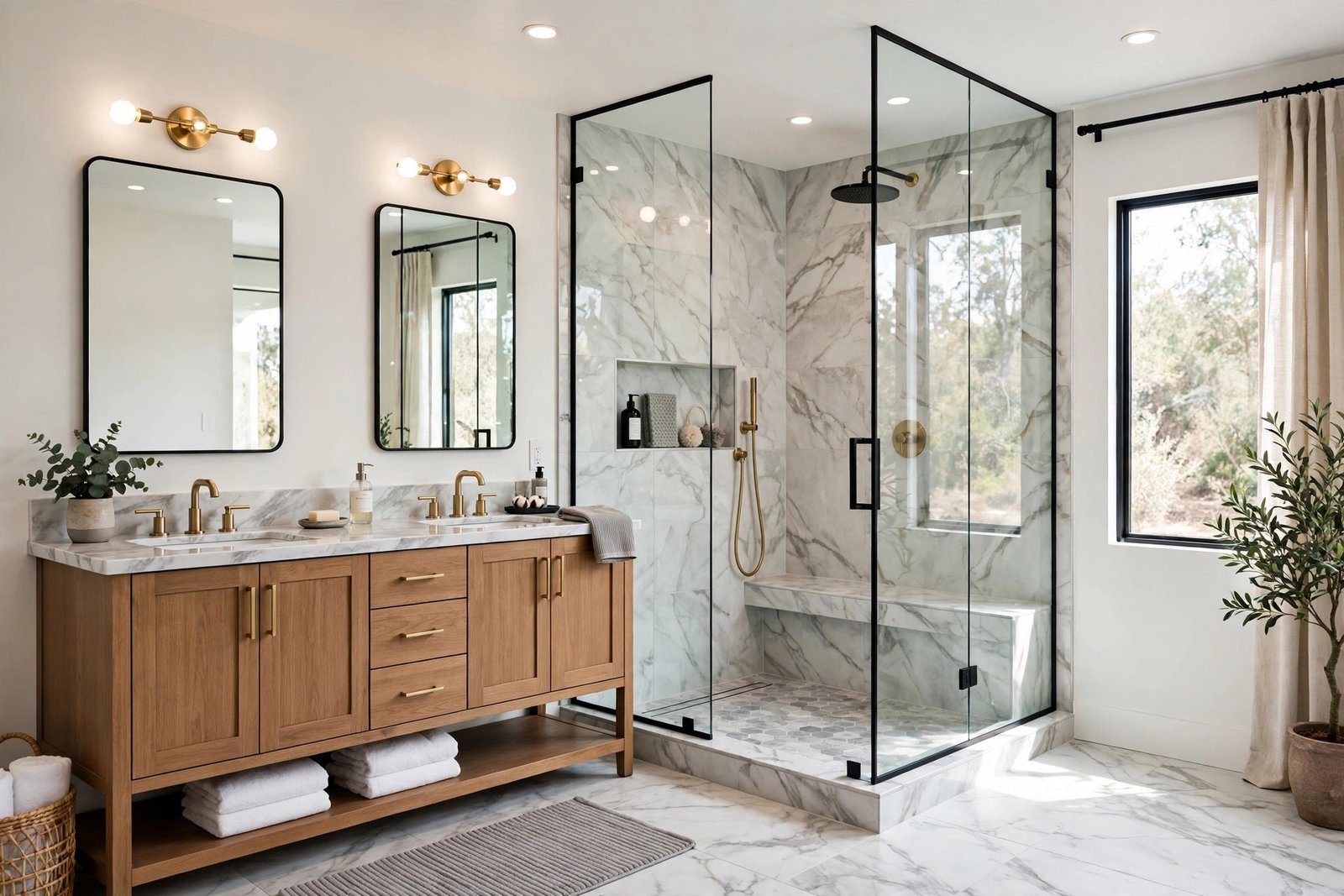
How Much Does a Bathroom Remodel Cost?
A quick cosmetic refresh might run a few thousand dollars, while a gut-to-the-studs luxury overhaul can sail past $50,000. The national average sits around $10,000 to $25,000, but your invoice will depend on bathroom size, how much you move around, and the finishes you choose.
Once you understand where the money goes, you can make smart trade-offs instead of guessing. This guide gives you realistic price ranges for small, mid-range, and major remodels, where every dollar lands, the hidden costs that surprise homeowners, and practical ways to trim the budget — honest numbers, no sales pitch.
Key Takeaways
- A typical bathroom remodel costs $10,000–$25,000; cosmetic refreshes start around $3,000, and luxury gut renovations can top $50,000.
- Labor is the biggest slice — usually 40–50% of the total — so keeping plumbing and electrical in place saves the most money.
- Tile scope, fixture quality, and moving pipes or walls are the three cost drivers that move the number the most.
- A 10–20% contingency fund is non-negotiable; water damage behind old walls is the most common surprise.
- You can save thousands by keeping the layout, choosing mid-range fixtures, and doing the painting and finishing touches yourself.

Bathroom Remodel Cost by Project Size
Most projects fall into one of three tiers. Match your goals to a tier, and your budget narrows from “somewhere between three and fifty thousand” to a number you can plan around.
Tier 1: Cosmetic Refresh — $3,000 to $8,000
This is the “same bathroom, better version” remodel. You keep the layout and swap what you see: a new vanity and mirror, a modern faucet and showerhead, fresh paint, updated lighting, maybe a reglazed tub or a new toilet. For a powder room or a bathroom in decent shape, this delivers a genuinely transformed look — and it is the cheapest way to make a dated bathroom photograph well when you are preparing to sell.
Tier 2: Mid-Range Remodel — $12,000 to $20,000
The mid-range remodel is where most homeowners land. You replace everything you touch: new tub or walk-in shower, new vanity, toilet, tile floor, and usually shower-wall tile too. Plumbing stays roughly in place, but the quality of everything goes up. This tier is the best value in remodeling — a bathroom that feels genuinely new and recoups roughly 60% of its cost in home value, per industry cost-vs-value surveys.
Tier 3: Major or Luxury Renovation — $25,000 to $50,000+
Here the walls come down to the studs. You move plumbing and electrical, reconfigure the layout, convert the tub to a curbless shower, and add heated floors or floor-to-ceiling custom tile. Labor climbs because the project now involves plumbers, electricians, and tile setters over several weeks. This tier is for your forever home. If you are weighing a bathroom against other big-ticket projects, it helps to compare — a bathroom typically costs far less than a full kitchen overhaul, as our guide to how much a kitchen remodel costs shows.
Where the Money Actually Goes
Knowing the average is only half the battle. Here is how a typical mid-range budget divides up:
- Labor — 40 to 50%: Demolition, plumbing, electrical, tile setting, and general contracting. Anything that adds labor hours hits the budget hardest.
- Fixtures — 15 to 20%: Toilet, vanity and countertop, faucets, showerhead, tub or shower base. Mid-range fixtures from reliable brands perform beautifully; designer labels add cost without adding function.
- Tile and surfaces — 10 to 15%: Floor tile, shower walls, and the labor to set them.
- Plumbing and electrical — 10 to 15%: New valves, drain lines, GFCI circuits, venting, and lighting. This climbs fast if you relocate anything.
- Finishing — 5 to 10%: Paint, mirrors, hardware, towel bars, trim — small individually, meaningful together, and the easiest place to DIY.
About half your budget is people, not products. Any decision that simplifies the labor — keeping the same footprint, reusing the tub, choosing larger-format tile — pays off twice, once on materials and once on hours.
The Biggest Cost Drivers (and How to Tame Them)
Moving plumbing and walls
Relocating a toilet, shower drain, or vanity plumbing can add $1,000 to $3,500 per move, because it means opening floors and walls and rerouting drain lines. Knocking down or moving a wall adds framing, drywall, electrical rerouting, and permits. The single cheapest layout decision you can make is to keep every fixture roughly where it already is.
Tile scope and complexity
Tile is priced twice — once for the material and once for the skilled labor to install it. Three choices control the number: how much area you tile (floor-only vs. full shower surround), the tile size (large-format covers faster than intricate mosaics), and the pattern (straight lay is cheapest; herringbone adds labor). A smart middle ground is tiling the shower fully but using painted walls elsewhere.
Tub-to-shower conversions
Swapping a tub for a walk-in shower typically adds $4,000 to $8,000, because it involves plumbing changes, new waterproofing, a shower pan, and wall tile. It is usually worth it for resale and daily enjoyment in a primary bath. But in a home’s only full bathroom, think carefully — families with young kids often want at least one tub, and removing it can narrow your buyer pool later.
Fixture and finish level
The price gap between basic and premium fixtures is staggering: a good toilet costs $250, a designer one $1,200; a vanity can be $400 at a big-box store or $3,000 custom-built. The sweet spot is mid-range — quartz counters, water-efficient fixtures from established brands — plus one “splurge” item (often the vanity or shower tile) that gives the room its personality.
Hidden damage behind the walls
This is the cost driver nobody budgets for until it finds them. Old bathrooms hide rotted subfloors, leaking shower pans, corroded pipes, and mold inside walls — especially around tubs and showers more than 20 years old. Once demolition opens things up, you cannot close the walls without fixing what is wrong. This is exactly why every remodeler worth hiring insists on a 10–20% contingency fund.
Smart Ways to Save Without Cutting Corners
A lower bathroom remodel cost does not have to mean a cheaper-looking bathroom. The trick is spending where it shows and saving where it does not. Keep the existing footprint and plumbing locations — this is the single biggest saver. Choose to refinish the existing tub ($400–$600 for professional reglazing) instead of replacing it, since tubs are expensive to remove and dispose of.
Shop fixtures during holiday sales events, when big-box retailers discount bathroom suites by 20–30%, and consider open-box or floor-model vanities. Use ceramic or porcelain tile that mimics marble — modern printed porcelain is nearly indistinguishable from the real thing at a third of the material cost. And take on the finishing work yourself: painting is one of the most beginner-friendly DIY tasks there is, as our step-by-step guide on how to paint a room walks through. If your project involves adding square footage rather than remodeling within existing walls, the math changes entirely — check our breakdown of the cost to build a house per square foot before you price that bump-out.
Every fixture that stays put saves plumbing labor. Design around the existing drain locations and redirect the budget to finishes you will actually see.
Pick one hero — a statement vanity, beautiful shower tile, or a frameless glass door — and keep everything else mid-range. One standout makes the whole room feel custom.
Bids for the same bathroom can differ by 30% or more. Compare line items, check references, and never choose on price alone.
Contractors are often most available — and most willing to negotiate — in late fall and winter. Scheduling outside the spring rush can shave real dollars off labor.
Should You DIY or Hire a Pro?
Be honest about your skills, because bathrooms punish mistakes with water damage. Safe DIY territory includes painting, installing mirrors and hardware, hanging towel bars, swapping a vanity faucet, and laying luxury vinyl flooring — these can save $1,000–$3,000 in labor.
Leave the rest to licensed professionals: water supply and drain lines, electrical work near water, shower waterproofing, and tile in wet areas. A failed DIY shower pan can cause tens of thousands in rot and mold — the savings evaporate the moment water finds a path. A good middle path: demo the old bathroom yourself (carefully, with the water off), then hand the skilled trades to the pros.
Frequently Asked Questions
What is the average cost to remodel a bathroom in 2026?
Most homeowners spend between $10,000 and $25,000. Cosmetic refreshes run $3,000 to $8,000, while luxury renovations with layout changes typically reach $25,000 to $50,000 or more.
How much does it cost to remodel a small bathroom?
A small bathroom or powder room remodel usually costs $5,000 to $12,000. Smaller spaces use less tile and fewer fixtures, but labor minimums mean the per-square-foot cost can be higher than in a larger bathroom.
What is the most expensive part of a bathroom remodel?
Labor is the most expensive part, at 40–50% of the total. After that, tile work and plumbing changes — especially moving a toilet or converting a tub to a shower — drive costs up fastest.
How long does a bathroom remodel take?
A cosmetic refresh takes 1–2 weeks, a standard full remodel 3–4 weeks, and a major renovation with layout changes 6–8 weeks or more. Lead times for custom vanities and specialty tile can add weeks before work starts.
Does a bathroom remodel increase home value?
Yes — a mid-range bathroom remodel typically recoups around 60% of its cost at resale, one of the better returns among interior projects. Updated bathrooms also help homes sell faster.
The Bottom Line
How much does a bathroom remodel cost? For most homeowners, the honest answer is $10,000 to $25,000 — with the final number decided less by bathroom size and more by how many pipes you move and how far you take the tile. Lock in your tier before you fall in love with fixtures, and keep a 10–20% contingency for what the walls are hiding.
Ready to start planning? Decide your must-haves versus nice-to-haves this week, get three line-item quotes from licensed contractors, and give yourself one focal point to splurge on. Do that, and you will know exactly where every dollar went — before the first tile is set.