
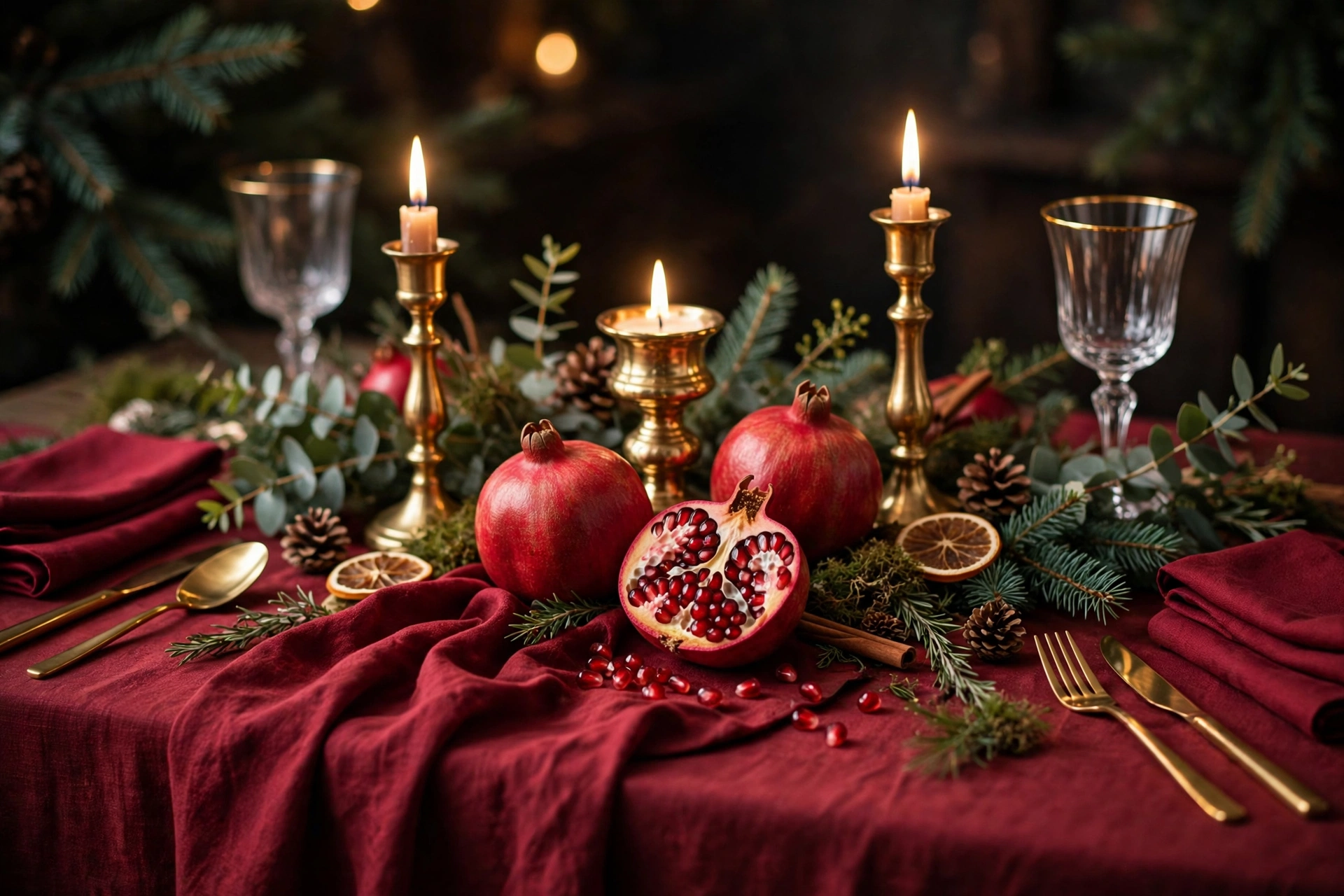
Christmas pomegranate decor ideas bring one of the oldest festive symbols back to the table. Pomegranates — deep red, glossy and jewel-like — are named in this year’s Hallmark “Fa La La La Luxe” trend alongside stained glass and winter florals, and they suit Christmas perfectly: they are seasonal, they last for weeks, and they look expensive without costing anything like it. A bowl of pomegranates is a centrepiece; a single one on a plate is a place setting.
The fruit’s appeal is its colour and its meaning. In many traditions the pomegranate stands for abundance and good fortune, which is exactly the message of a Christmas table. Our Christmas centerpiece ideas show how one strong natural element can anchor a whole table — and the pomegranate is the strongest of them.
- Pomegranates are a natural centrepiece: deep red, glossy and long-lasting.
- Use whole fruit for decor; cut fruit is for eating, not display.
- Pair with gold, deep green and cream — the luxe palette of 2026.
- One pomegranate per place setting doubles as a favour and a decoration.
1. A Bowl of Pomegranates as a Centrepiece
The simplest pomegranate display is also the best: a wide, shallow bowl filled with whole pomegranates, a few sprigs of eucalyptus and a string of fairy lights tucked underneath. The red fruit glows against the green, the bowl catches the light, and the whole thing takes two minutes. Use a brass or wooden bowl for warmth, and keep the fruit dry — moisture is what makes pomegranates spoil.
Whole pomegranates last two to three weeks at room temperature, so a bowl made in early December will still look good on Christmas Day. Check the fruit weekly and remove any that soften. Our Christmas coffee table decor ideas show how the same bowl works on a coffee table, a sideboard or a hallway console.
2. Pomegranates at Each Place Setting
Place one pomegranate on each dinner plate, on a folded napkin, with a sprig of rosemary tucked beside it. It is a place setting, a decoration and a talking point in one — and guests can take theirs home. The deep red against a white plate is one of the most photogenic details on a Christmas table, and it costs less than a pound per person.
For a more formal table, tie a name tag to the stem end with gold twine. The tag doubles as a place card, and the fruit’s weight stops the card blowing away when the door opens. Keep the rest of the place setting plain — white plates, gold cutlery — so the pomegranate is the colour on the plate.
3. Pomegranate Garlands and Wreaths
Small pomegranates wired into a garland or wreath add jewel-like spots of red to the greenery. Use whole mini pomegranates — the small ornamental kind sold by florists — wired firmly to the garland base so they do not roll off. A pomegranate wreath on the front door is striking: deep green foliage, deep red fruit, and nothing else.
Dried pomegranate slices are another option. Slice the fruit thinly, dry the slices slowly in a low oven, and thread them onto twine for a garland, or wire them into a wreath. They keep their deep red colour for weeks and add a homemade touch that shop-bought baubles cannot match.
4. Pomegranates on the Mantel and Shelves
A row of pomegranates along the mantel, mixed with pine cones and brass candlesticks, is a complete mantel display. The fruit’s shine catches the candlelight, and the deep red stands out against both dark wood and white paint. On a shelf, a single pomegranate beside a stack of books and a small vase is a quiet, elegant touch.
Mix sizes: large pomegranates at the ends of the mantel, smaller ones in the middle, so the display has rhythm. And keep them away from direct heat — fruit above a lit fire dries out and splits.
5. Pomegranate Colour in Textiles and Baubles
If fresh fruit is not practical, use the colour. Deep pomegranate-red baubles, a pomegranate-red velvet ribbon, or cushions in the same rich shade all carry the theme without any fruit at all. The colour sits between ruby and burgundy — richer than red, warmer than plum — and it is one of the jewel tones defining Christmas 2026.
Pair pomegranate red with gold and deep green for a traditional luxe look, or with cream and blush for a softer, modern one. Our Christmas pillow decor ideas show how one deep-red cushion changes a whole sofa.
What to Avoid With Pomegranates
The classic mistake is cutting the fruit for display. A cut pomegranate looks beautiful for an hour and then browns, leaks and stains the tablecloth. Display whole fruit only; cut fruit belongs in a bowl at the table, eaten the same day.
Also avoid pairing pomegranates with bright, artificial reds. The fruit’s deep, natural red clashes with plastic-red tinsel and cheap red baubles. Keep the reds around it deep and natural — burgundy, ruby and the fruit itself.
Frequently Asked Questions
How long do pomegranates last as decoration? Two to three weeks at room temperature if the skin is unbroken. Check weekly and remove any fruit that softens.
Can I use pomegranates on a Christmas wreath? Yes — wire whole mini pomegranates firmly to the wreath base. They last the season and add jewel-like colour.
What does a pomegranate symbolise at Christmas? In many traditions it stands for abundance, fertility and good fortune — a fitting symbol for a Christmas table.
Are pomegranates expensive for decorating? No — a single fruit costs little, and a bowl of six to eight is cheaper than most centrepieces. Mini ornamental pomegranates from florists cost a little more.
Christmas pomegranate decor ideas are a reminder that the best decorations are sometimes the ones you can eat. One bowl of deep red fruit, a few candles and some greenery — and the table is dressed.