
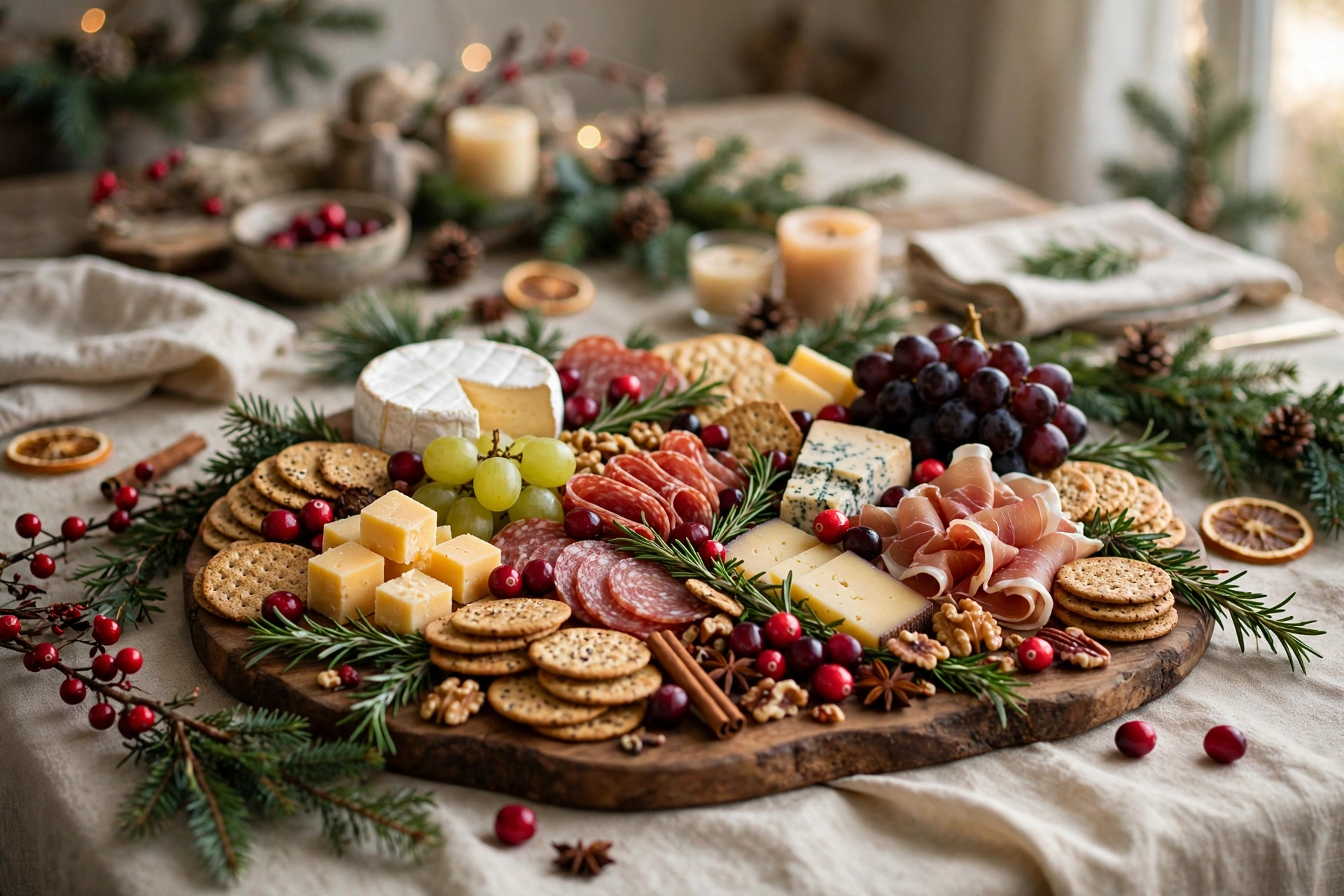
Christmas charcuterie board season is here, and the board has become the unofficial centrepiece of every festive gathering — part food, part decoration, and the first thing guests gather around. The best boards look abundant and effortless, but there is a simple method behind them: a mix of cheeses, meats, crackers, fruit and something sweet, arranged in layers with gaps filled by nuts and herbs. This guide has 20 ideas, from the classic board to a Christmas-tree-shaped showstopper, plus the shopping list and the mistakes to avoid.
- A Christmas charcuterie board needs five things: cheese, meat, crackers, fruit and something sweet — plus nuts and herbs to fill the gaps.
- Use three cheeses (soft, hard, blue), two or three meats, and two kinds of crackers for balance.
- Arrange in layers: big items first, then fill the gaps with small items, then garnish with rosemary and cranberries.
- Plan on 100–150g of food per person for a grazing board, and put the board out 30 minutes before guests arrive.
- Keep the board at room temperature for 20 minutes before serving — cold cheese has no flavour.
Christmas Charcuterie Board: The Classic Build
Start with the board itself — a large wooden board, a slate, or even a baking tray lined with parchment. Place the cheeses first, spacing them around the board: a soft brie, a hard aged cheddar, and a blue cheese for the adventurous. Add the meats next, folded or rolled rather than laid flat — salami roses are the classic trick, made by draping slices over the rim of a small glass. Then the crackers and breadsticks, fanned in two or three spots. Fill the remaining gaps with grapes, dried apricots, nuts and olives, and finish with sprigs of rosemary and a scattering of fresh cranberries for the Christmas colour. The whole build takes about twenty minutes, and it looks like it took an hour. If you need more festive food inspiration, our Thanksgiving charcuterie board uses the same method with autumn flavours, and Christmas breakfast recipes cover the morning after.
What cheese should go on a Christmas board?
Three cheeses are the sweet spot. A soft cheese (brie or camembert) for spreading, a hard cheese (aged cheddar, manchego or parmesan) for slicing, and a blue (stilton or gorgonzola) for contrast. Add a flavoured cheese for fun — a cranberry-studded Wensleydale is the Christmas classic and doubles as decoration. Cut the hard cheeses into slices or cubes before the board goes out, leave the soft cheese whole with a knife beside it, and label the cheeses with small tags if your guests are curious. A little honey drizzled over the blue cheese is the pairing nobody expects and everyone loves.
Christmas Charcuterie Board Ideas: Shapes and Themes
The Christmas-tree board is the showstopper: arrange the items in a triangle on a large board, with a star of cheese on top and a trunk of pretzel sticks at the bottom. A wreath board — a ring of items on a round board with a bowl of dip in the middle — is easier and just as festive. A red-and-green board leans on cranberries, rosemary, red grapes and green olives for colour. And a dessert board swaps the meats for chocolate, shortbread, dried fruit and marshmallows, which children prefer anyway. Whatever the shape, keep one rule: every item should be reachable without moving another item, or guests will not eat the good stuff at the back.
Christmas Charcuterie Board Shopping List
For eight people, the shopping list is: three cheeses (about 600g total), two meats (about 300g), two cracker varieties, a baguette, a bunch of grapes, a box of dried apricots, a jar of olives, a bag of mixed nuts, a small pot of honey, fresh cranberries and rosemary for garnish. That is the whole list, and it costs far less than a catered platter. Buy the cheese from a deli counter rather than pre-packaged if you can — the quality is better and the staff will cut exactly what you need. And buy the crackers last, so they stay crisp.
Dietary needs and allergies
A good board feeds everyone, so plan for it. Keep a separate small board for gluten-free crackers, label the nuts clearly, and put the vegetarian options — cheeses, fruit, breads and dips — on one side so they are easy to find. If someone is dairy-free, a hummus and olive board beside the main one takes five minutes and means nobody is left watching everyone else eat. Our Thanksgiving potluck ideas include more crowd-feeding recipes for mixed groups.
Mistakes to Avoid with a Christmas Charcuterie Board
The most common mistake is overcrowding: a board packed so tightly that nothing can be picked up without a collapse. Leave breathing room — a board that is 80 percent full looks abundant and works better than one at 100 percent. The second mistake is serving cheese fridge-cold; take it out twenty minutes early so the flavour opens up. The third is forgetting the small things: cocktail sticks, a cheese knife for each soft cheese, small spoons for the chutney, and a spare plate for olive stones. And the last is making the board too early — build it no more than an hour before serving, or the crackers go soft and the fruit dries out.
What goes on a Christmas charcuterie board?
Three cheeses, two or three meats, crackers, bread, fruit, nuts, olives and something sweet — arranged in layers with rosemary and cranberries for garnish.
How much food do I need per person?
About 100–150g of food per person for a grazing board, less if it is an appetiser before a meal.
How far ahead can I make a charcuterie board?
Build it no more than an hour before serving, so the crackers stay crisp and the fruit stays fresh.
Should cheese be served cold?
No — take it out of the fridge 20 minutes before serving so the flavour opens up.
1 thought on “Christmas Charcuterie Board: 20 Ideas”