
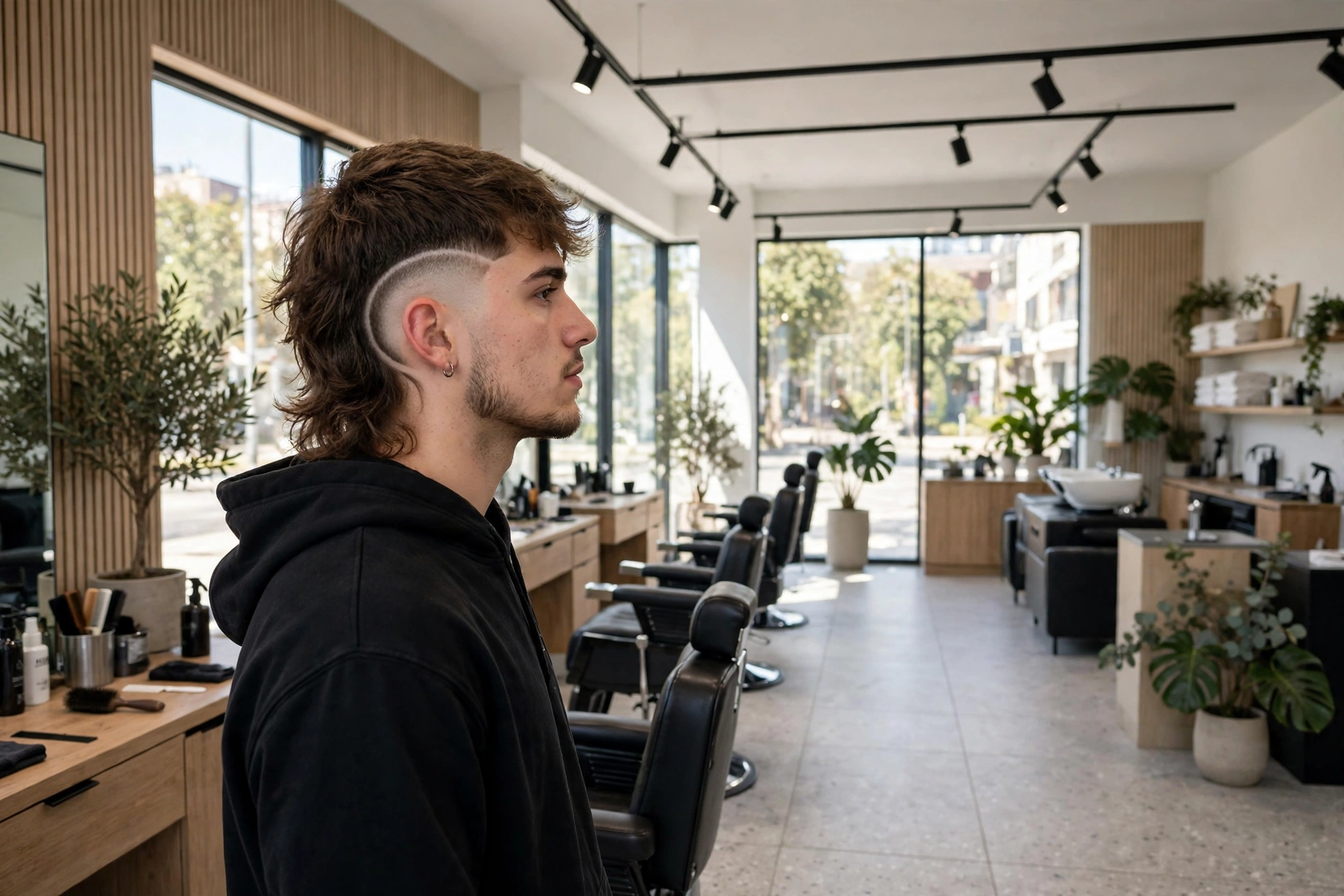

A few years ago the mullet was a punchline. Now it is one of the most asked-for cuts in barbershops, and the burst fade mullet is the version that made it happen. It keeps the party-at-the-back length of a classic mullet, but the sides are faded in a smooth arc around the ear — the “burst” — which makes the whole thing look deliberate, clean, and modern instead of accidental. It works on straight hair, wavy hair, and curls, and it suits everyone from teenagers to guys in their thirties who want something with a bit of edge. This guide explains what the cut is, who it suits, the main variations, and exactly what to say to your barber.
- A burst fade mullet pairs a faded arc around the ear with longer hair at the back and on top.
- It suits straight, wavy, and curly hair — curly hair gives the most natural volume on top.
- Ask for a burst fade (not a regular taper) and show a photo; the arc around the ear is the defining detail.
- Keep the top textured and the back long enough to see — that contrast is the whole point of the cut.
- It needs a tidy-up every 3 to 4 weeks, but the grow-out is forgiving.
What Is a Burst Fade Mullet?
The burst fade mullet has three parts. On top, the hair is left medium length and textured, usually pushed forward or to the side. Around the ears, the barber fades the hair in a curved arc — tight at the bottom, blending up into the longer hair — which is the burst fade, named because the fade bursts out in a semicircle around the ear. At the back, the hair stays long, covering the neck, which is the mullet part. The contrast between the clean faded sides and the flowing back is what makes the cut work: it looks sharp from the front and relaxed from behind.
It is different from a regular mullet because the sides are not left long and shaggy — they are faded, which keeps the cut looking intentional. And it is different from a standard burst fade because the back is not tapered off; it is left long. The combination is why it photographs so well and why it has spread from barbershop Instagram to the mainstream. If you like the idea of a fade but want something with more personality, our low taper fade guide covers the subtler version of the same idea.
Who Does the Burst Fade Mullet Suit?
Honestly, most people. The cut works best on hair with some natural texture, because the top needs volume and movement to balance the length at the back. Wavy and curly hair are ideal — the curls give the top a natural shape with almost no styling. Straight hair works too, but it needs a bit of product and a texturising cut on top so it does not fall flat. Thick hair is easier to work with than very fine hair, because the back needs enough weight to sit properly instead of wisps.
Face shape matters less than people think, but it does change which version to ask for. A rounder face suits a bit more height on top, which lengthens the face. A longer face suits a flatter top with more width at the sides. The fade itself suits every face shape because it is so clean around the ears. The one thing to be honest about is maintenance: if you hate visiting the barber, this is not the cut for you, because the fade grows out in about three weeks. If you want a lower-maintenance option in the same family, our high taper fade guide explains a version that grows out a little more gracefully.
Burst fade mullet variations to know
There are a few versions worth knowing before you sit in the chair. The classic burst fade mullet keeps the top around two to three inches and the back down to the collar or a little past it. The curly burst fade mullet lets natural curls do the work on top, with the fade kept tight so the curls stand out. The textured burst fade mullet adds choppy layers on top for a messier, lived-in look. And the modern burst fade mullet is the shortest, cleanest version — shorter back, tighter fade, closer to a regular haircut with a mullet twist. Knowing which one you want before you arrive makes the whole appointment easier.
How to Ask Your Barber for a Burst Fade Mullet
Barbers love a clear request, and this cut is easy to get wrong if you are vague. Say “burst fade mullet” first, then be specific: how long you want the back, how tight you want the fade, and what you want on top. A photo helps more than any description, so save two or three pictures of the exact version you want — one from the front, one from the side showing the fade arc, and one from the back showing the length. Show the barber the side photo and point at the arc around the ear, because that is the detail that makes it a burst fade rather than a regular fade.
A few phrases that help: “burst fade around the ear, not a straight taper,” “keep the length at the back, just clean up the ends,” and “texture on top, not too short.” If your barber has never done one, that is fine — the technique is standard, and any good barber can follow a photo. And if you are growing your hair out to get there, our layered shaggy haircuts guide has ideas for the awkward in-between stage.
How to Style a Burst Fade Mullet at Home
Styling is simpler than it looks. Wash your hair, towel dry it until it is damp, and work a small amount of matte clay or sea salt spray through the top with your fingers. Push the front forward or to the side, depending on the version you have, and let the back fall naturally — do not try to style the back much, because it looks best when it just hangs. A hairdryer on a low setting, blowing the top forward, adds volume if your hair is flat. Avoid heavy gels and shiny pomades, which make the cut look stiff and dated; the whole point of this style is that it looks effortless.
For curly hair, the routine is even easier: a leave-in conditioner or curl cream, scrunched in while the hair is damp, and then leave it alone. The fade keeps the sides tidy, so the curls on top and the length at the back are the only things that need attention. If your hair is straight and fine, a volumising powder at the roots makes a real difference, and a quick blast with the dryer is usually enough to hold the shape for the day.
How Often Does It Need a Trim?
Plan on a tidy-up every three to four weeks. The fade is the part that grows out first — after about three weeks the arc around the ear starts to blur, and the cut loses its sharpness. A barber can clean up just the fade in ten minutes, which is cheaper than a full cut, and it keeps the style looking fresh between full appointments. The back can go longer between trims, usually six to eight weeks, because a mullet actually looks better with a bit of length. Just ask the barber to take the split ends off the back without shortening it.
The grow-out is one of the cut’s best features. Because the top and back are already long, the style does not fall apart the way a short cut does — it just gets softer and more relaxed. If you decide you are done with it, growing it into a longer shaggy style is easy, and cutting it short again is a single appointment. That low-risk quality is a big part of why so many people are trying it.
Frequently Asked Questions
What is a burst fade mullet?
It is a mullet with a burst fade: the hair around the ears is faded in a curved arc, the top is left medium length and textured, and the back is left long. The clean faded sides make the classic mullet look modern.
Does a burst fade mullet suit straight hair?
Yes, but it needs a texturising cut on top and a little product, such as matte clay or sea salt spray, so the top does not fall flat. Wavy and curly hair give the most natural volume.
How do I ask my barber for a burst fade mullet?
Say “burst fade mullet” and show a photo, ideally from the side so the barber can see the fade arc around the ear. Specify how long you want the back and how tight you want the fade.
How often should I get a burst fade mullet trimmed?
Every 3 to 4 weeks for the fade, and every 6 to 8 weeks for the back. A quick fade tidy-up between full cuts keeps it looking sharp.
Is the burst fade mullet still in style in 2026?
Yes — it is one of the most requested cuts of the year, and the cleaner modern version has moved well beyond its trend phase into a mainstream style.
The burst fade mullet works because it is two haircuts in one: sharp and clean from the front, relaxed and a little rebellious from the back. Bring a photo, be specific about the length, and give it a few weeks — most people who try it wonder why they waited so long.