
What Does HVAC Stand For? Heating, Ventilation, and Air Conditioning Explained
If you have ever read a home listing, a contractor quote, or an energy bill, you have almost certainly seen the letters HVAC. But what does HVAC stand for, and what does it actually cover in your home? HVAC stands for Heating, Ventilation, and Air Conditioning. Those three words describe the complete system that keeps indoor spaces warm in winter, cool in summer, and filled with fresh, clean air all year round. Far from being a single appliance, HVAC is an umbrella term for a family of equipment, ductwork, controls, and safety devices that work together to control temperature, humidity, and air quality. This guide breaks down each part in plain language, explains how the pieces fit together, and shows what homeowners should know before buying, replacing, or maintaining a system.
Key Takeaways
- HVAC stands for Heating, Ventilation, and Air Conditioning: the three functions that control indoor comfort.
- Heating warms the home, ventilation exchanges stale indoor air for fresh outdoor air, and air conditioning cools and dehumidifies.
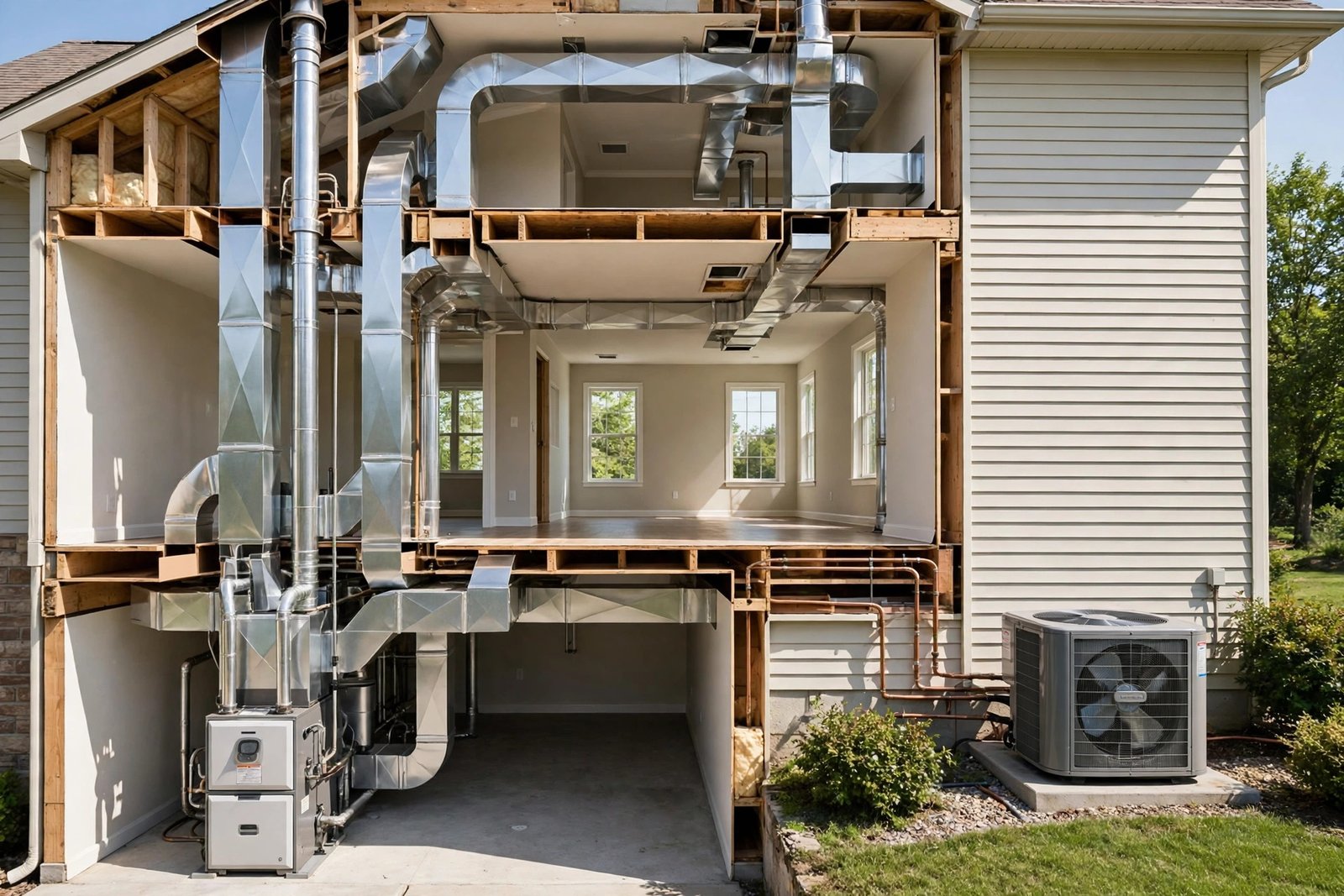
- Most homes use a split system: an outdoor condenser, an indoor furnace or air handler, ductwork, and a thermostat.
- Heat pumps combine heating and cooling in one unit and are increasingly popular for energy efficiency.
- Ventilation is the most overlooked leg of HVAC, yet it drives air quality, moisture control, and health.
H: Heating — Warmth When You Need It
The heating leg of HVAC covers every method used to warm a building. In most homes this means a furnace, which burns natural gas, propane, or oil, or uses electric resistance elements to heat air that is then blown through ducts. Other common heating sources include boilers, which heat water and circulate it through radiators or underfloor pipes, and heat pumps, which move heat from outdoor air or the ground into the home rather than generating it by burning fuel. Each approach has trade-offs in upfront cost, running cost, and suitability for different climates, which is why comparing options such as a heat pump versus a furnace matters before a replacement purchase.
Heating systems are sized to the home, not to a generic rule of thumb. A furnace that is too large will short-cycle, turning on and off frequently, which wastes energy and wears components faster. One that is too small will run constantly in cold weather and still leave rooms chilly. Professional load calculations consider insulation, window area, ceiling height, and local climate to size equipment correctly. The thermostat is the heating system’s brain, and modern programmable and smart thermostats can cut heating bills significantly by lowering temperatures automatically when the home is empty or everyone is asleep.
V: Ventilation — The Overlooked Essential
Ventilation is the process of exchanging indoor air with outdoor air to remove odours, moisture, carbon dioxide, and airborne pollutants. It is the leg of HVAC that homeowners think about least, yet it has the biggest impact on how fresh a home feels and how healthy its air is. Natural ventilation happens through open windows and gaps in the building envelope, but modern, well-sealed homes need mechanical ventilation to guarantee enough fresh air. Bathroom exhaust fans, kitchen range hoods, and whole-house ventilators such as heat recovery ventilators and energy recovery ventilators all belong to this category.
Good ventilation also controls moisture, which protects both health and the building itself. Cooking, showering, and even breathing add litres of water vapour to indoor air every day. Without ventilation, that moisture condenses on cold surfaces, encouraging mould growth and damaging paint, plaster, and timber. A balanced ventilation strategy removes moist air from kitchens and bathrooms while supplying fresh air to bedrooms and living spaces, keeping humidity in the comfortable range of roughly 30 to 50 percent. When ventilation is poor, homes feel stuffy, odours linger, and condensation appears on windows even when the heating and cooling seem fine.
AC: Air Conditioning — Cooling and Dehumidifying
Air conditioning does two jobs at once: it lowers air temperature and removes humidity. A standard split air conditioner circulates refrigerant between an indoor evaporator coil and an outdoor condenser coil. Inside, the refrigerant absorbs heat from room air as it evaporates; outside, it releases that heat as it condenses, with a fan blowing the heat away. The cooled, dehumidified air is then distributed through ducts or, in ductless mini-split systems, blown directly into individual rooms by wall-mounted units. Central air conditioning, window units, portable units, and ductless systems all use the same basic refrigeration principle at different scales.
Humidity removal is just as important as temperature drop. On a humid day, air at 26 degrees with high humidity feels far more uncomfortable than the same temperature with dry air, because sweat cannot evaporate efficiently. A correctly sized air conditioner dehumidifies as it cools, since moisture condenses on the cold evaporator coil and drains away. An oversized unit cools the air so quickly that it shuts off before removing enough moisture, leaving the home cool but clammy. This is one reason proper sizing matters for cooling just as much as for heating, and why the basics of what an HVAC system is always come back to balance between the three functions.
How the Parts Work Together
In a typical split system, the thermostat calls for heating or cooling, the indoor unit responds, and the outdoor unit supports the process. In winter, the furnace heats air and the blower pushes it through supply ducts to each room, while return ducts carry cooler air back to be reheated. In summer, the same blower and ducts distribute cooled air from the evaporator coil, and the outdoor condenser rejects heat outside. Ventilation equipment runs alongside both modes, exhausting stale air and bringing in fresh air. Filters in the return path catch dust and allergens before air reaches the coils, which is why routine filter care sits at the heart of any sensible HVAC maintenance routine.
Ductwork deserves more attention than it usually gets. Leaky, poorly insulated, or badly designed ducts can waste a quarter or more of the energy a system produces, delivering warm or cool air into attics and crawl spaces instead of living rooms. Sealed, insulated ducts with balanced airflow keep every room comfortable and reduce strain on equipment. In homes without ducts, mini-split heat pumps offer room-by-room control, letting occupants heat or cool only the spaces they use, which can be a major efficiency win in older homes or additions.
Types of HVAC Systems in Homes
Split systems
The most common setup in detached homes: an outdoor unit paired with an indoor furnace or air handler, connected by refrigerant lines and controlled by a central thermostat. Split systems suit homes with existing ductwork and deliver whole-home comfort from one control point.
Packaged systems
All components sit in a single outdoor cabinet, common in smaller homes and in regions with mild climates. Packaged units save indoor space but expose all equipment to outdoor weather, which can shorten component life in harsh climates.
Ductless mini-splits
One outdoor unit serves one or more indoor wall, ceiling, or floor units, each with its own control. Mini-splits are ideal for homes without ducts, room additions, and zoned comfort, and most models provide both heating and cooling.
Heat pumps
Heat pumps move heat rather than creating it, making them highly efficient in moderate climates. Air-source heat pumps are the most common, while ground-source or geothermal systems offer higher efficiency at a higher installation cost. Cold-climate heat pumps now perform well even in freezing weather.
Boilers and radiant systems
Boilers heat water for radiators, baseboards, or underfloor tubing, delivering gentle, even warmth without blowing air. They pair with separate ventilation and cooling solutions, since they do not use ductwork.
Check the labels on your indoor and outdoor units and note the model numbers. Knowing what you own makes every future quote and repair conversation easier.
Run bathroom fans during and after showers and use the range hood when cooking. These small habits protect air quality daily.
A correctly sized mid-range system outperforms an oversized premium unit. Always ask for a load calculation before replacement.
Filters, thermostat batteries, and clear space around the outdoor unit are the three cheapest tasks that prevent the most breakdowns.
HVAC Efficiency Ratings Explained
Shopping for HVAC equipment means decoding a set of efficiency ratings. For furnaces, AFUE (Annual Fuel Utilization Efficiency) shows how much fuel becomes useful heat; a 96 percent AFUE furnace converts 96 percent of its fuel into warmth. For air conditioners, SEER2 (Seasonal Energy Efficiency Ratio) measures cooling output per unit of electricity over a season, with higher numbers meaning better efficiency. Heat pumps carry both SEER2 for cooling and HSPF2 for heating. These ratings let homeowners compare running costs fairly, but real-world efficiency also depends on installation quality, duct condition, insulation, and thermostat habits. A high-rated unit installed poorly can underperform a modest unit installed well.
Energy labels and rebate programmes often reward higher-efficiency equipment, and in many regions heat pumps qualify for incentives that reduce the upfront cost gap. When comparing quotes, ask each contractor for the estimated annual running cost, not just the purchase price, and check whether the quote includes duct sealing, thermostat upgrades, or ventilation improvements. The cheapest quote that skips these essentials often costs more over the life of the system.
Common HVAC Problems Homeowners Should Recognise
Most HVAC trouble announces itself early if you know what to listen for. Uneven room temperatures often point to duct leaks, blocked vents, or an aging blower. Short cycling, where the system turns on and off every few minutes, can mean an oversized unit, a dirty filter, or a thermostat placed in a poor location. Strange noises such as grinding, squealing, or banging usually signal a failing motor, loose component, or blower issue that deserves prompt attention. Musty smells when the system starts can indicate mould in ducts or a clogged condensate drain, while a burning smell at the start of heating season is often just dust burning off the heat exchanger, though persistent burning smells always warrant a professional check.
Regular professional servicing, ideally once a year for each function, catches refrigerant leaks, worn electrical connections, cracked heat exchangers, and airflow problems before they become emergencies. A heat exchanger crack is a safety issue, not just a comfort one, because it can allow carbon monoxide into the home. That is why every home with fuel-burning heating equipment needs working carbon monoxide detectors, tested monthly and replaced on schedule.
Frequently Asked Questions
Is HVAC the same as air conditioning?
No. Air conditioning is only the cooling leg of HVAC. A full HVAC system also covers heating and ventilation, so a home with only a window air conditioner has cooling but not a complete HVAC system.
What does HVACR mean?
HVACR adds R for Refrigeration, covering commercial refrigeration as well as heating, ventilation, and air conditioning. Residential contractors usually say HVAC, while commercial and industrial work often uses HVACR.
How long does an HVAC system last?
Furnaces typically last 15 to 20 years, air conditioners 12 to 17 years, and heat pumps 12 to 15 years, depending on climate, usage, and maintenance. Regular servicing and filter changes are the biggest factors in reaching the upper end of those ranges.
Do I need HVAC if I live in a mild climate?
Even mild climates need ventilation and some heating and cooling for comfort and moisture control. A ductless mini-split heat pump often suits mild climates perfectly, providing efficient heating and cooling in one compact system.
When should I replace instead of repair?
Consider replacement when the system is over 15 years old, repairs exceed half the cost of a new unit, energy bills keep rising, or breakdowns recur each season. A professional assessment can weigh repair cost against efficiency gains from new equipment.
HVAC stands for Heating, Ventilation, and Air Conditioning, and understanding those three words gives you a clear map of your home’s comfort system. Heating warms, ventilation refreshes, and air conditioning cools and dehumidifies, all coordinated by the thermostat and delivered through ducts or direct indoor units. Know your system type, keep ventilation in mind alongside temperature, and maintain the basics on schedule. With that knowledge, every contractor conversation, replacement quote, and maintenance decision becomes far easier to judge.