
Jewel Tone Christmas Tree Ideas: Rich, Bold & Festive
If your Christmas tree has looked the same for years — red and gold, silver and white, or a cheerful mix of everything you own — jewel tones are the upgrade that makes it feel brand new. Emerald, sapphire, ruby, amethyst and topaz are colours with depth. They glow under warm fairy lights instead of competing with them, and they turn an ordinary green tree into something that looks like it belongs in a grand hotel lobby. Best of all, you do not need to replace everything: jewel tones work beautifully alongside the gold and greenery you already have.
The secret to a jewel tone Christmas tree is layering colour like a gemstone collection, not scattering it like confetti. Choose two or three jewel shades as your main palette, add gold or brass as the metal that ties them together, and use texture — velvet, glass, matte and shine — to keep the tree interesting from every angle. This guide walks through palettes, ornament choices, lighting, and the finishing touches that make a jewel tone tree look expensive rather than busy.
Key Takeaways
- Pick two or three jewel tones (for example emerald, ruby and sapphire) and let gold or brass tie them together.
- Mix textures — velvet ribbon, glass baubles, matte ornaments and metallic accents — for depth.
- Use warm white lights; cool white lights can make jewel colours look harsh and flat.
- Place the largest ornaments deep inside the tree and smaller ones at the tips for a full, layered look.
- Repeat one jewel colour in the room — a throw, cushions or table linen — so the tree feels connected to the space.
- Keep the tree topper simple and metallic so it crowns the colour rather than competing with it.
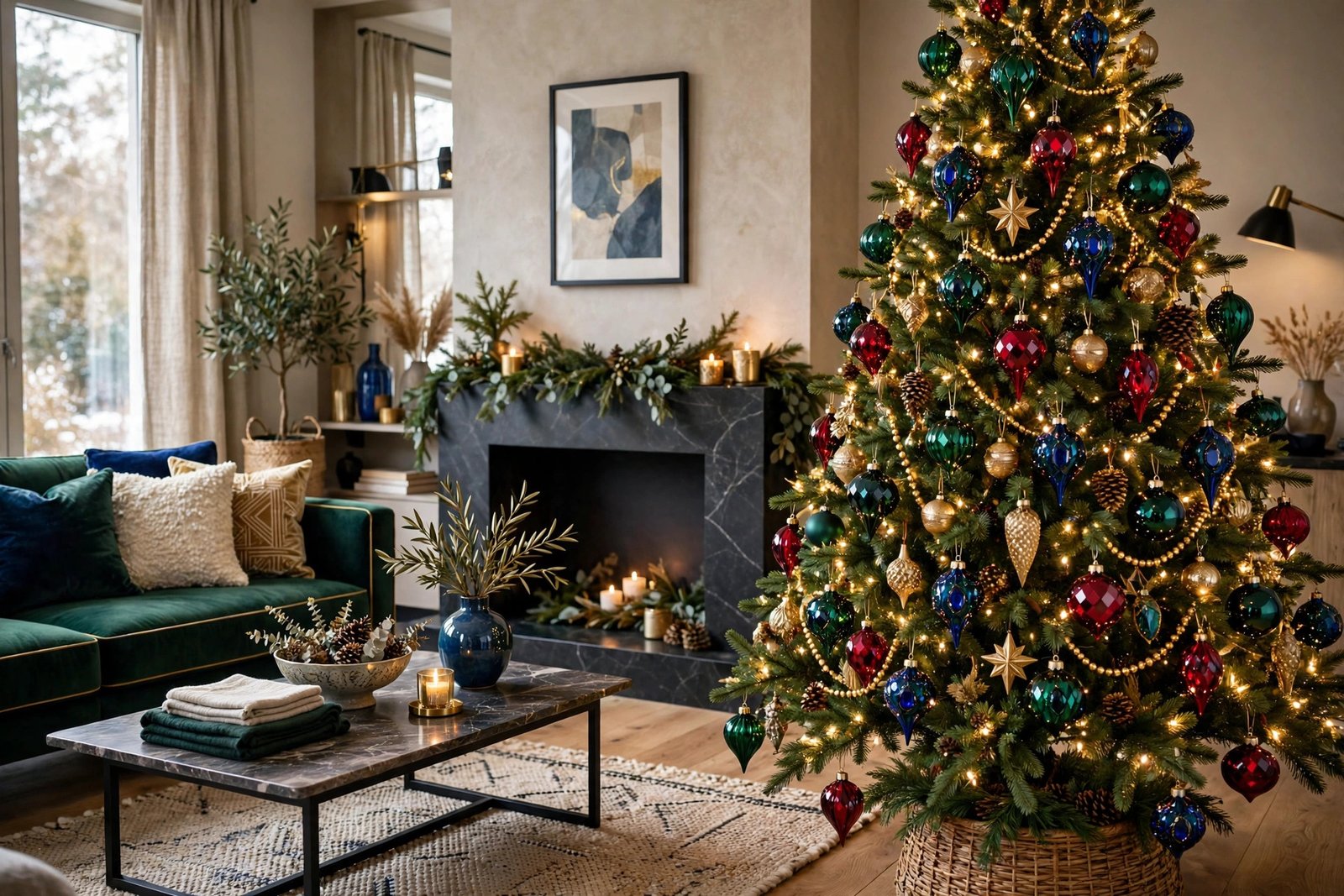
Choosing Your Jewel Tone Palette
The most reliable jewel palette is emerald, ruby and gold. Emerald gives the tree its richness, ruby adds warmth and festive energy, and gold acts as the light that lifts both. This combination suits traditional homes, dark wood furniture and rooms with warm lighting, and it photographs beautifully. If your room is cooler in tone — grey sofas, white walls, chrome details — try sapphire, amethyst and silver instead. The blue and purple shades feel modern and a little dramatic, and silver keeps them from looking too dark.
For a bolder statement, go all in on one jewel colour. An all-emerald tree with gold accents is strikingly elegant, and an all-ruby tree with brass details feels opulent without being fussy. A single-colour tree also makes shopping easier: you can buy ornaments gradually, in different textures, without worrying about matching shades. Whatever palette you choose, buy a few extra baubles in your main colour in different sizes — large, medium and small — because size variety is what makes a tree look professionally dressed. For classic foundations to build on, see our Christmas home decor ideas.
Ornaments: Glass, Velvet and Metal
Jewel tones demand good materials. Cheap plastic baubles in bright colours look exactly like what they are, while glass baubles in deep emerald or sapphire catch the light and seem to glow from within. You do not need an all-glass tree — mix glass feature baubles with shatterproof ones in the same colours for the bulk, especially if you have children or pets. The eye will register the glass highlights and assume the whole tree is luxurious.
Velvet is the second hero material. Velvet ribbon in emerald or burgundy, velvet-covered baubles, or even small velvet bows tied to branches add a softness that glass alone cannot provide. Metal finishes should be warm: gold, brass and copper flatter jewel tones, while chrome and bright silver can clash with ruby and emerald. If you already own silver ornaments, keep them to one section of the palette — sapphire and amethyst pair well with silver — rather than mixing metals all over the tree. And do not forget picks and sprays: deep-coloured berries, gold-dipped leaves and jewel-toned florals tucked into the branches fill gaps far more elegantly than extra baubles.
Lighting a Jewel Tone Tree
Lighting can make or break a jewel tone tree. Warm white lights are almost always the right choice: they bring out the warmth in ruby and topaz, make emerald look deep rather than cold, and turn gold accents into a soft glow. Cool white or blue-white lights, by contrast, can make jewel colours look icy and washed out, and multicoloured lights will fight with your carefully chosen palette. If you love colour, use it elsewhere in the room — on the mantel or in the window — and keep the tree lights warm and consistent.
Use more lights than you think you need. A jewel tone tree needs light to show off its colours; a sparsely lit tree in deep colours can look dark and heavy. As a rough guide, aim for around 100 lights per foot of tree height, and wind them deep into the branches as well as around the outside, so the tree glows from within. Cluster lights, which sit close together on a single wire, give a particularly luxurious effect on jewel trees. Once the lights are on, step back and look at the tree in the evening with the room lights low — that is how it will be seen most, and it is the view worth perfecting. Our home light decor ideas for Christmas cover the rest of the room too.
Finishing Touches: Ribbon, Topper and Skirt
Ribbon is the fastest way to make a jewel tree look finished. A wide velvet or satin ribbon in one of your palette colours, woven through the branches in long, flowing loops, ties the whole tree together and hides any bare patches. Alternatively, use a narrower ribbon in gold to add sparkle without adding another colour. Whichever you choose, wired ribbon is worth the small extra cost — it holds its shape for the whole season, while unwired ribbon droops within days.
For the topper, restraint pays off. A simple gold star, a brass finial, or a large gold bow crowns a jewel tree without introducing a new colour or shape to compete with the ornaments. Avoid novelty toppers on a jewel tree; they break the elegant mood you have built. At the base, a tree skirt in deep velvet, or a simple gold or cream skirt, finishes the look and hides the stand. A collar in brass or gold also works beautifully here, echoing the metallic accents elsewhere in the room. For a full festive scheme, our traditional Christmas home decor ideas show how jewel tones sit within a classic home.
Bringing Jewel Tones into the Room
A jewel tree looks best when the room echoes it, even slightly. You do not need to redecorate: a couple of velvet cushions in emerald or ruby on the sofa, a jewel-toned throw, or a table runner in one of your tree colours will make the tree feel like part of the room rather than an isolated decoration. Candles in deep colours on the mantel, or a bowl of jewel-toned baubles as a centrepiece, extend the palette without extra effort.
Be careful not to overdo it. If the tree is rich and colourful, the room should stay relatively calm — plain walls, neutral furniture and one or two jewel accents are enough. If every surface is also jewel-toned, the room becomes overwhelming and the tree loses its impact. Think of the tree as the jewellery and the room as the outfit: the outfit should be elegant and simple, so the jewellery shines. This balance is also why jewel trees work so well in smaller rooms — a single, rich focal point makes a small space feel luxurious rather than crowded.
Tips for a Show-Stopping Jewel Tree
More jewel colours than that turns rich into chaotic. Limit the palette and repeat it.
Warm light flatters jewel colours; cool light flattens them. Check the box before you buy.
Place large baubles deep in the branches to give the tree depth and fullness.
Matte velvet plus shiny glass plus metallic gold keeps the eye moving around the tree.
When in doubt, add gold. It connects emerald, ruby and sapphire into one scheme.
Judge the tree at night with room lights low — that is when jewel tones truly glow.
Finally, do not be afraid to build your jewel collection over time. Start with lights, ribbon and a set of baubles in your main colour this year, add a second jewel tone next year, and let the tree evolve. A tree that grows gradually, with pieces chosen carefully, always looks better than one bought in a single, hurried shopping trip — and each ornament will carry a story, which is, after all, what Christmas decorating is really about.
Frequently Asked Questions
What colours count as jewel tones for Christmas?
Emerald green, ruby red, sapphire blue, amethyst purple and topaz gold. These are deep, saturated colours inspired by gemstones, and they all pair well with gold or brass.
Do jewel tone trees suit small rooms?
Yes — a single rich focal point can make a small room feel luxurious. Keep the rest of the room calm and neutral so the tree stands out without overwhelming the space.
Should I use warm or cool lights on a jewel tree?
Warm white, almost always. Warm light brings out the depth in jewel colours, while cool light can make them look flat and cold.
Can I mix jewel tones with my existing red and gold ornaments?
Yes. Ruby is already a jewel tone, and gold ties the palette together. Add emerald or sapphire gradually and keep the gold consistent.
Are glass baubles necessary for a jewel tree?
Not exclusively, but a few glass feature baubles make a big difference. Mix them with shatterproof baubles in the same colours for a luxurious look that is also practical.
Go Bold This Christmas
A jewel tone tree is a confident choice, and confidence is what makes it work. Choose your palette, invest in good lights and a few beautiful glass pieces, and let the deep colours do the talking. You do not need more decorations — you need richer ones, placed with intention.
This year, skip the safe red-and-gold repeat and try emerald, ruby and gold instead. When the lights go on that first evening, you will understand why jewel tones never go out of style.