

Christmas home decor ideas work best when they follow a simple rule: warm light, real greenery, and one hero moment in each room. You do not need a house full of ornaments to make December feel magical. A glowing tree, a dressed mantel, a wreath on the door, and a table set with care will do more than ten boxes of decorations scattered everywhere.
Key Takeaways
- Pick one colour palette for the whole house before you buy or unpack anything.
- Lead with warm light and greenery; ornaments come last, not first.
- Give every room one hero piece — a tree, a mantel, a dressed table — and leave the rest calm.
- Decorate in stages: living room and entry first, bedrooms and kitchen last.
- Reusable basics (lights, garland, wreath, textiles) are the only big spend; everything else can be DIY.
Start With One Palette for the Whole House
Before a single box comes down from the loft, choose your palette, because it decides every later purchase. Traditional red, green, and gold suits warm, classic interiors and looks instantly Christmassy. Woodland neutrals — pine green, cream, wood tones, and copper — suit modern and farmhouse homes. Scandinavian white, pale wood, and soft grey suit small or bright homes, as long as warm light keeps them cosy rather than cold. Carry your palette into every room in at least one small way: the same ribbon on the wreath and the tree, the same candle colour in the living room and the bathroom. That repetition is what makes a house feel deliberately decorated instead of randomly festive.
Christmas Living Room Decor Ideas
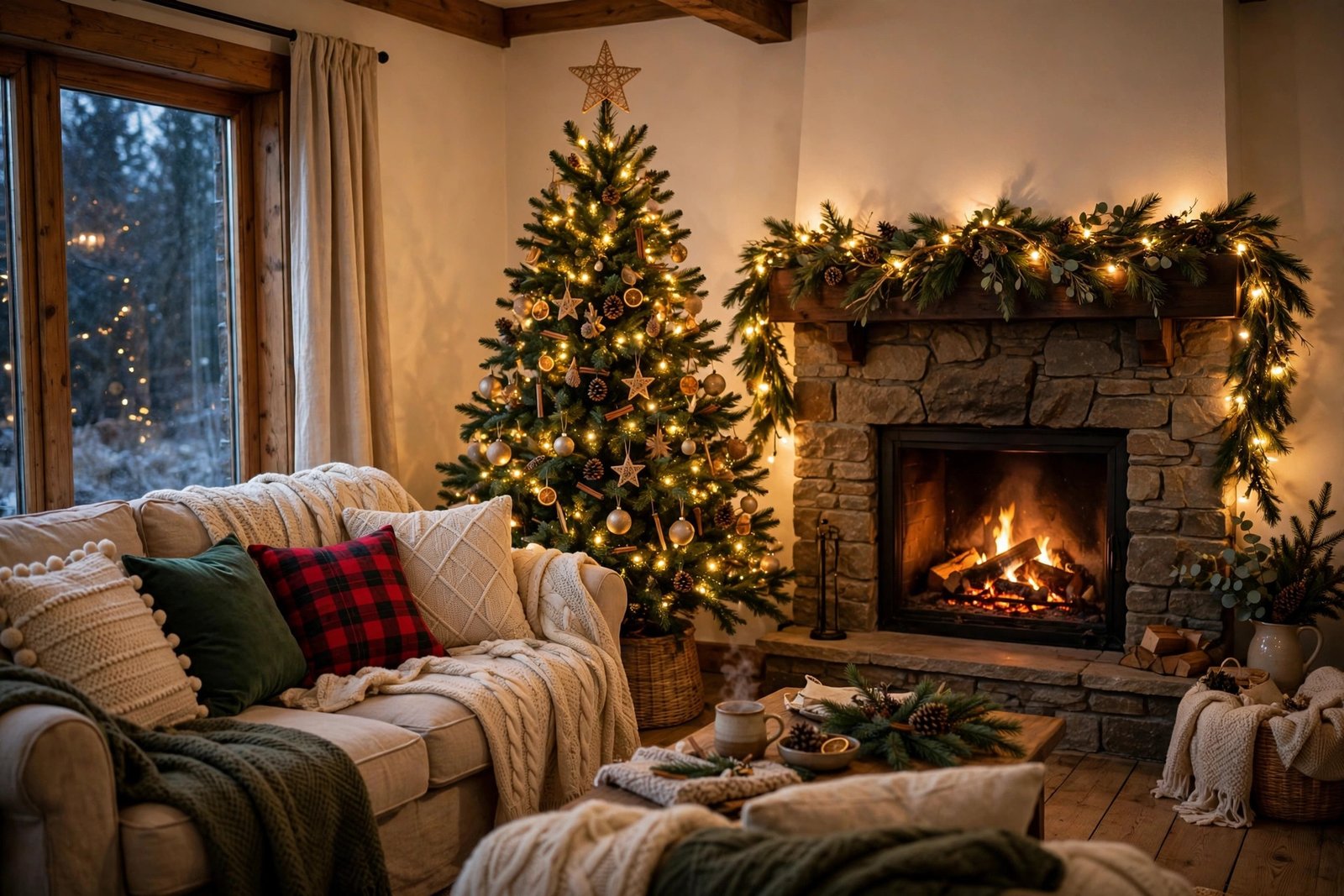
The living room is where Christmas lives, so it earns the most effort — spent in the right order. Lights first: roughly 100 lights per foot of tree, wound from the trunk outward to the tips, plus a lit garland on the mantel and a strand along a window or bookshelf if the room is large. Then greenery: the tree, the mantel garland, and one wreath or swag. Then ornaments, layered large to small and deep to tip. Then textiles: two festive cushion covers and a throw at least 50 by 60 inches, actually draped for use rather than folded neatly away.
Scale matters more than quantity. A seven-foot tree needs ceilings of at least eight feet and about three feet of clear floor around it; in a smaller room, a slim six-foot tree or a tabletop tree looks far better than a wide tree squeezed into a corner. Place the tree where it can be seen from the doorway — that first view is the one guests remember. For a broader refresh, these home decor ideas for the living room help balance the tree with everyday furniture.
The Mantel and Shelves
Dress the mantel with a garland that drapes, not one pulled taut: allow about one and a half times the mantel length, with a gentle dip in the centre. Add lights before ornaments, then three to five accents — dried oranges, pinecones, or small baubles — spaced unevenly so it looks gathered, not lined up. On shelves, swap one or two everyday objects per shelf for a festive one, rather than adding to already full shelves. A single candle, a small pine sprig, or a miniature house per shelf is enough.
Christmas Entryway Decor Ideas
The entryway is the first hello, and it only needs three things: a wreath on the door, warm light, and a scent of the season. A full, fresh-looking wreath — real pine if you can get it, good faux if you cannot — instantly signals Christmas before anyone steps inside. Inside, a console or bench gets a small arrangement: a tray with a candle, a pine sprig, and a couple of baubles, plus a string of fairy lights along a mirror frame or stair rail if the hallway allows it. Keep the floor clear for coats, bags, and shoes.
If your entry is small, skip the console display entirely and let the door wreath and one lit garland on the stair rail do the work. A festive-coloured doormat and a basket for winter accessories doubles as decor and practical storage. One often-missed detail: a cinnamon or pine reed diffuser in the hallway means the house smells like Christmas the moment the door opens.
Christmas Dining Room and Table Decor Ideas
Christmas tables fail in one specific way: centrepieces so tall or wide that guests cannot see or pass dishes to each other. Build low and long instead. A runner down the centre, a wooden board or tray as the base, three pillar candles in graduated heights, pine sprigs, and a few baubles or dried oranges — all below eye level, and all removable in one lift if the table needs more room for serving dishes. Each place setting needs just one festive touch: a napkin tied with twine and a rosemary sprig, or a simple handwritten name card.
For the room itself, a wreath on the wall or a lit garland along a sideboard is plenty; the table is the star here. Candlelight matters more than any centrepiece: dim the overhead lights, light the candles, and the whole room instantly feels like Christmas dinner.
Christmas Bedroom Decor Ideas
Bedrooms should feel like a quieter echo of the rest of the house, not a second living room. One hero piece per bedroom is the rule: a small tabletop tree on a dresser, a lit garland along the headboard, or a wreath above the bed. Then add one textile — a festive throw across the foot of the bed or a pair of seasonal cushion covers — and stop. Children’s rooms can take a little more: a small tree of their own and a stocking hung where they can see it.
Keep sleeping comfort first. Avoid scented candles burning near bedding, keep fairy lights away from pillows and curtains, and choose battery-operated lights with a timer so nothing stays on overnight. A bedroom that smells faintly of pine from a single sprig on the nightstand, glows softly from one strand of lights, and feels warm under a heavier throw is a Christmas bedroom done right.
Christmas Kitchen Decor Ideas
Kitchens go wrong at Christmas when decoration competes with cooking. Keep counters clear for work and put the festivity where it does not get in the way: a garland or fairy lights along the top of cabinets or a window frame, a small potted rosemary or pine on the windowsill, festive tea towels on the oven handle, and a tray on the island or table with candles and greenery. That is the whole kitchen plan.
Choose battery-operated lights for the kitchen, kept away from the hob and sink, and avoid real candles near tea towels or curtains. A simmering pot on the hob — orange peel, cinnamon, cloves, and rosemary in water — gives the kitchen its Christmas scent for the cost of ingredients you may already own. If you bake, display one thing: a plate of biscuits under a glass dome, or a simply iced cake on a stand.
Four Christmas Decor Styles to Choose From
1. Cosy Traditional
Red, green, and gold; a full tree with mixed ornaments collected over years; stockings on the mantel; plaid throws and candlelight. Traditional style is forgiving — mismatched ornaments look intentional here because the style is built on memory, not matching sets.
2. Modern Christmas
A limited palette (two colours plus metallics), a slim or sparse tree, geometric ornaments, and clean lines. Modern Christmas decor uses negative space deliberately: fewer ornaments, more light, and one striking piece — a sculptural star topper or an oversized wreath — instead of many small ones.
3. Farmhouse Christmas
Natural wood, burlap, plaid, galvanized metal, and dried oranges; a tree with wooden bead garlands and simple ornaments; a mantel dressed with pine, candles in lanterns, and a wooden-framed sign. Much of it can be DIY: dried orange slices, cinnamon stick bundles, and paper stars cost almost nothing and look entirely at home in this style.
4. Minimalist Christmas
One tree (or one branch in a vase), one wreath, white lights, and almost nothing else. Minimalist Christmas decor is about restraint as a choice, not a compromise: a single beautiful object, well placed, carries the whole season — and it is the cheapest and fastest Christmas look of all.
Christmas Decor on a Budget
A first Christmas of reusable basics — lights, garland, wreath, and textiles — runs roughly $150 to $250 for the whole house. Later years need only candles, ribbon, and dried fruit, usually under $50. Spend in this order: lights first (they make the biggest difference per dollar), then one good wreath, then textiles, then ornaments last. Buy lights and garlands in January sales for the following year, when prices drop by half or more.
DIY fills the gaps beautifully. Dried orange garlands cost a few dollars and look expensive on a tree or mantel. Paper stars and snowflakes, folded from kraft paper, suit farmhouse and Scandinavian homes alike. A stovetop scent pot costs nothing beyond pantry spices. And greenery is often free: ask a local tree lot for offcuts, or trim a few branches from your own garden — pine, fir, holly, and ivy all work.
Room-by-room budget guide for a first Christmas: living room $60–100 (lights, garland, textiles), entryway $25–40 (wreath, lights), dining room $20–35 (candles, runner, napkin touches), bedrooms $15–25 each, kitchen $10–20. Keep receipts for the reusable items and store them by room in labelled boxes — next year, you will only need to replace the consumables.
Christmas Decorating Mistakes to Avoid
Decorating every surface. A house where every shelf holds a festive object feels like a shop. Pick hero spots per room and leave the rest alone.
Ignoring scale. A wide tree in a small room, a towering centrepiece on a small table, or a huge wreath on a narrow door all fight their space. Measure first: tree width against floor space, centrepiece height against sightlines, wreath diameter against door width.
Mixing too many palettes. Red and gold in the living room, silver and blue in the dining room, and rainbow in the hallway makes the house feel unsettled. One palette, carried lightly into every room, is what makes a home feel professionally decorated.
Forgetting safety. Keep candles twelve inches from greenery and curtains, never leave them burning unattended, and switch fairy lights off at night. Keep fresh greenery away from radiators and open fires, and mist it lightly so it does not dry out.
Leaving undecorating until January chaos. Label storage boxes by room as you pack away, and note what needs replacing next year on the box lid.
Frequently Asked Questions
What are the best Christmas home decor ideas for a small home?
Choose one hero piece per room — a tabletop tree, a dressed mantel, or a lit windowsill — and keep everything else to warm light and one textile. Small homes feel festive quickly because warmth and light carry through the whole space.
How do I decorate my living room for Christmas on a budget?
Start with lights (about 100 per foot of tree), then a garland on the mantel, then two festive cushion covers and a throw. Add DIY touches like dried orange garlands and paper stars. A living room can feel fully Christmassy for $60–100 with reusable basics.
What colour scheme should I choose for Christmas decor?
Traditional red, green, and gold suits classic homes; woodland neutrals (pine green, cream, wood, copper) suit modern and farmhouse homes; Scandinavian white and pale wood suits small or bright homes. Pick one palette and carry it lightly into every room for a cohesive look.
When should I start decorating for Christmas?
Most households start in late November or the first weekend of December, working room by room — living room and entry first, bedrooms and kitchen last. Decorating in stages keeps it enjoyable.
How can I make my home smell like Christmas without candles?
Simmer orange peel, cinnamon, cloves, and rosemary in water on the hob; place a pine sprig on a nightstand or windowsill; or use a cinnamon or pine reed diffuser in the hallway. All three give a lasting Christmas scent with no open flame.
What is the cheapest way to decorate for Christmas?
Lead with light and DIY: fairy lights, dried orange garlands, paper stars, and a stovetop scent cost very little. Buy reusable basics first — lights, garland, wreath — and add ornaments gradually over several years instead of buying everything at once.
Bringing It All Together
Christmas home decor ideas work room by room: a tree and mantel in the living room, a wreath and warm light in the entryway, a low table guests can talk across, one cosy layer in each bedroom, and festivity without clutter in the kitchen. Keep one palette, lead with warm light and greenery, choose the style that fits your home, and let simple DIY touches make the house personal.
Start with the living room this weekend, then move through the checklist one room at a time. Decorate in stages, enjoy each finished room before moving on, and you will have a home that feels like Christmas in every room — without the overwhelm and without overspending.
5 thoughts on “Christmas Home Decor Ideas for a Warm, Festive Home”