
How to Get Rid of Termites Yourself: A Homeowner’s DIY Guide
Finding out termites are eating your home is every homeowner’s nightmare — but knowing how to get rid of termites yourself can save you thousands and put you back in control. The good news: many termite problems, especially early ones, respond well to DIY treatment when you pick the right method and apply it correctly.
This guide covers how to confirm you actually have termites, the three DIY treatments that genuinely work — bait stations, liquid barriers, and borate wood treatments — and an honest look at when calling a professional is the smarter move. No scare tactics — just a practical playbook.
Key Takeaways
- Confirm termites first: mud tubes, hollow-sounding wood, and discarded wings are the classic signs — not every wood problem is termites.
- The three proven DIY methods are in-ground bait stations, non-repellent liquid barriers, and borate treatments for exposed timber.
- Bait stations take weeks to months but eliminate the whole colony; liquid barriers work faster but demand precise, label-faithful application.
- Moisture control — fixing leaks, improving drainage, and removing wood-to-soil contact — is half the battle and prevents reinfestation.
- Call a professional for widespread structural damage, large active colonies, or termites in multiple areas of the home.
First, Make Sure They’re Actually Termites
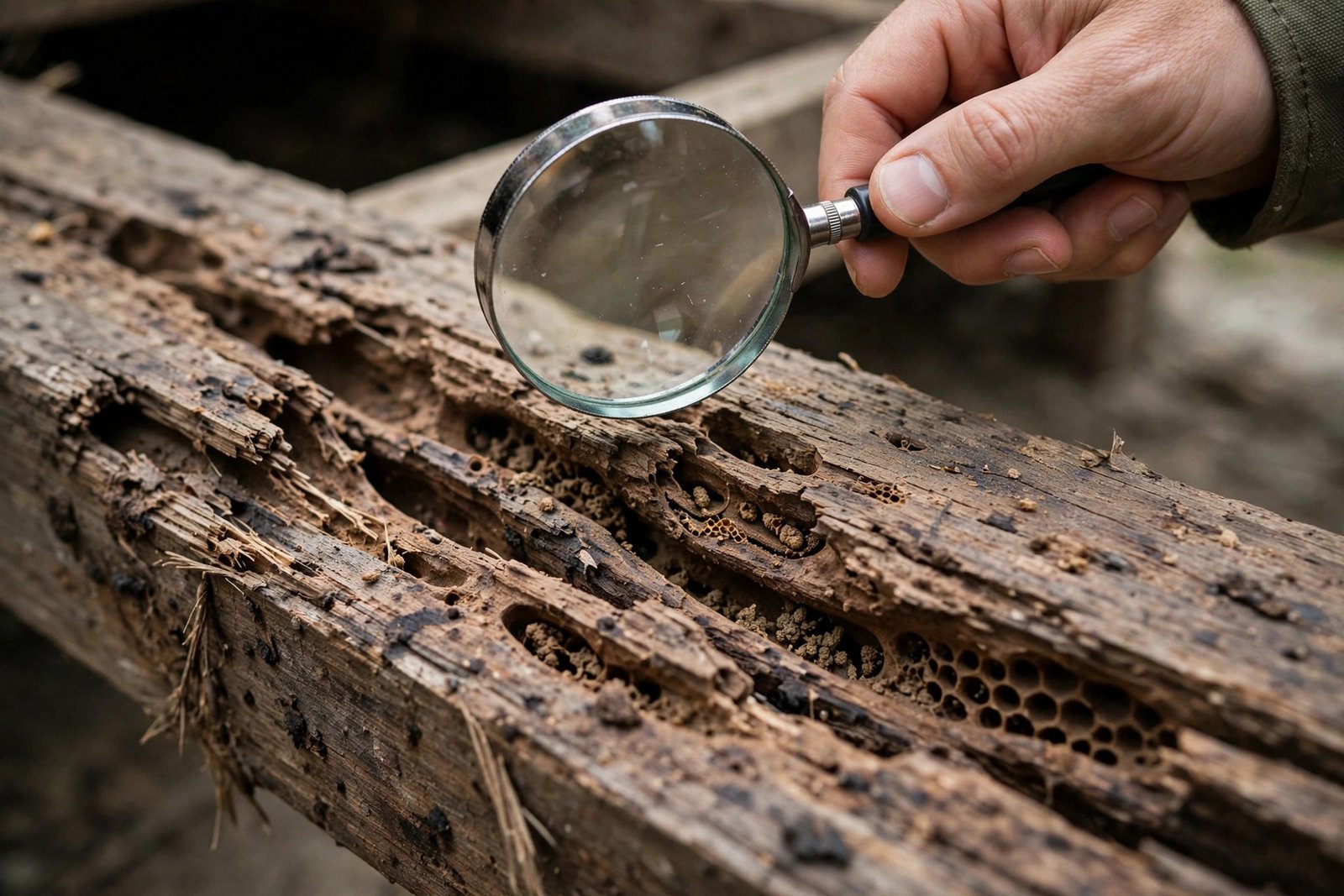
Before spending money on treatment, confirm the diagnosis. Many homeowners find wood damage and panic — when the culprit might be carpenter ants, which excavate wood rather than eat it, or simply moisture rot. Treating for the wrong pest wastes money and lets the real problem spread.
Mud Tubes and Hollow Wood
Subterranean termites build pencil-width mud tunnels from the soil up to your home’s woodwork. Check the foundation, crawl-space piers, and where pipes enter the house. Break one open — if it’s rebuilt within a day or two, termites are active. Also tap suspicious baseboards and door frames: termite-eaten wood sounds papery and hollow, and paint may bubble over hollowed areas. Termites eat wood from the inside out, so surfaces can look almost normal while the interior is gone.
Swarmers and Frass
After rains or in spring, colonies release winged “swarmers.” Dozens of tiny dead insects — or piles of translucent wings — on windowsills signal an established colony nearby. Don’t confuse them with flying ants: termites have straight antennae, a broad waist, and four equal-length wings. Drywood termites, meanwhile, leave tiny ridged pellets (frass) piled like miniature sawdust under kick-out holes — a sign you’ll need a different treatment approach, covered below.
What DIY Termite Control Can Realistically Achieve
Be honest with yourself about the scale of the job. DIY termite control is absolutely viable in three common situations: early infestations caught before major damage, localized drywood spots in accessible furniture or trim, and — most commonly — as a long-term protection system around your home’s perimeter. A full-scale infestation inside load-bearing walls or under a slab is genuinely hard to reach with consumer products, and structural repairs are never DIY.
DIY Termite Treatments That Actually Work
1. In-Ground Bait Stations
Bait stations are the most beginner-friendly DIY option. Each station holds a cellulose bait laced with a slow-acting growth regulator. Foraging termites feed on the bait and share it with the colony until the queen dies and the colony collapses. The trade-off is patience: discovery and colony death can take several weeks to several months. Check stations every 4–6 weeks and don’t disturb active ones. Baiting is also the safest option around pets and gardens.
2. Non-Repellent Liquid Barriers
Application means digging a shallow trench (about 6 inches wide and deep) along the foundation, pouring the label-diluted solution in, and backfilling. Results often show within weeks — but this method is unforgiving of shortcuts. Gaps in the trench, wrong dilution, or skipped areas like patios leave highways open. Wear gloves and eye protection, and keep runoff out of ponds and storm drains.
3. Borate Wood Treatments
Borate products are sprayed or foamed onto bare, unfinished wood — attic rafters, crawl-space joists, exposed studs, deck framing. They penetrate the surface and make wood indigestible and toxic to termites, while also fighting wood-decay fungi. Borates are low-toxicity to mammals and excellent preventive protection when framing is exposed during renovations. The limitation: painted, stained, or sealed wood won’t absorb the treatment.
Drywood Termites: Direct, Localized Treatment
Drywood termites live entirely inside wood, so perimeter treatments and bait stations won’t touch them. For a small, accessible infestation — a furniture piece, a windowsill, one trim section — drill tiny holes into the galleries and inject drywood termite foam or borate solution, or simply remove and replace the affected piece. But frass piles in multiple rooms mean it’s a professional job: whole-structure fumigation is one of the few treatments that reliably reaches every gallery, and it is never DIY.
Your Step-by-Step DIY Action Plan
- Step 1 — Inspect and map. Walk the full perimeter, check mud tubes, tap wood, and photograph everything. Treatment works best when you know exactly where they’re coming in.
- Step 2 — Fix moisture and wood-to-soil contact. Repair leaks, extend downspouts, regrade soil away from the foundation, and remove firewood piles and mulch touching the siding. Do this before or alongside treatment.
- Step 3 — Choose your method. Bait stations for the patient, low-risk route; a liquid barrier for faster knockdown; borates for exposed wood; direct injection for a small drywood spot.
- Step 4 — Apply exactly per the label. Dilution, trench depth, station spacing, and retreatment intervals come from the product label, not from memory. Read it twice.
- Step 5 — Monitor for 6–12 months. Check stations monthly, re-inspect mud tubes, and watch for new swarmers. Termite control is a campaign, not a single battle.
Pro Tips That Separate Success From Failure
Break suspicious tubes and check back in 48 hours. Rebuilt tubes mean active termites; abandoned ones may be from a dead colony.
If you break open wood and see live termites, close it back up. Panicked termites seal off damaged tunnels, making bait and liquid uptake worse.
Soil and mulch should stay at least 6 inches below siding and framing. The gap exposes mud tubes so you can spot them early.
Bait stations outside plus a liquid barrier at the foundation attack the colony from two directions — a combination pros use for stubborn infestations.
Spot-treating one wall pushes termites to the next unprotected wall. An incomplete liquid barrier is barely better than none at all.
A dated photo log of tubes and stations shows whether activity is shrinking — and it’s gold if you later call a professional.
Mistakes That Make DIY Termite Control Fail
Using repellent sprays on termites. “Kills on contact” hardware-store sprays scatter termites into new areas instead of killing the colony. For termites, repellent insecticides are actively counterproductive.
Treating the symptom, not the colony. Killing swarmers on your windowsill feels satisfying but does nothing to the colony underground or in your walls. Always target the colony itself.
Skipping the trench under patios and driveways. Termites travel under concrete slabs. A barrier that stops at the porch edge leaves the front door open — these areas need rods or drilled injection points, or a professional.
Ignoring moisture. Damp soil against the foundation, leaking pipes, and poor drainage make a home a termite magnet. Fix water first, treat second.
When DIY Is Not Enough: Call a Pro
Knowing how to get rid of termites yourself also means knowing where DIY stops. Call a licensed termite professional if you find soft, crumbling structural wood or sagging floors; swarmers keep appearing after months of treatment; frass or mud tubes show up in multiple rooms; or termites are active under a slab. Get at least two written quotes, ask whether they offer both bait and liquid options, and look for a warranty with a retreatment clause. And your DIY effort still pays off — a photo log and fixed moisture problems mean a faster, cheaper professional treatment.
Keep Them From Coming Back
Elimination without prevention is a rental, not a cure. Keep gutters clean and downspouts extended at least 4 feet from the foundation; fix plumbing leaks quickly; never store firewood, cardboard, or scrap lumber against the house; keep mulch well below the siding; and inspect every spring — a 20-minute flashlight walk-around catches nearly every early infestation. The same vigilance pays off indoors too: our guide to getting rid of ants in the kitchen and the walkthrough for getting rid of cockroaches permanently use the same inspect-treat-prevent framework.
Frequently Asked Questions
How long does it take to get rid of termites yourself?
Bait stations typically take 2–6 months to eliminate a colony. Non-repellent liquid barriers work faster — often 3–8 weeks — but only if the barrier is continuous. Keep monitoring for a full year before declaring victory.
What is the fastest DIY termite killer?
A correctly applied non-repellent liquid barrier gives the fastest DIY knockdown for subterranean termites. Avoid repellent contact sprays — they scatter termites instead of killing the colony.
Can I get rid of termites without tenting my house?
Yes, for subterranean termites — bait stations and liquid barriers routinely eliminate colonies without fumigation. For widespread drywood infestations, whole-structure fumigation is usually the only reliable option and requires professionals.
Are DIY termite treatments safe for pets and kids?
Bait stations are the safest option — the toxicant stays locked inside underground stations. With liquid termiticides, keep children and pets away from treated soil until it dries, and always follow the label exactly.
How do I know the termites are actually gone?
Watch for three all-clear signals over 6–12 months: broken mud tubes are never rebuilt, previously hollow wood sounds solid again, and no new swarmers or frass appear. Empty, undisturbed bait stations confirm no foraging activity.
Start Your Termite-Free Home Today
You now know how to get rid of termites yourself — from spotting the signs, to choosing between bait stations, liquid barriers, and borate treatments, to knowing exactly when to call a professional. The most important step is the first one: grab a flashlight and inspect your foundation this weekend. Early detection turns a weekend project into a success story instead of a repair bill.
Keep learning: our walkthrough of getting rid of carpenter ants helps you rule out the most common termite look-alike, and the guide to getting rid of cockroaches permanently rounds out your home pest-defense playbook.