
How Long Does It Take to Build a House? A Realistic Timeline Guide
If you are planning a custom build or even a production home, the first question on your mind is probably: how long does it take to build a house? The honest answer is that a typical single-family home takes about seven to twelve months from breaking ground to move-in day, and that number swings based on the home’s size, the complexity of the design, your local permitting process, and — most often — the weather and the availability of skilled labor.
This guide walks you through the full home-construction timeline phase by phase, so you know how long each stage usually takes, what tends to cause delays, and the practical steps you can take to keep your build on schedule. Understanding the timeline before you sign a contract is the single best way to protect your budget and your sanity.
Key Takeaways
- A typical new home build takes 7 to 12 months from groundbreaking to move-in, plus 1 to 3 months for permits and design before that.
- Framing and interior finishing are the longest construction phases — together they can take 4 to 5 months.
- The most common delays are weather, material shortages, permit bottlenecks, and change orders mid-build.
- Locking your design and finishes early is the single biggest thing you can do to keep the schedule.
- Build a 10 to 15 percent time buffer into your moving and rental plans so a delay never becomes an emergency.
The Short Answer: 7 to 12 Months on Average
National construction data consistently lands in the same range: the average new single-family home takes roughly 7 to 12 months once ground is broken. Smaller, simpler production homes can finish in five or six months, while large custom homes with complex rooflines or basements frequently take 12 to 18 months.
That range does not include the pre-construction period. Design work, engineering, and permit approvals typically add one to three months before a shovel ever hits the dirt. If you are just starting to plan, read our guide to the stages of building a house step by step to see how the whole process fits together from first sketch to final walkthrough.
The Pre-Construction Phase: 1 to 3 Months
Before construction begins, you will spend time finalizing plans, getting bids, and securing permits. Many first-time builders underestimate this phase, but rushing it is how mistakes get baked into the build.
- Design and plan finalization (2 to 6 weeks): Working with an architect or designer to lock the floor plan, elevations, and structural details. If you are buying a builder’s existing plan, this is much faster.
- Bidding and contract (1 to 3 weeks): Getting quotes from general contractors or builders, checking references, and negotiating the contract.
- Permits and approvals (2 to 8 weeks): The wild card. Simple jurisdictions approve plans in a couple of weeks; complex ones with HOA review, zoning variances, or environmental checks can take two months or more.
The smartest time-saving move in this phase is to make your finish selections — flooring, cabinets, fixtures, colors — before construction starts rather than during it.
The Home Building Timeline, Phase by Phase
Here is how the construction itself typically breaks down for a standard single-family home. Timelines overlap in practice, but these are the durations each phase usually consumes.
Site Preparation and Foundation: 3 to 6 Weeks
Clearing the lot, excavating, pouring footings, and setting the foundation slab or basement walls take roughly three to six weeks. This phase is the most weather-sensitive of the entire build — heavy rain or frozen ground can stop excavation cold.
Framing: 4 to 8 Weeks
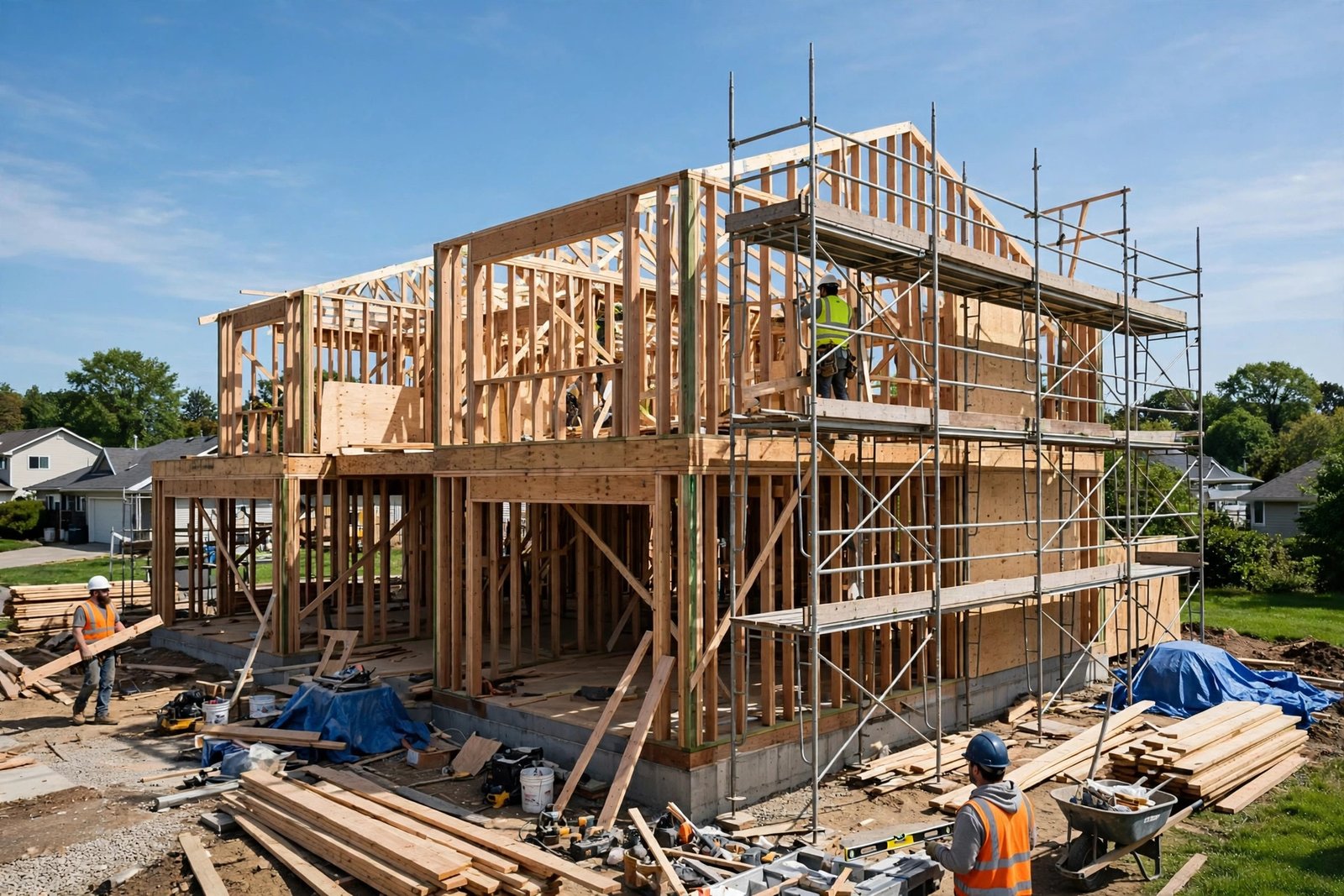
Framing is when your house suddenly looks like a house: floor joists, wall studs, roof trusses, and sheathing go up. For an average-size home this takes one to two months, and most builders schedule a mid-frame inspection here.
Roofing, Siding, and Exterior: 3 to 5 Weeks
Once the shell is framed, roofers install the roof while siding, windows, and exterior doors get set. Getting the house “dried in” — weatherproof on the outside — is a major milestone, because interior work can then proceed regardless of rain.
Plumbing, Electrical, and HVAC Rough-In: 3 to 5 Weeks
With the shell weatherproof, the mechanical trades run wiring, pipes, ductwork, and gas lines through the open walls, ending with a rough-in inspection. Rough-in delays are common when a trade is booked out, so confirm your builder’s trade schedule early.
Insulation and Drywall: 3 to 4 Weeks
Insulation goes in, then drywall hangs, gets taped, mudded, sanded, and primed. The mudding and sanding cycles need drying time between coats, and rushing them shows up as visible seams later.
Interior Finishing: 2 to 3 Months
This is the longest single phase of the build. Flooring, cabinets, countertops, tile, interior doors, trim, and painting all happen here, followed by final electrical and plumbing trim-out. Keep selections locked and this phase flows; keep changing them and it drags.
Exterior Finishing and Landscaping: 2 to 4 Weeks
Driveways, walkways, final grading, sod or seed, and exterior paint touch-ups finish the outside while final inspections run inside. Basic grading and drainage should be complete before closing.
Final Inspection, Walkthrough, and Closing: 1 to 3 Weeks
The building department conducts its final inspection and issues a certificate of occupancy. Then you do a detailed walkthrough with your builder and note any punch-list items — paint touch-ups, misaligned doors, caulking gaps — and schedule their fixes.
What Causes Construction Delays (and How to Avoid Them)
Almost every delayed build traces back to a handful of culprits. Knowing them in advance lets you negotiate contract protections and plan around them.
Weather
Rain, snow, and extreme heat affect nearly every exterior phase. You cannot control the weather, but you can build a weather buffer into the contract timeline and avoid starting excavation at the worst season for your region.
Permit and Inspection Bottlenecks
Municipal review queues, re-inspections, and zoning disputes can each add weeks. Ask your builder how long permits typically take in your specific jurisdiction — and confirm who is responsible for pulling them.
Material Shortages and Lead Times
Special-order items like custom windows, imported tile, or specialty lumber can have lead times of 8 to 16 weeks. Order long-lead items during pre-construction, not when the phase starts. This is the most preventable delay in home building and also one of the most common.
Labor Shortages
Skilled trades are in short supply in many markets. A builder juggling too many projects can leave your site idle for days between trades. Ask your builder how many active jobs they run and how crews are scheduled — a clear sequencing plan is a good sign.
Change Orders
Changing finishes, layouts, or materials mid-build is the number-one homeowner-caused delay: new materials must be ordered, trades rescheduled, and inspections repeated. Treat your finish selections as locked once framing begins. To set a realistic selection budget before you choose, check our breakdown of the cost to build a house per square foot.
How to Keep Your Build on Schedule: 4 Pro Tips
Plans, permits, and every finish selection should be locked before day one. Decisions made during construction cost you both time and money.
A weekly walkthrough keeps momentum visible and catches small issues before they become schedule-eating rework. Photograph progress each visit.
Negotiate written completion targets for major phases — dried-in, rough-in passed, finishes started — with remedies if they slip without cause.
Do not schedule movers or end your lease for the exact contract date. A month of buffer turns a delay into an inconvenience instead of a crisis.
Timeline by Home Type: A Quick Comparison
- Production / spec home (5 to 8 months): The builder uses a proven plan, pre-ordered materials, and a tight trade sequence. Fastest option, least customization.
- Semi-custom home (8 to 12 months): A builder’s plan with your finish and layout choices. The most common suburban scenario.
- Fully custom home (12 to 18+ months): Architect-designed with unique details. Design and permitting alone can take 4 to 6 months.
- Owner-builder (12 to 24+ months): You act as the general contractor. Lower cost, but scheduling trades yourself adds significant time.
- Prefab or modular (3 to 6 months on-site): Modules are built in a factory while site work happens in parallel, usually adding 2 to 3 months of factory time.
Frequently Asked Questions
How long does it take to build a 2,000 square foot house?
A 2,000 sq ft home typically takes 7 to 10 months from groundbreaking to move-in with a production or semi-custom builder. Custom designs at that size usually run 10 to 14 months because of longer design and finish phases.
What is the slowest phase of building a house?
Interior finishing is usually the slowest phase, taking 2 to 3 months. It has the most trades working in sequence — flooring, cabinets, tile, trim, paint — and it is where change orders cause the biggest delays.
Can a house be built in 6 months?
Yes, if it is a straightforward production-home design with standard finishes, good weather, and a builder running an efficient trade schedule. Custom homes with unique details or long-lead materials almost never finish that quickly.
Does building a house take longer in winter?
Often, yes. Cold, rain, and short daylight hours slow excavation, concrete curing, framing, and roofing. In freezing climates, foundation work may pause entirely until the ground thaws.
How much does a one-month construction delay cost?
For most homeowners, a month of delay costs one month of construction-loan interest, extended rent or temporary housing, and storage — commonly several thousand dollars.
Should I sell my current home before the new build is finished?
Most experts recommend waiting until your new home has its certificate of occupancy or is very close to it. Selling early can leave you renting under pressure if the build slips — keep a housing buffer of at least a month past the contract date.
Your Timeline Starts Before the First Shovel
The homeowners who finish on time are rarely the lucky ones — they are the prepared ones. They locked their design early, ordered long-lead materials ahead, and planned their move with a buffer. Do the same and the question “how long does it take to build a house” becomes a plan instead of a worry.
Once you know your timeline, the next step is planning your money around it: our guide to the cost to build a house per square foot helps you budget each phase. And when move-in day finally arrives, our home maintenance checklist will keep your brand-new home in perfect shape from the very first month.