
Handmade Christmas Decorations DIY: Easy Festive Crafts
The decorations people remember are rarely the ones bought in a box. They are the slightly wonky salt-dough star from a childhood Christmas, the orange slice garland that perfumed the whole house, or the paper snowflake a child cut with enormous concentration. Handmade Christmas decorations carry stories in a way shop-bought ones never can, and making them is half the pleasure — an excuse to slow down, gather around a table, and create something together in the busiest weeks of the year.
Handmade does not have to mean complicated, expensive or messy beyond reason. The best DIY Christmas decorations use simple materials — paper, dried fruit, salt dough, pinecones, fabric scraps — and techniques anyone can manage, including children. This guide collects the most rewarding projects, from quick evening crafts to weekend makes, with honest notes on time, cost and durability, so you can choose projects that suit your household and actually enjoy making them.
Key Takeaways
- Start with simple materials — paper, salt dough, dried oranges and pinecones — before buying specialist supplies.
- Choose one or two projects per weekend in November, not a frantic crafting marathon in December.
- Make decorations in batches: garlands, ornaments and gift tags are faster and more fun in quantity.
- Let children own their projects — imperfect handmade pieces are the ones that become keepsakes.
- Seal and store handmade decorations properly so they last for many Christmases.
- Use handmade pieces as focal points, mixed with plain shop-bought basics, for a balanced look.
Dried Orange Garlands and Ornaments
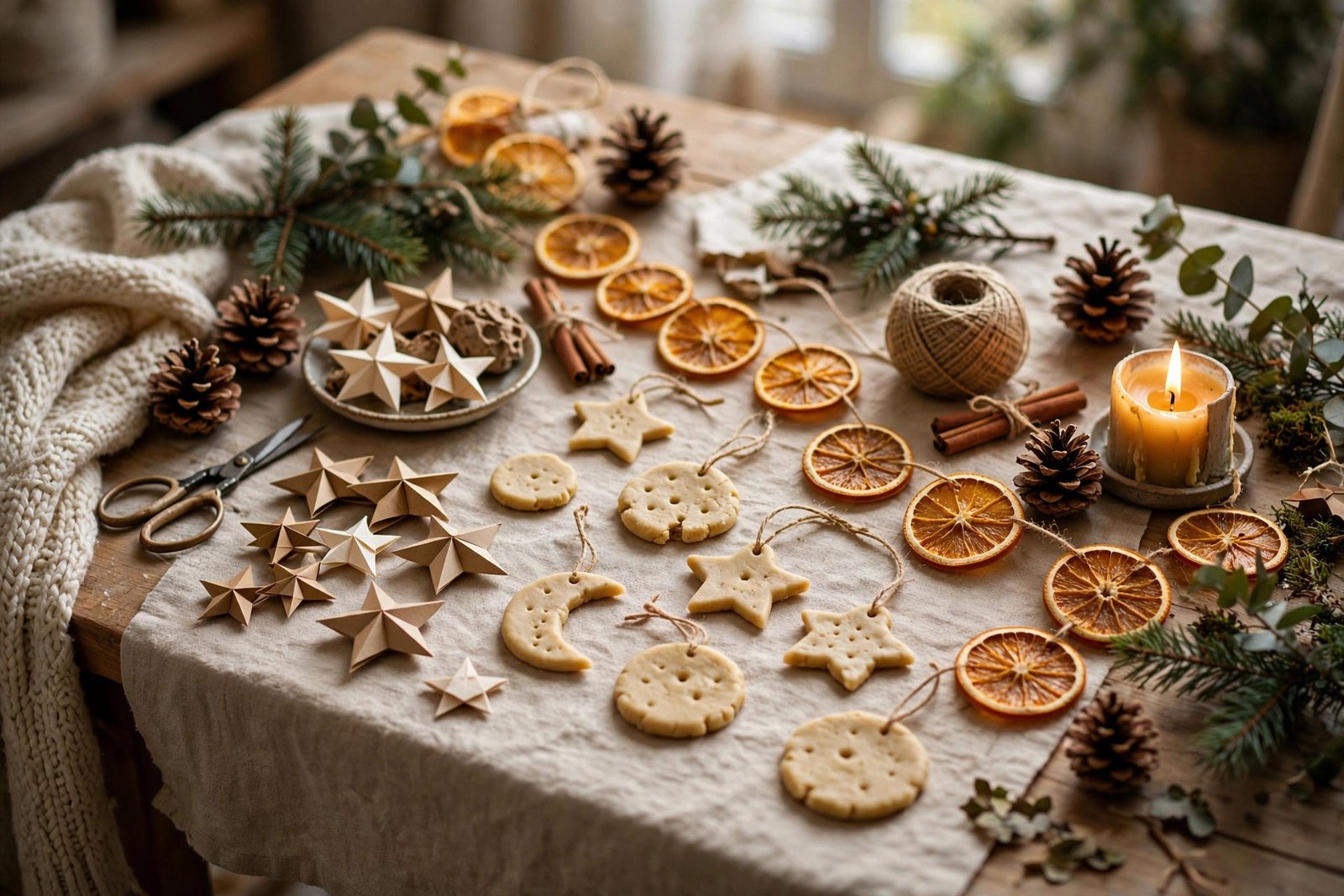
Dried orange slices are the easiest handmade decoration with the biggest payoff. Slice oranges thinly, about 5 millimetres thick, pat them dry, and bake them on a low oven (around 100°C) for two to three hours, turning halfway, until they are dry and slightly translucent. They smell wonderful while baking, look beautiful against both green trees and white walls, and last for years if stored dry. Thread them onto string with cinnamon sticks, star anise and small pinecones for a garland, or hang single slices from the tree with ribbon.
The same technique works for lemons, limes and apples, and a mixed citrus garland in golds and pale greens looks particularly elegant on a mantel or along a staircase. For a more polished finish, press the slices flat under a heavy book for a day before hanging, and seal finished pieces with a light coat of clear varnish if they will be handled often. Dried fruit decorations are also wonderfully sustainable — no plastic, no glitter, fully compostable at the end of their life — which makes them a good choice if you are trying to reduce festive waste. Pair them with natural greenery for a scheme like our rustic Christmas home decor ideas.
Salt Dough Ornaments the Whole Family Can Make
Salt dough is flour, salt and water in a 2:1:1 ratio, mixed into a firm dough, rolled out, cut with cookie cutters, and baked on low until hard. It is the classic family Christmas craft for a reason: it costs almost nothing, children can do every step, and the finished ornaments — stars, trees, hearts, gingerbread people — can be painted, glittered or left natural. Use a straw to poke a hanging hole before baking, and bake slowly to avoid puffing or cracking.
For a more grown-up finish, keep the shapes simple and the painting restrained: white or cream paint with gold details, or a single colour per ornament, looks far more elegant than every colour at once. Adults can also try more refined salt dough projects, such as embossed ornaments pressed with lace or leaves, or small gift tags stamped with initials. Seal finished pieces with clear varnish on both sides to protect them from moisture, and store them wrapped in tissue. With care, salt dough ornaments easily last a decade, and they become more precious each year as children grow. If you love the homemade look throughout the house, our DIY home decor ideas for Christmas have more projects to try.
Paper Stars, Snowflakes and Garlands
Paper is the most versatile DIY material, and paper stars are the standout project. A five-pointed paper star, folded from strips or cut from a template, looks stunning hung in a window, clustered on the tree, or strung as a garland across a mantel. Use sturdy paper — kraft paper for a rustic look, white or cream for elegance, or old maps and book pages for character — and make stars in several sizes for the best effect. A single large paper star as a tree topper, made from folded paper bags or card, is a beautiful alternative to a bought topper.
Paper snowflakes, cut from folded squares, are a perfect children’s project and look wonderful taped to windows or hung from the ceiling on invisible thread. For adults, paper garlands — chains of stars, trees or simple folded fans — fill a mantel or doorway quickly and cheaply. The key with paper is consistency: use one or two paper types and one colour family, and the result looks designed rather than random. Keep paper decorations away from open flames and damp, and store them flat between sheets of tissue so they can be reused next year.
Pinecones, Greenery and Natural Decorations
Nature provides some of the best Christmas materials for free. Pinecones, gathered on a walk and cleaned and dried in a low oven, can be left natural, painted white at the tips for a snowy effect, or dipped in gold paint for glamour. Use them as tree ornaments, bowl fillers, place-card holders (with a slit cut in the top), or tied to gifts instead of a bow. A bowl of pinecones, dried oranges and cinnamon sticks on a coffee table is a centrepiece that costs almost nothing and smells like Christmas.
Fresh greenery — pine, fir, eucalyptus, holly and ivy — makes wreaths, garlands and table runners that no artificial version can match. A simple wreath base of twisted willow or wire, covered with bunches of greenery tied on with florist wire, takes under an hour and looks professional if you keep the greenery full and the shape round. Add dried oranges, pinecones and a ribbon bow, and you have a wreath worth far more than its materials. Keep fresh greenery away from radiators and direct heat, mist it lightly every few days, and it will last well through Christmas. For table ideas to pair with natural decor, see our Christmas table setting ideas.
Fabric, Felt and Sewn Decorations
If you can sew a straight line — by hand or machine — felt is your friend. Felt does not fray, so shapes can be cut and stitched simply, without hemming. Felt stars, hearts, trees and stockings, stuffed lightly and hung with ribbon, are charming on the tree and make lovely gifts. Fabric scraps can also become bunting, tree skirts, or simple drawstring gift bags that replace wrapping paper year after year.
For non-sewers, fabric can still be used: wrap small boxes in festive fabric instead of paper, tie fabric strips onto a wreath or garland for a rag-bow effect, or use a beautiful tea towel or scarf as a table runner. The handmade look here comes from texture and imperfection — slightly uneven stitching, mixed fabrics, a visible hand — which is exactly what makes these pieces feel warm and personal. Keep a box of fabric scraps, ribbons and buttons through the year, and by November you will have a free craft stash ready to go. For a softer festive base, our cosy Christmas home decor ideas complement handmade pieces perfectly.
Tips for Happy, Stress-Free Crafting
Crafting in November is relaxing; crafting on 23 December is stressful. Spread projects out.
Make ten ornaments at once, not one. Batching is faster and the set looks intentional.
An old shower curtain or newspaper layer saves the table and makes clean-up painless.
Varnish salt dough, seal dried fruit, and store paper flat — sealing is what makes crafts last.
Do not correct children’s decorations. Their versions are the keepsakes you will treasure.
Handmade focal pieces plus plain bought basics look balanced; all-handmade can look chaotic.
Finally, remember that the point of handmade decorations is not perfection. A slightly crooked star, a salt dough ornament with a fingerprint in it, a garland that is not quite symmetrical — these are not flaws, they are the reason handmade decorations matter. They show that someone took time, in a busy season, to make something with their hands for the people they love. That is the oldest Christmas tradition of all, and it never goes out of style.
Frequently Asked Questions
What are the easiest handmade Christmas decorations for beginners?
Dried orange garlands, paper stars and snowflakes, and pinecone ornaments. All use cheap materials, need no special skills, and look beautiful with minimal effort.
How long do dried orange decorations last?
Years, if stored dry in an airtight box with tissue between layers. Keep them away from damp, and they will look and smell good for many Christmases.
Are salt dough ornaments safe for children to make?
Yes — the dough is just flour, salt and water. Supervise baking, as ovens are hot, and remind children that salt dough ornaments are decorations, not food, because of the high salt content.
How do I stop handmade paper decorations getting damaged?
Store them flat between tissue paper in a rigid box, keep them away from damp and direct heat, and avoid hanging paper near candles or fireplaces.
Can handmade decorations look elegant, not childish?
Absolutely. Keep shapes simple, limit the colour palette to one or two colours plus neutrals, and mix handmade focal pieces with plain, good-quality bought basics.
Make Something This Christmas
You do not need to be artistic, and you do not need to make everything. Choose one project from this guide — dried oranges, salt dough, paper stars, or a simple wreath — and make it this weekend. Put on some music, clear the table, and enjoy the slow, satisfying work of making something by hand.
Years from now, when the shop-bought decorations have been replaced, that handmade piece will still be there, a little worn and a lot loved, telling the story of a Christmas you made yourself.