
There is nothing quite like a creaky floorboard for ruining a quiet house. Every step announces itself, the kids wake up when you go to the bathroom at night, and guests look at the floor like something is wrong with it. The good news is that learning how to fix creaky floorboards is usually a simple job. Most creaks have one cause — a board moving slightly against a joist or against the board next to it — and most fixes take less than half an hour and cost almost nothing.
- Find the exact board and the exact spot before you fix anything — walk the floor slowly and mark each creak.
- Most creaks are a loose board moving against a joist; a screw fixes most of them.
- Powdered graphite or talc works for small gaps between boards.
- Never use nails to fix a creak — they work loose again. Screws hold.
- If the floor bounces or sags, that is a structural problem, not a creak — get a professional.
Find the Creak Before You Fix It
The first step is finding the exact spot. Walk the floor slowly, shifting your weight from heel to toe, and listen. When you find a creak, stand on it and rock gently — the board that moves is the one making the noise. Mark it with a piece of masking tape. Do the whole room this way, because there is often more than one creaky board and you will want to fix them all in one go.
Then work out what is causing it. The most common cause is a board that has come loose from the joist underneath — the nail has worked its way up over years of footsteps, and now the board lifts slightly and drops back down with every step. The second most common cause is two boards rubbing against each other where they meet. The third is a board that has shrunk slightly as it dried out, leaving a small gap. Each cause has a different fix, so it is worth spending five minutes diagnosing before you pick up a tool. If the whole floor feels bouncy or sagging, stop — that can mean a damaged joist, and that is a job for a professional, not a DIY fix. For other small home repairs, our how to fix a stripped screw hole in wood guide covers the repair you will need if a screw ever pulls loose.
The Screw Fix: For Loose Boards
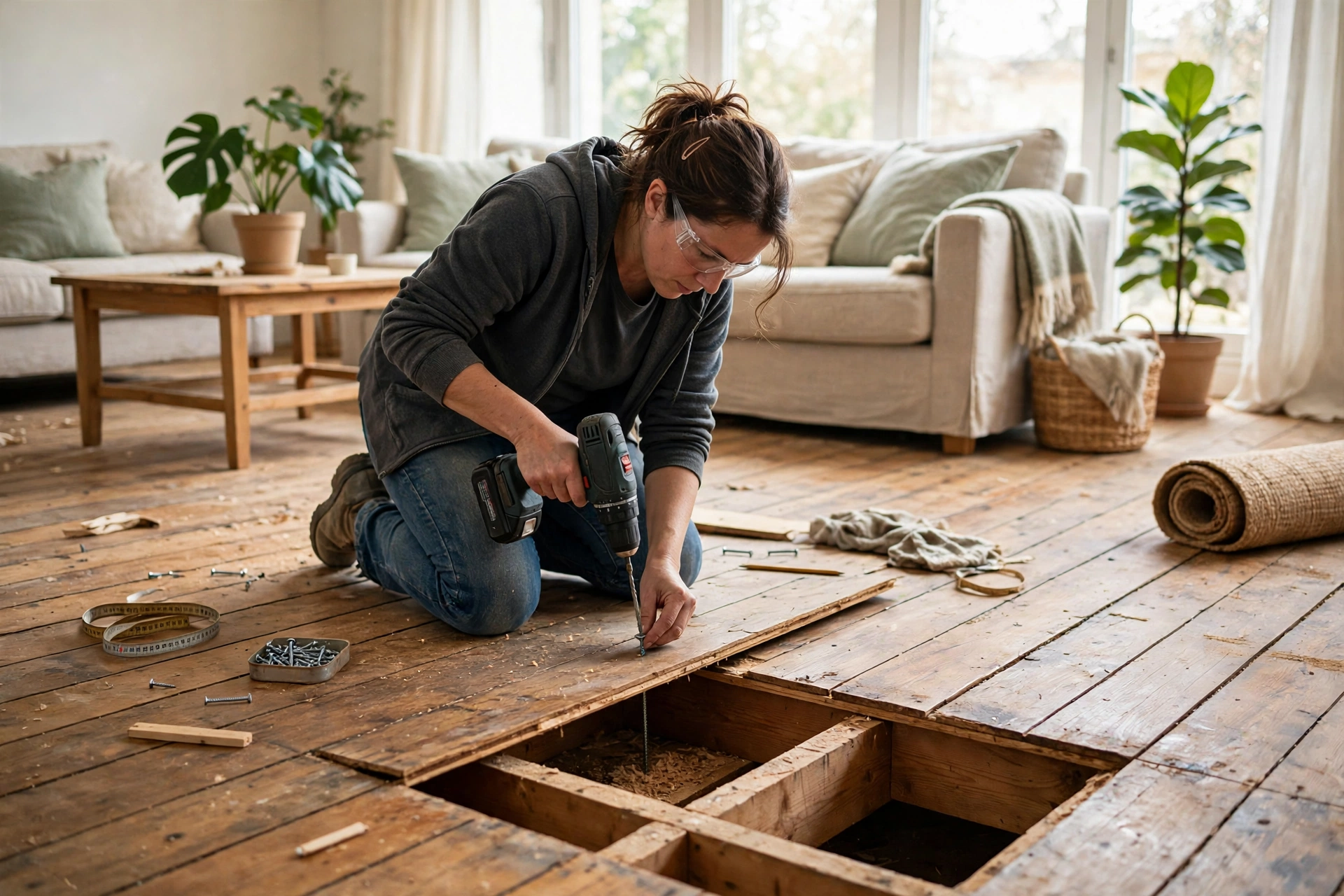
The screw fix is the best fix for most creaks, and it works on both carpeted and bare floors. If the floor is bare wood, find the joist under the creaky board — you can usually find it by looking at the nail pattern in the floor, or by tapping along the board and listening for the solid sound where the joist is. Drill a small pilot hole through the board and into the joist, then drive a wood screw through it until the head sits just below the surface. The screw pulls the board tight against the joist and stops the movement. Fill the hole with wood filler in a matching colour and the repair is almost invisible.
If the floor is carpeted, you can use a special kit — a breakaway screw with a jig that holds the carpet down while you drive the screw through it. The screw snaps off below the surface, leaving no mark on the carpet. Without a kit, you can still do it: cut a small slit in the carpet over the joist, drive the screw in, and glue the slit closed afterwards. Either way, use screws, not nails — nails work loose again within months, and you will be back where you started. For the rest of the room, our how to install a curtain rod guide is another small job that uses the same drill-and-screw skills.
The powder fix: for boards rubbing together
If the creak is two boards rubbing against each other, a screw will not help — there is nothing to screw into. Instead, work a lubricant into the gap. Powdered graphite is the classic choice: sprinkle it along the seam between the boards, work it in with an old toothbrush or a thin card, and walk over the spot a few times to work it down into the gap. Talcum powder works too, and so does a little washing-up liquid on a cloth worked into the seam. The lubricant stops the friction, and the creak stops with it. This fix is quick and cheap, but it may need repeating every year or two as the powder works its way out. It is the right fix for a small creak in a floor that is otherwise solid.
Fixing Creaks From Below
If you can get underneath the floor — from a basement or a crawl space — you have more options. The best fix from below is a wooden shim: a thin wedge tapped gently into the gap between the top of the joist and the bottom of the board. Tap it in until it is snug, but do not force it — a shim driven in too hard will lift the board and create a bump in the floor. A small amount of construction adhesive on the shim before you tap it in will hold it in place permanently.
Another good fix from below is a metal bridging bracket, sometimes called a squeak eliminator: a plate that screws to the joist and presses up against the board, holding it tight without any work on the floor surface. These are especially useful under carpeted floors where you do not want to disturb the carpet at all. Whatever fix you choose from below, have someone walk on the floor above while you listen underneath — you can pinpoint the exact board and the exact joist, which makes the fix much more precise. Once the floor is quiet, the room feels finished — and if the room itself could use a refresh, our laundry room ideas post covers the spaces where a creaky floor is most often noticed.
When to Call a Professional
Most creaks are a DIY job. Call a professional when the floor sags or bounces, when several boards are loose across a wide area, when the creaking started suddenly after a leak or flooding, or when the floor is an expensive hardwood that you do not want to risk damaging. A flooring specialist can lift boards properly, replace damaged joists, and refinish the floor if needed. The cost is usually a few hundred dollars for a room, which is a lot less than replacing a floor that was damaged by a bad DIY repair.
If you live in a rented home, check with your landlord before you drill or screw anything — some landlords will fix it themselves, and some will not want you altering the floor. And if the creaking is in a new-build home, it may be covered by the builder’s warranty, so it is worth asking before you spend your own money. Either way, a creaky floor is almost never an emergency — it is an annoyance, and it can wait a week for the right fix rather than a rushed one.
Frequently Asked Questions
What causes floorboards to creak?
Usually a board moving slightly against a joist or against the board next to it. Nails working loose over time is the most common cause, along with wood shrinking as it dries.
Can I fix a creaky floor without removing the carpet?
Yes. Use a breakaway screw kit designed for carpeted floors — the screw snaps off below the surface and leaves no mark. Or fix it from underneath with shims or a bridging bracket.
Will talcum powder stop a creaky floor?
It works for creaks caused by two boards rubbing together. Work the powder into the gap between the boards. It is a quick fix but may need repeating every year or two.
How much does it cost to fix creaky floorboards?
A DIY fix costs a few dollars for screws or a shim kit. A professional repair for one room typically costs a few hundred dollars, depending on the floor and the cause.