
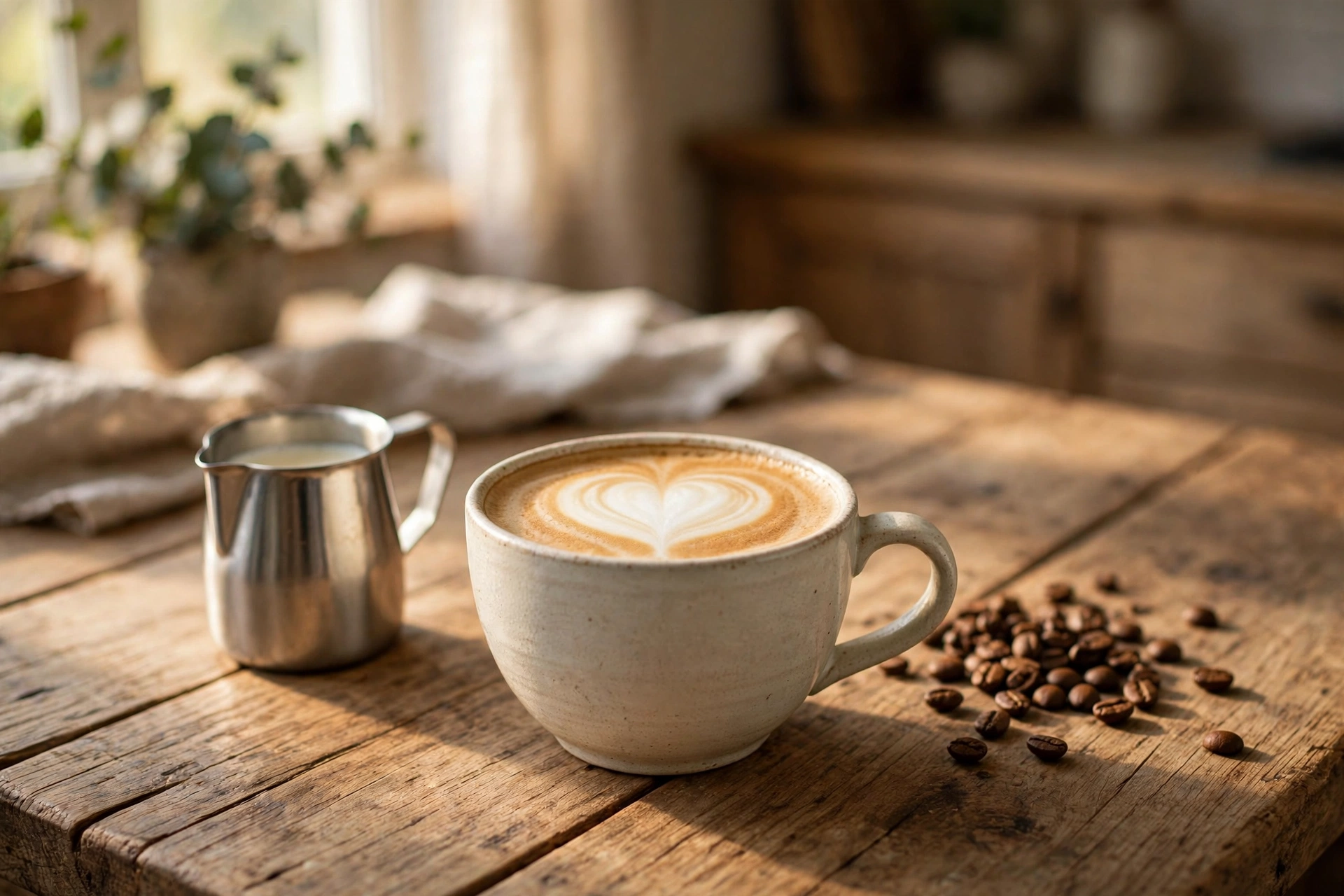
A cafe latte costs four or five dollars, and once you make it a daily habit, that adds up to well over a thousand dollars a year. Learning how to make a latte at home is one of the easiest kitchen skills to pick up: you need coffee, milk, and a way to make both hot and foamy. No espresso machine is required to start, and a decent homemade latte is closer to the cafe version than most people expect.
- A latte is one part espresso to three parts steamed milk, with a thin layer of foam on top.
- Whole milk froths best; oat milk is the best dairy-free option for foam.
- You can make a good latte without an espresso machine — a moka pot or strong coffee works.
- Heat the milk to about 65 degrees Celsius; hotter milk tastes burnt and flat.
- Pour slowly and steadily for latte art; pour fast and you just get a milky coffee.
What Is a Latte, Exactly?
A latte is espresso and steamed milk, in roughly a one-to-three ratio, topped with a thin layer of foam. That is what separates it from its cousins: a cappuccino has equal parts espresso, steamed milk, and foam, so it is airier and stronger-tasting. A flat white uses less milk and a thinner foam, so the coffee flavour comes through more. A latte is the milkiest and the mildest of the three, which is why it is the most popular — and the most forgiving to make at home.
The standard recipe is one shot of espresso (about 30ml) and 120 to 150ml of steamed milk, served in a 240ml cup. A double shot with 180ml of milk makes a larger latte. The milk should be silky and smooth, not stiff and bubbly — think wet paint, not bubble bath. If your milk looks like the foam on a cappuccino, you have added too much air. If you are still building your coffee setup, our best coffee maker guide compares the machines that make this easy.
The Coffee: Espresso, Moka Pot, or Strong Brew
An espresso machine is the proper tool, but it is not the only one. A moka pot — the little stovetop pot that brews strong coffee by pushing hot water through the grounds — makes a rich, intense coffee that works beautifully in a latte. Use a fine grind, fill the basket without pressing the coffee down, and take it off the heat the moment it starts to gurgle. A French press can work too if you use double the normal amount of coffee, though the result is less intense. Even a strong pour-over or an AeroPress will do in a pinch.
Whatever method you use, the coffee should be strong. A normal-strength cup of coffee will disappear under the milk, and you will end up with warm milk that tastes faintly of coffee. Use dark or medium roast beans, freshly ground if you can — pre-ground coffee goes stale fast, and stale coffee makes a flat latte no matter how good your milk is. For more on getting the coffee itself right, our best coffee beans for espresso guide covers the beans that hold up under milk.
Which milk works best?
Whole milk is the easiest to froth and the best tasting in a latte, because the fat helps the foam hold together and gives the drink a natural sweetness. Semi-skimmed works too, but the foam is thinner and the flavour is less rich. Skimmed milk froths into big, stiff bubbles that collapse quickly, so it is the hardest to work with. For dairy-free options, oat milk is the clear winner — it froths almost like whole milk and tastes creamy rather than nutty. Barista-edition oat milk is worth the extra cost because it is formulated to steam well. Almond milk froths poorly and can split in hot coffee, and soy milk works but has a stronger flavour that some people love and others hate.
How to Froth Milk Without an Espresso Machine
You do not need a steam wand to froth milk. The simplest method is a French press: heat the milk, pour it into the press, and pump the plunger up and down for thirty seconds. It makes excellent foam. A handheld milk frother — a little battery-powered whisk — costs a few dollars and works well for one cup. A jar with a lid works too: pour in warm milk, seal it, shake hard for thirty seconds, then microwave it for another thirty seconds to set the foam.
Whatever method you use, heat the milk first to about 60 to 65 degrees Celsius — hot to the touch but not scalding. Milk heated past 70 degrees tastes burnt and loses its sweetness, and it will not froth properly. If you do have an espresso machine, the steam wand is the gold standard: keep the tip just below the surface, listen for a gentle hissing sound, and stop when the jug feels too hot to hold comfortably. That is roughly the right temperature. For the French press method itself, our how to use a French press guide covers the technique in detail, and it doubles as a frother.
Putting It Together: The Pour
Make the coffee first and pour it into a wide cup. Then pour the milk in a slow, steady stream from about ten centimetres above the cup, aiming for the centre. Start high so the milk sinks under the coffee, then lower the jug as the cup fills so the foam sits on top. If you want latte art, the last part of the pour is where it happens: a slow wiggle of the wrist makes a heart, and a steady pull-through makes a rosetta. Do not worry if your first ten attempts look like blobs — everyone starts there, and the latte tastes the same either way.
For flavoured lattes, add syrup to the coffee before the milk, not after — a pump of vanilla, caramel, or hazelnut stirred into the espresso mixes evenly, while syrup on top just sits there. A teaspoon of honey works the same way. And if you like your latte iced, make the espresso, pour it over ice, then add cold milk and stir — no frothing needed. Cold foam, made by frothing cold milk in a French press, is a nice touch on top. For another cosy coffee drink, our how to make French press coffee guide is the simplest way to a good morning cup.
Frequently Asked Questions
Can I make a latte without an espresso machine?
Yes. A moka pot makes the best substitute, and strong French press or AeroPress coffee works too. Froth the milk with a French press, a handheld frother, or a jar — no steam wand needed.
What milk is best for a latte?
Whole milk froths best and tastes sweetest. Oat milk is the best dairy-free option and froths almost as well. Avoid skimmed milk, which makes stiff bubbles that collapse quickly.
How hot should the milk be for a latte?
About 60 to 65 degrees Celsius — hot to the touch but not scalding. Milk heated past 70 degrees tastes burnt and will not froth properly.
Why does my homemade latte taste weak?
Your coffee is probably not strong enough. A latte needs a double-strength brew — a normal cup of coffee disappears under the milk. Use more coffee grounds or a finer grind.