
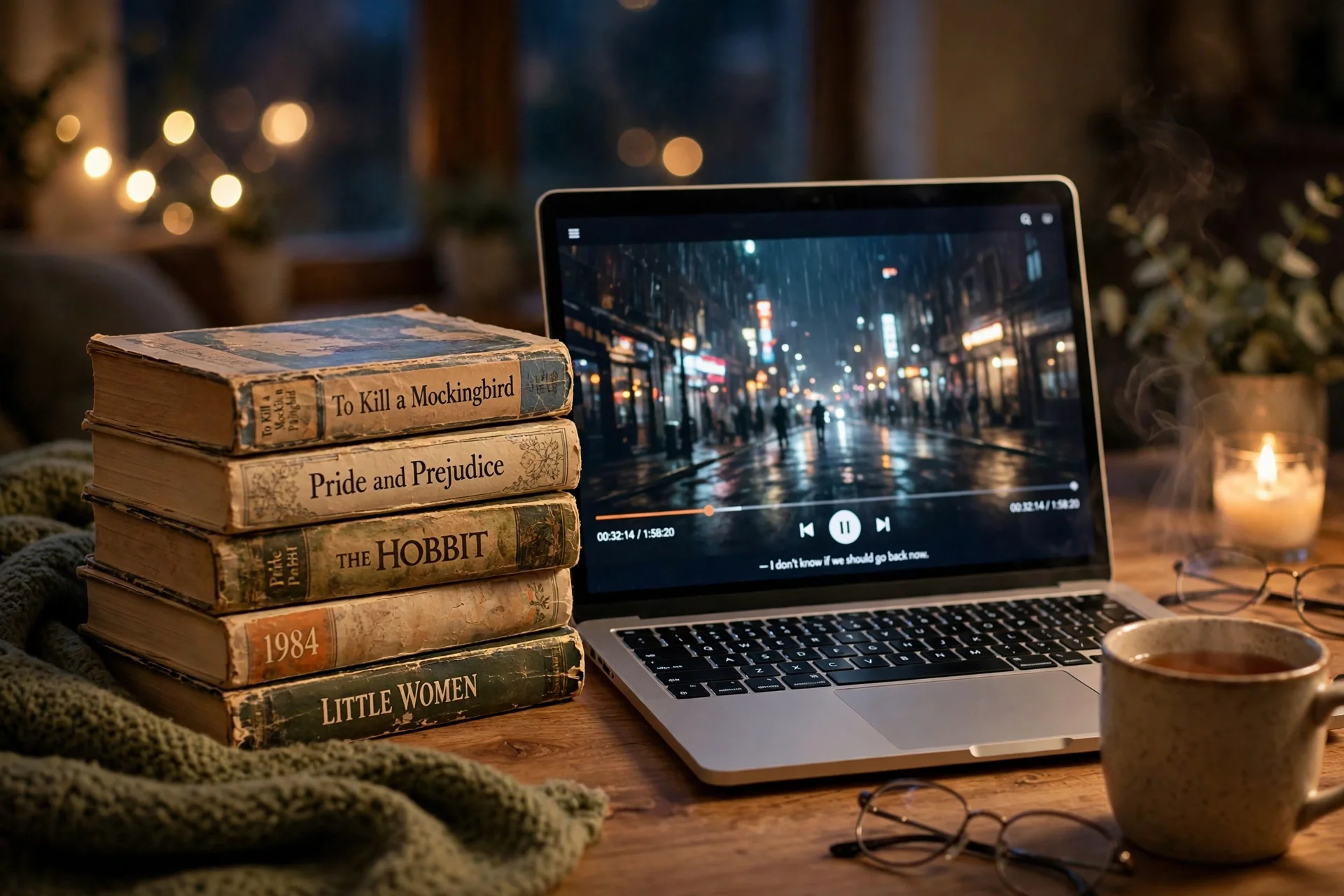
Every reader has felt it: the film starts, and within five minutes you know whether the people who made it actually read the book. The best book to movie adaptations are not always the most faithful ones. Sometimes the best film changes the ending, cuts a favourite character, or rearranges the whole story — and still feels like the book. What they all share is respect: for the characters, for the heart of the story, and for the audience. Here are the adaptations that get it right, and what makes them work.
- The best adaptations capture the spirit of the book, not just the plot — faithfulness to the story’s heart matters more than scene-by-scene accuracy.
- Great adaptations know what to cut: a 400-page novel cannot fit in two hours without losing something.
- The Lord of the Rings trilogy remains the gold standard for epic adaptation.
- Smaller, quieter books often make the best films — The Shawshank Redemption and Little Women prove it.
- Watch the film first or read the book first? Read first, if you can — the book is almost always richer.
What Makes a Great Book to Movie Adaptation?
The first thing to understand is that a book and a film are different animals. A novel can spend ten pages inside a character’s head. A film has two hours and a camera. The adaptations that work are the ones that find the film version of the book’s best moments — the scene, the line, the image — rather than trying to film the book word for word. The Lord of the Rings trilogy is the classic example: Peter Jackson cut whole chapters, merged characters, and changed the ending of the story, and fans still call it the definitive version. He kept the heart — friendship, sacrifice, the long walk into darkness — and let the rest go.
The adaptations that fail usually fail in one of two ways. Either they are too faithful, cramming in every subplot until the film collapses under its own weight, or they are too loose, keeping the title and the names but losing everything that made the book worth reading. The sweet spot is in the middle: a filmmaker who loves the book enough to protect it, and is confident enough to change it. If you want a night in with a great film, our cosy movie night ideas will help you set the scene.
The Best Book to Movie Adaptations to Watch
Start with the big ones. The Lord of the Rings trilogy (from J.R.R. Tolkien’s novels) is still the benchmark for epic fantasy on screen — three films, one continuous story, and a world that feels real enough to walk into. The Shawshank Redemption (from Stephen King’s novella Rita Hayworth and Shawshank Redemption) is the quiet opposite: a small, hopeful story about friendship in prison that most people now rank among the best films ever made. Both prove the same point: a great adaptation serves the story, not the page count.
For something more recent, the Harry Potter films turned a generation of readers into a generation of moviegoers, and the best of them — Prisoner of Azkaban, directed by Alfonso Cuaron — understood that the books are about growing up, not just about magic. Little Women, in Greta Gerwig’s 2019 version, rearranged the timeline of Louisa May Alcott’s novel and made it feel more modern, not less. And Gone Girl, from Gillian Flynn’s thriller, kept the book’s twist and its cold, calculating tone intact — no small feat for a story that lives or dies on its ending. For the full story of how one franchise made the jump, our Spider-Man movies in order guide covers a series built on decades of comic-book source material.
The ones that are better than the book (yes, really)
It is almost rude to say it, but some films improve on their source material. The Godfather is the famous example: Mario Puzo’s novel is a pulpy bestseller, and Francis Ford Coppola turned it into a masterpiece about family, power, and America. Forrest Gump took a strange, wandering novel and turned it into one of the most beloved films of the 1990s. Jaws cut the novel’s messy subplots — including an affair and a mafia storyline — and became a perfect thriller. In each case, the filmmakers understood that adaptation is not transcription. It is translation, and sometimes the translation is clearer than the original.
That is also why some beloved books make terrible films. A novel that lives in a character’s interior thoughts, or one whose power is in the language itself, is very hard to film. The film has to find a visual equivalent for what the book does with words, and not every book has one. When a film fails, it is often not because the filmmakers did not care — it is because the book was doing something a camera cannot do. If you are looking for what to watch next after the credits roll, our free movie websites guide lists the legal places to stream your next pick.
Should You Read the Book First?
Most of the time, yes. The book is almost always richer — more detail, more interior life, more of the story. Reading first also means you get to enjoy the film as an interpretation rather than a replacement: you can appreciate what the director kept, what they changed, and why. There is a particular pleasure in watching a scene you have imagined for years finally appear on screen, even if it looks nothing like the version in your head.
But there is a case for watching first. If you watch the film first, you get to enjoy it without comparing every scene to the book, and then the book becomes a deeper, richer version of a story you already love. Either order works. The only order that does not work is skipping the book entirely because the film exists — the film is the postcard, and the book is the trip. Read the book. Then watch the film. Then argue about which was better, like everyone else.
Frequently Asked Questions
What is the best book to movie adaptation of all time?
Most critics and audiences pick The Lord of the Rings trilogy or The Godfather. The Shawshank Redemption is the most-loved by audiences. All three are faithful to the spirit of their books while making real changes.
Are movie adaptations usually worse than the book?
Often, but not always. A film has less time and no access to a character’s inner thoughts, so it loses something. But great adaptations can match or even improve on the book by finding the visual heart of the story.
Which book adaptations are most faithful?
The Harry Potter films and the Lord of the Rings trilogy are among the most faithful big adaptations, though both cut subplots and merged characters. Total faithfulness is impossible — a novel simply has more room than a film.
What book should I read after watching the film?
Start with the book of the film you just loved. If you enjoyed the Lord of the Rings films, the books are richer. If you liked Gone Girl, Gillian Flynn’s other novels are just as sharp.
Do authors like the movie versions of their books?
It varies. Some authors love them, some hate them, and most fall somewhere in between. Stephen King famously disliked Stanley Kubrick’s version of The Shining, while Gillian Flynn wrote the screenplay for Gone Girl herself.
The best book to movie adaptations prove that a film can honour a book without copying it. They keep the characters, protect the heart of the story, and trust the audience to follow. Read the book, watch the film, and then have the argument — that is half the fun.
1 thought on “Best Book to Movie Adaptations to Watch in 2026”