
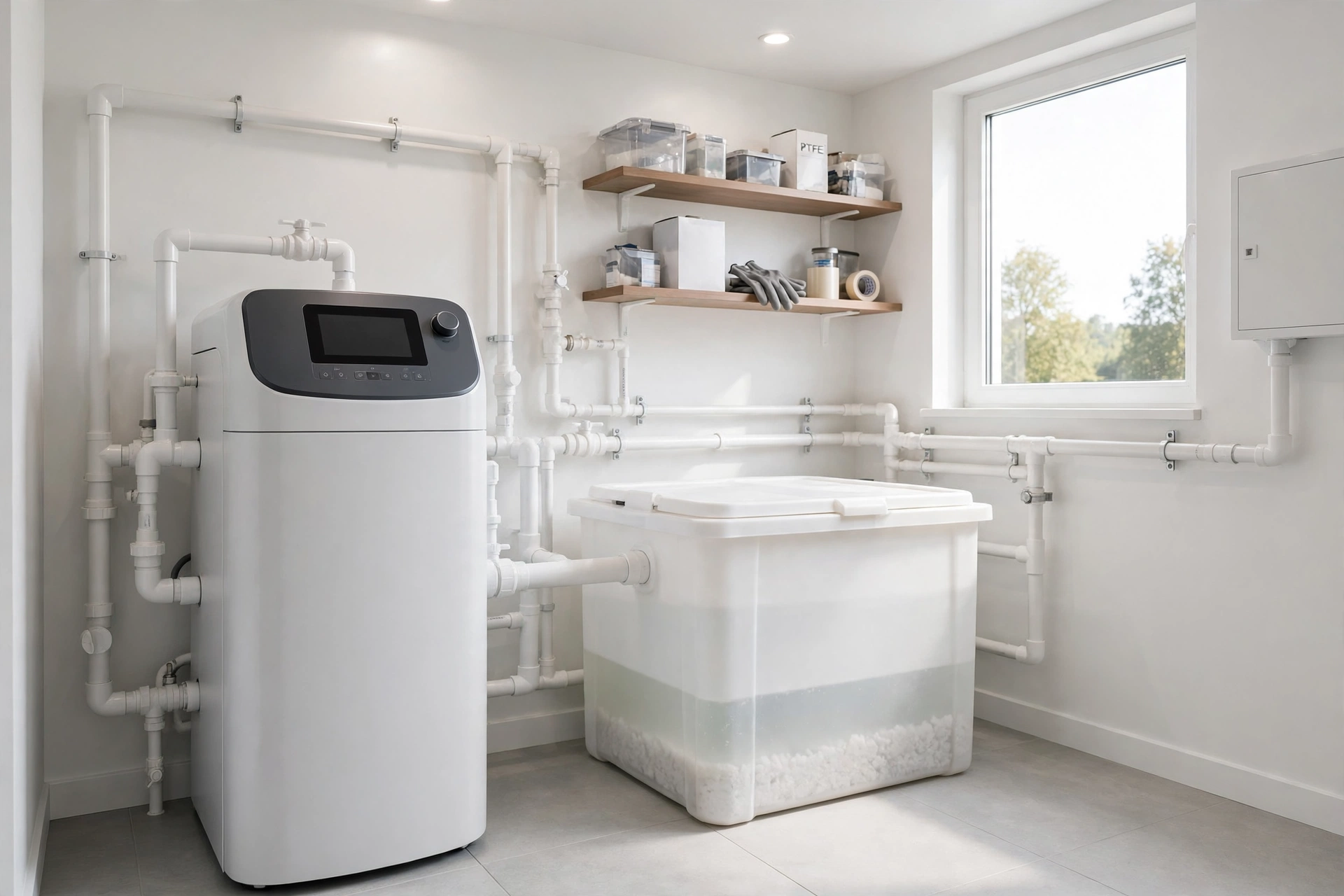

If your taps are crusty with limescale, your shower pressure feels weak, and your kettle furs up every few weeks, you probably have hard water — and you have probably started looking at softeners. The first question everyone asks is the same one: what does a water softener system cost? The honest answer is that it depends on the size of your home, the hardness of your water, and whether you install it yourself or hire a plumber. A small system for a flat can cost a few hundred, while a whole-house system for a large family home can run into the thousands. This guide breaks down the real numbers for 2026, including installation, salt, and running costs, so you can budget properly.
- A water softener system cost typically runs $400 to $2,500 for the unit, plus $300 to $1,500 for professional installation.
- Salt-based ion exchange systems cost more upfront but soften water fully; salt-free conditioners are cheaper but do not remove hardness.
- Size the system to your household: a family of four usually needs a 32,000 to 48,000 grain system.
- Running costs are modest — roughly $5 to $15 a month in salt, plus a little extra water and electricity.
- Get your water tested first: the hardness level decides the size and type you actually need.
Water Softener System Cost: The Full Breakdown
For a typical family home, the water softener system cost breaks down into three parts: the unit itself, the installation, and the running costs. The unit is the biggest variable. A compact salt-based system for a one or two bedroom home usually costs $400 to $800. A mid-range whole-house system for a three to four bedroom home runs $800 to $1,500. A large or premium system — high capacity, smart controls, high efficiency — runs $1,500 to $2,500 or more. Magnetic and electronic descalers, which are not true softeners, sit at the cheap end at $100 to $400, but they do not remove hardness minerals, they only claim to change how they behave.
Installation is the second cost, and it is the one people forget to budget for. A straightforward install by a plumber, where the main water line is easy to reach, usually costs $300 to $600. If the plumbing needs rerouting, if the system goes in a garage or basement far from the main line, or if a drain and power outlet need adding, the price can reach $1,000 to $1,500. A confident DIYer can install a basic system in a day and save the labour cost, but mistakes with the main water line are expensive, so most people hire a professional. If your home has other water issues too, our best home water filters guide explains how filtration and softening work together.
Salt-Based vs Salt-Free: Which Costs More Over Time?
The two main types of system have very different cost profiles. Salt-based ion exchange softeners are the real thing: they remove calcium and magnesium from the water, which is what stops limescale, improves soap lather, and protects appliances. They cost more upfront, usually $600 to $2,500 installed, and they need salt — about $5 to $15 a month depending on water hardness and usage — plus a small amount of water and electricity for the regeneration cycle.
Salt-free water conditioners are cheaper, usually $300 to $1,200, and they need almost no maintenance and no salt. But they do not soften water. They use a process called template-assisted crystallisation, which changes the structure of the hardness minerals so they are less likely to stick to pipes, but the minerals stay in the water. That means no more limescale on fixtures in theory, but your water still tests hard, soap still does not lather as well, and spots can still appear on glassware. For most people with genuinely hard water, the salt-based system is the one that actually solves the problem. If hard water has already left its mark on your bathroom, our hard water stain removal guide shows how to clean it off.
What size water softener do you need?
Size is measured in grains — the amount of hardness the system can remove before it needs to regenerate. A household’s daily grain requirement is roughly the number of people, times the gallons each person uses per day (around 75), times the water hardness in grains per gallon. For a family of four with moderately hard water, that works out to roughly 32,000 to 48,000 grains. Buying too small means the system regenerates constantly, wasting salt and water. Buying too big wastes money upfront. A water test — either a free test strip or a lab test — gives you the hardness number, and any reputable supplier will size the system from it.
Running Costs: Salt, Water, and Electricity
Once installed, a salt-based softener is cheap to run. Salt costs about $5 to $15 a month for a typical family, depending on how hard the water is and how much you use. A 40-pound bag of salt pellets costs around $5 to $8 and lasts a few weeks in most homes. The regeneration cycle uses water — roughly 20 to 50 gallons per cycle, a few times a week — and a small amount of electricity for the control valve. All together, most households spend $100 to $200 a year on running costs, which is modest compared with the cost of replacing a scaled-up water heater or a dishwasher killed by limescale.
Maintenance is simple: check the salt level every month and top it up before it runs out, clean the brine tank once a year, and check the system for leaks when you do. A well-maintained softener lasts 10 to 15 years, sometimes longer, which makes the upfront cost easier to swallow when you spread it over the system’s life. If your water heater is already struggling with scale, our water heater flushing guide explains how to clear it out before it fails.
Is a Water Softener Worth the Money?
For homes with genuinely hard water, yes — and the payback is in the things you stop replacing. Soft water extends the life of water heaters, dishwashers, and washing machines, because limescale is what kills them. It cuts soap and detergent use by up to half, because soft water lathers properly. It stops the white crust on taps and showerheads, which means less cleaning, and it is kinder to skin and hair — people with eczema and dry skin often notice a real difference. It can also help with water pressure, since scale buildup narrows pipes over time; if your shower feels weak, our shower pressure guide covers the other causes too.
The case is weaker if your water is only slightly hard. Below about 7 grains per gallon, most people barely notice the difference, and the money is better spent elsewhere. And if you are renting, or you plan to move within a couple of years, a softener is a hard cost to justify — a portable or point-of-use option might make more sense. For a long-term home with hard water, though, it is one of the few home upgrades that pays for itself in appliance life and cleaning time.
Frequently Asked Questions
How much does a water softener system cost in 2026?
A salt-based whole-house system typically costs $400 to $2,500 for the unit, plus $300 to $1,500 for professional installation. Running costs are roughly $100 to $200 a year in salt, water, and electricity.
Do I need a plumber to install a water softener?
Not always — a confident DIYer can install a basic system — but most people hire a plumber because the system connects to the main water line. A professional install usually costs $300 to $600 for a straightforward job.
How much salt does a water softener use?
A typical family uses one to two 40-pound bags of salt a month, costing about $5 to $15. Usage depends on water hardness and how much water the household uses.
Is a salt-free water softener as good as a salt-based one?
No. Salt-free conditioners do not remove hardness minerals from the water; they only change how the minerals behave. A salt-based ion exchange system is the only type that truly softens water.
How long does a water softener last?
With basic maintenance — topping up salt monthly and cleaning the brine tank yearly — a good system lasts 10 to 15 years.
The water softener system cost is really three numbers: the unit, the install, and the running costs. Budget $1,000 to $2,500 all-in for a typical family home, test your water first so you buy the right size, and remember that the payback comes quietly — in appliances that last longer, taps that stay clean, and a shower that actually feels like a shower.