
Small Christmas Tree Ideas for Flats, Bedrooms and Cosy Corners
Not every home has room for a six-foot tree, and not every Christmas needs one. Small Christmas trees — tabletop firs, ceramic trees, slim pencil trees and even wall-mounted trees — are one of this season’s biggest searches, and for good reason: they fit flats, bedrooms, offices and hallways, they cost a fraction of a full tree, and they let every room have its own little Christmas instead of one big tree carrying the whole house.
A small tree also solves the decorating problem that defeats many people: a big tree in a small room eats the room. A tabletop tree on a sideboard, a ceramic tree glowing on a windowsill, or a slim tree tucked beside a bookcase gives you the scent, the lights and the ritual without rearranging furniture. The key is treating the small tree as a complete decoration, not as a sad leftover — a good base, the right scale of ornaments, and a spot where it can actually be seen. If you do have a large tree as well, a small tree in the bedroom or kitchen extends the season beautifully; see our kids’ room Christmas ideas for how second trees work for children too.
- Match ornament size to tree size — small trees need small, light ornaments.
- Raise a tabletop tree on a stand, crate or stack of books so it sits at eye level.
- One small tree per room is charming; five in one room is clutter.
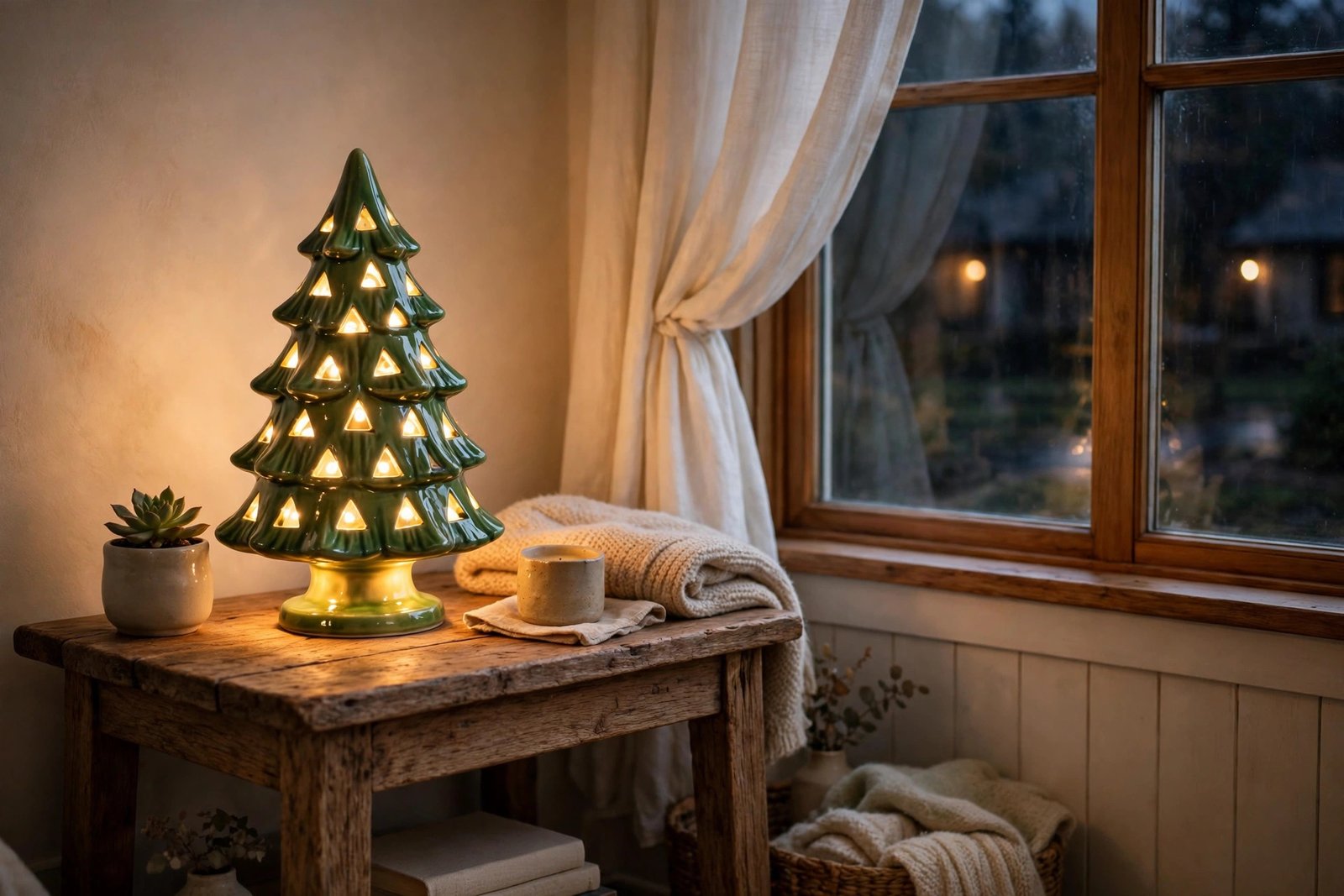
- Ceramic trees are the nostalgic favourite this year and need no ornaments at all.
1. Tabletop Trees: The Classic Small Tree
A tabletop tree is usually 60 to 120 centimetres tall and sits on any stable surface: a side table, a console, a kitchen counter, a desk. Real mini firs smell wonderful but drop needles and need watering; good artificial tabletop trees look full, pack away neatly and can be reused for years. Choose a tree with a sturdy base — a pot, a wooden stand or a weighted basket — because a top-heavy tabletop tree on a wobbly surface is an accident waiting for a cat.
Decorate with restraint. A tabletop tree holds roughly 15 to 25 small ornaments, plus a short string of lights. Mini baubles, small wooden shapes and tiny dried-orange slices all suit the scale; full-size baubles overwhelm it instantly. Finish with a small star or a simple bow, not a heavy topper, and stand back: a tabletop tree should look full but not stuffed.
2. Ceramic Christmas Trees: Nostalgia in Lights
Ceramic trees — the green, light-studded trees many people remember from their grandparents’ homes — are back in a big way, with searches up sharply this year. They need no decorating at all: plug them in, and the coloured or clear bulbs glow through the ceramic. They suit mantels, windowsills and bedside tables perfectly, and they are one of the few Christmas decorations that look good lit all evening in an otherwise undecorated room.
Buy ceramic trees in the size your surface allows — a large ceramic tree on a narrow mantel looks top-heavy, while a small one disappears on a wide sideboard. Vintage ceramic trees appear in charity shops and online marketplaces, but check the wiring and bulbs before buying second-hand, and replace any cracked bulb covers. New ceramic trees come in white, pink and green, so you can match one to your room rather than defaulting to green.
3. Slim and Pencil Trees for Tight Spaces
If you want a full-height tree but lack floor space, a slim or pencil tree is the answer. These trees are nearly as tall as a standard tree but much narrower — often under 60 centimetres wide — so they fit beside a sofa, in a hallway corner or at the end of a corridor. They suit flats and narrow living rooms where a wide tree would block a walkway.
Because slim trees have less branch depth, ornaments should hang close to the trunk and be small to medium in size. Deep, dangling ornaments swing into walls and get knocked off. Lights should be wrapped tightly, following the narrow silhouette, and a slim tree skirt or a simple collar hides the stand without adding width. Pair a slim tree with a small-space decorating approach elsewhere in the room and the whole space will feel considered rather than cramped.
4. Wall Trees and Alternative Small Trees
For the smallest homes of all, a wall tree — a triangle of garland, lights or wooden slats fixed to the wall — gives the shape of a tree with zero floor space. Hang ornaments from the garland rungs, add a star at the top, and you have a tree that children can decorate at eye level and that no pet can knock over. Wooden ladder trees and wall-mounted half-trees work the same way and fold flat for storage.
Other alternatives suit specific rooms: a rosemary plant dressed as a kitchen tree, a small olive tree with fairy lights in a bright hallway, or a branch in a vase with hanging ornaments for a truly minimalist take. These are not substitutes for a “real” Christmas — for many people, they are the Christmas they actually prefer, because they fit their home and their life.
5. Small Trees in Bedrooms and Children’s Rooms
A bedroom tree should be calming, not stimulating: warm white lights, a few soft ornaments, no flashing settings, and a timer so it switches off after you fall asleep. Battery lights with a timer are ideal here. In children’s rooms, a small tree of their own is a gift in itself — let them choose the ornaments and the topper, and keep glass and heavy pieces off it entirely.
Safety matters more with small trees because they sit at reachable height. Keep real candles far away, use LED lights that stay cool, secure the tree so it cannot be pulled down, and keep small ornaments away from toddlers who mouth everything. A felt or wooden advent-style tree is a safer choice for the youngest children.
6. Styling Around a Small Tree
A small tree needs a styled base to look intentional. Raise it on a wooden crate, a stack of festive books, or a decorative stand, and add a small skirt or a piece of fabric underneath to hide the pot. Place one or two companions beside it — a candle, a small figurine, a jar of pinecones — but not a crowd. The tree is the star; the companions are the supporting cast.
Finally, think about the view. A small tree earns its place when it is visible from where you sit in the evening: across the room from the sofa, on the windowsill seen from the street, or beside the bed. A tree hidden behind furniture is wasted, however pretty it is. Move it until you can see it from your favourite chair — that is where it belongs.
Frequently Asked Questions
What size ornaments suit a tabletop tree? Mini ornaments around 3–5 cm. Full-size baubles (8 cm and up) overwhelm trees under 120 cm.
Can I use a real mini tree? Yes — potted mini firs smell lovely and can be planted out after Christmas in mild climates. Water them and keep them away from radiators.
How do I store a ceramic tree? Wrap it in bubble wrap, store bulbs separately in a small bag, and keep the box. Ceramic trees chip easily if tossed loose into a decoration box.
Are slim trees stable? Yes, if the base is weighted and the tree is not top-heavy. Anchor tall slim trees to a wall in homes with children or large pets.
Small trees prove that Christmas does not scale with square footage. Choose the right size, decorate to its scale, give it a good spot, and your smallest tree may become the one everyone gathers around.
3 thoughts on “Small Christmas Tree Ideas for Flats and Cosy Corners”