
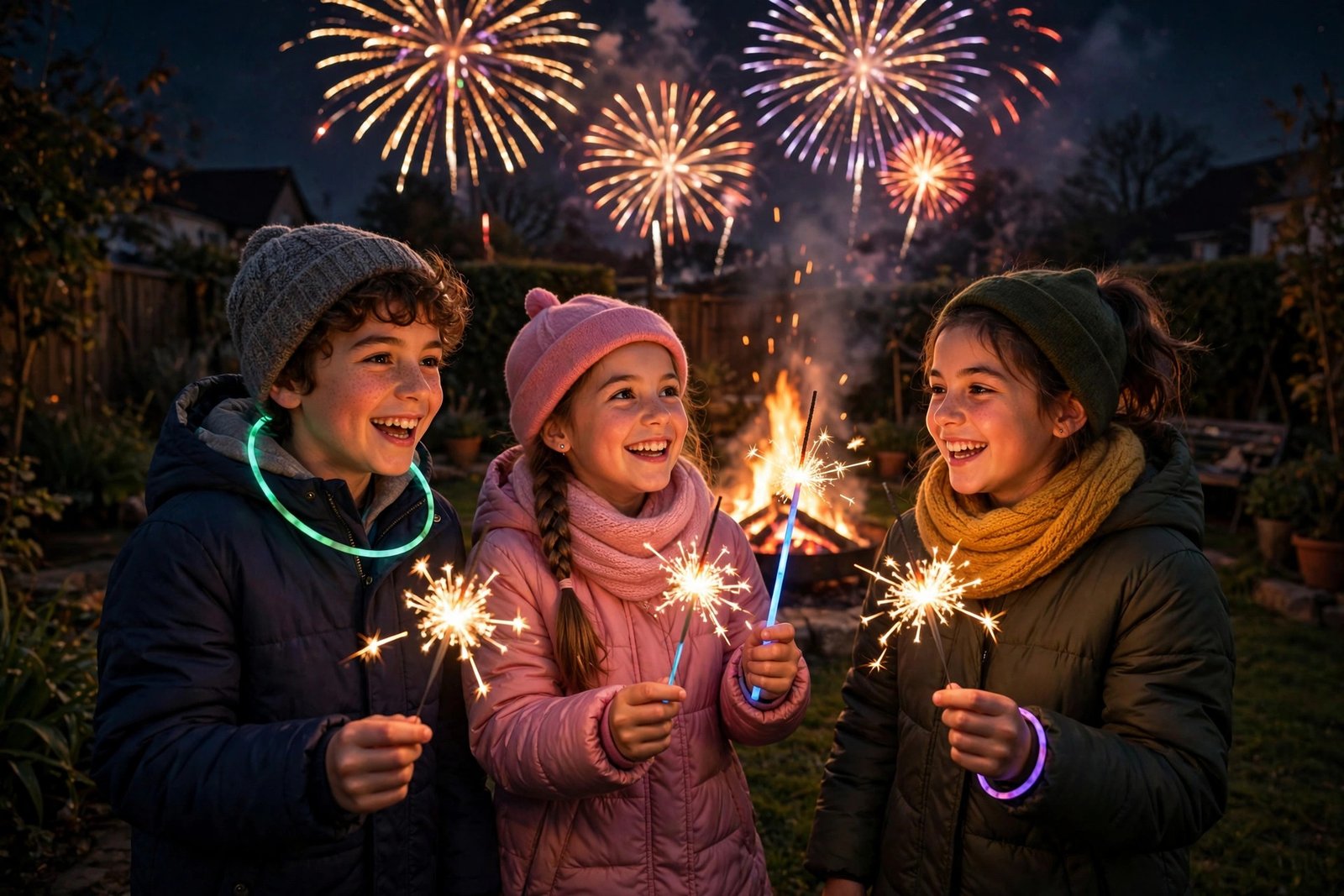
Bonfire Night Kids Activities: Fun Ideas for 5 November
Bonfire Night falls on Thursday, 5 November 2026, and for children it is one of the most exciting nights of the year — fireworks, sparklers, hot chocolate, staying up late. For parents, it is also one of the most tiring: cold, dark, loud, and often ending with an overtired, overstimulated child. The difference between those two experiences is planning, and it starts days before the 5th.
This guide covers activities for the afternoon before the fireworks, ideas for the display itself, a calm plan for children who find fireworks frightening, and things to do the next day when the excitement wears off.
Key Takeaways
- Plan the whole evening, not just the fireworks: afternoon activity, early dinner, display, then a calm wind-down.
- For nervous children, watch from indoors or from a distance first — never force a front-row fireworks experience.
- Sparklers are for over-fives only, one at a time, with gloves and a bucket of water nearby.
- Glow sticks, ear defenders and a torch are the three items that prevent most Bonfire Night meltdowns.
Afternoon Activities Before the Fireworks
The afternoon is your secret weapon. A child who has been busy all afternoon handles the evening far better than one who has waited impatiently since lunchtime. Start with a craft: firework paintings (paint dots bursting outward from a centre point on black paper), paper-plate fireworks, or glow-jar lanterns made from jam jars and glow sticks. All three are cheap, quick, and genuinely fun.
Then tell the story. The Gunpowder Plot — Guy Fawkes and the barrels of gunpowder under Parliament in 1605 — is a brilliant bedtime-length story for children over six, and the rhyme “Remember, remember the fifth of November” is easy to learn. Older children love the science: different metals make different firework colours (strontium red, copper blue, sodium yellow, barium green). A “fireworks in a jar” experiment (oil, water and food colouring) demonstrates the idea safely at the kitchen table.
At the Display: Making It Work
Choose your display wisely. Organised displays are far safer and more impressive than garden fireworks, and many now offer low-noise or family sessions. Arrive early, dress warmly (layers, hats, gloves, waterproof shoes — fields are muddy), and bring glow sticks, which keep children visible and happy during the wait. A flask of hot chocolate and a snack prevent the hunger meltdown that ruins many evenings.
Position matters: stand at the back or side, where children can see without being in the thickest crowd, and where you can leave easily if a child gets upset. Ear defenders are a game-changer for toddlers and noise-sensitive children — they reduce the bang without removing the visual magic. For the full family display guide, see our Bonfire Night party ideas at home and Bonfire Night safety tips for pets and kids.
The Calm Plan for Nervous Children
Some children love fireworks; some find them terrifying, and both reactions are normal. For a nervous child, watch the display from indoors through a window, from the car, or from a distance where the sound is muffled. Let them control the volume (ear defenders on, window closed) and the duration (watch five minutes, then go inside for hot chocolate). Never force a child to “be brave” in front of fireworks — it creates a lasting fear, not courage.
At home, a “fireworks den” works wonders: blankets, cushions, fairy lights, and a tablet or book for distraction, with the real fireworks visible (or audible) only as background. Many children who hate a display love watching fireworks on television, where they control the volume. That counts as celebrating — there is no rule that says Bonfire Night must be spent in a field.
Sparklers: The Rules
Sparklers burn at over 1000 degrees — hotter than a bonfire flame — and they stay hot long after they go out. The rules are simple and non-negotiable: no sparklers for under-fives, one sparkler per child at a time, gloves on, held at arm’s length, and used sparklers dropped straight into a bucket of water. Never let children run with sparklers, wave them near faces, or hold two at once.
For under-fives, glow sticks are the safe sparkler substitute, and they are honestly more fun — they last longer, come in more colours, and can be worn as bracelets, necklaces and swords. A child with a glow stick sword is a happy child, and a safe one.
Food, Wind-Down and the Next Day
Bonfire Night food should be warm, handheld and easy: jacket potatoes, hot dogs, sausage rolls, soup in mugs, and toffee apples or parkin for pudding. Our Bonfire Night food recipes and toffee apple recipes cover the traditional menu in full. Eat before the display, not after — a hungry child at a fireworks display is a countdown to tears.
After the fireworks, wind down deliberately: warm bath or shower, pyjamas, a story, and bed at a reasonable hour, even if it is a school night. Bonfire Night falls on a Thursday in 2026, so many families move their main celebration to the weekend (displays run through Sunday 8 November) — a Saturday display with no school the next day is a much easier evening for everyone. The next day, let children draw their favourite firework or write about the night; it turns a fleeting display into a lasting memory.
Frequently Asked Questions
What age can children use sparklers?
Over-fives only, with adult supervision, gloves, one at a time, and a bucket of water for used sparklers. Under-fives should use glow sticks instead.
What if my child is scared of fireworks?
Watch from indoors, from a distance, or on television. Use ear defenders, agree an exit signal in advance, and never force a child to stay at a display.
When is Bonfire Night 2026?
Thursday, 5 November 2026, with many organised displays on Saturday 7 and Sunday 8 November instead.
Are organised displays better than garden fireworks with kids?
Yes — organised displays are safer, more impressive, and remove all the risk of storing and lighting fireworks at home with children around.