
Iqbal Day 2026 in Pakistan: Date, History & How It Is Observed
Iqbal Day is observed in Pakistan on 9 November each year, marking the birth anniversary of Allama Muhammad Iqbal, the poet-philosopher whose vision inspired the Pakistan Movement. In 2026, Iqbal Day falls on Monday, 9 November. It is a day of remembrance, reflection and public ceremony — and, for many Pakistanis, a welcome pause in the working week to reconnect with Iqbal’s ideas.
This guide explains who Iqbal was, why the day matters, whether it is a public holiday in 2026, and how it is observed across the country, from official ceremonies in Lahore to school programmes and family discussions at home.
Key Takeaways
- Iqbal Day 2026: Monday, 9 November 2026 — the 149th birth anniversary of Allama Muhammad Iqbal (born 9 November 1877, Sialkot).
- Iqbal is Pakistan’s national poet; his philosophy of Khudi (selfhood) and his Urdu and Persian poetry shaped the intellectual case for Pakistan.
- Observances include an official ceremony at Iqbal’s mausoleum in Lahore, seminars, school programmes and poetry recitals.
- Holiday status has varied in recent years — check the official federal holiday notification for 2026 before planning travel or appointments.
Who Was Allama Iqbal?
Muhammad Iqbal (1877–1938) was a poet, philosopher and politician, born in Sialkot in Punjab. Educated in Lahore, Cambridge and Munich, he wrote in both Urdu and Persian, and his poetry — collections such as Bang-e-Dra, Bal-e-Jibril and Asrar-e-Khudi — combined Islamic thought, Western philosophy and a powerful call for self-respect, action and renewal among Muslims of South Asia.
Iqbal’s famous Allahabad Address of 1930 proposed a separate Muslim state in north-western India, and his ideas directly influenced Muhammad Ali Jinnah and the Pakistan Movement. That is why Iqbal is honoured as the “spiritual father” of Pakistan, and why his birthday is a national day of remembrance rather than just a literary anniversary.
Is Iqbal Day a Public Holiday in 2026?
Iqbal Day’s holiday status has changed over the years: it was a public holiday for decades, was removed from the federal holiday list, and has been restored at different times by different governments. Because the status can change by official notification, the reliable check is the federal government’s public holiday notification for 2026, issued by the Cabinet Division, and announcements from provincial governments.
Practical advice: if you have an appointment, a bank visit, a school run or a government office visit planned for Monday, 9 November 2026, confirm opening hours in advance. Banks, government offices and schools follow the official notification, and private employers may observe the day even when it is not a federal holiday. Plan travel with the same caution — ceremonies in Lahore can affect traffic around Iqbal Park and the Badshahi Mosque area.
How Iqbal Day Is Observed
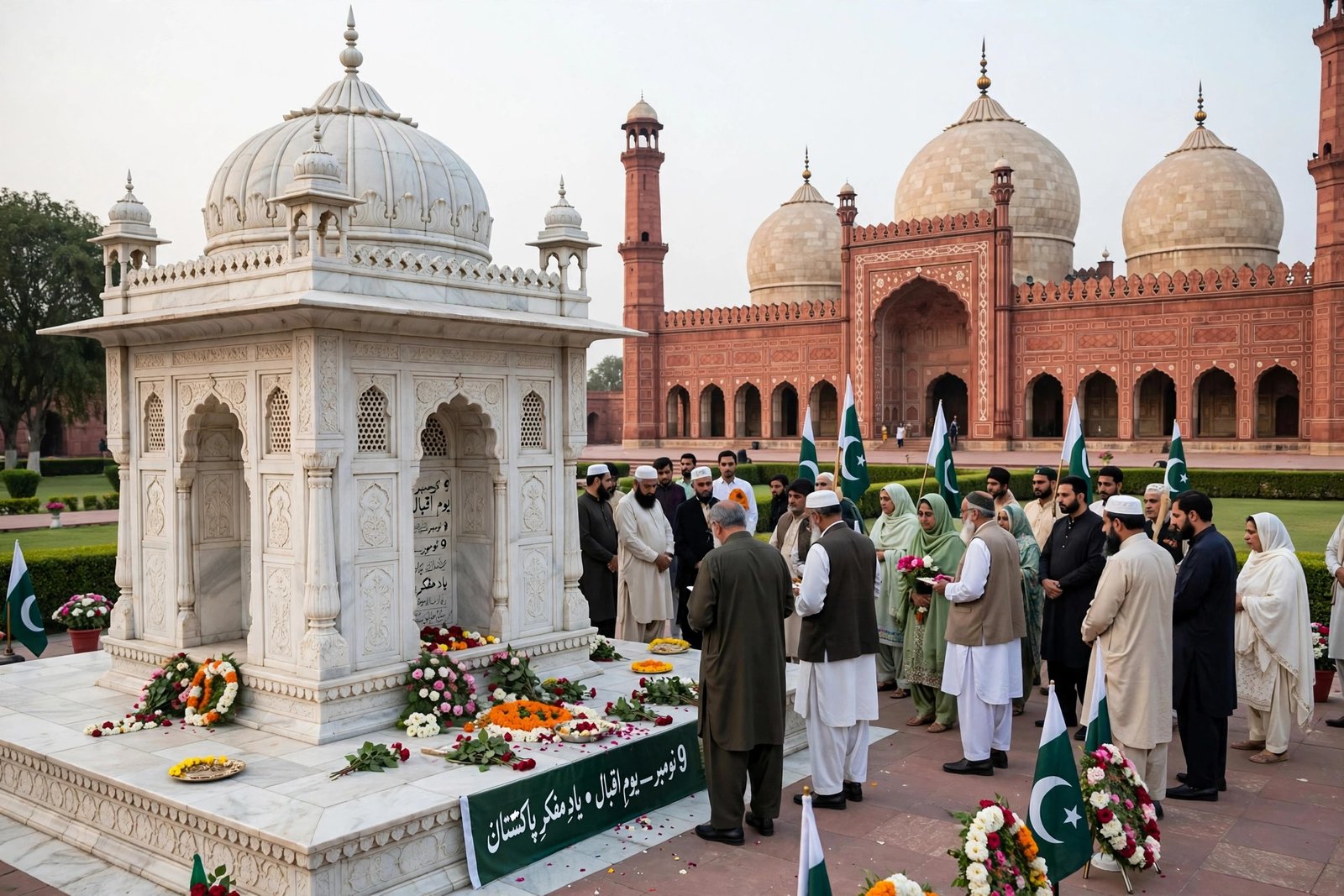
The central observance is the official ceremony at Iqbal’s mausoleum (Mazar-e-Iqbal) beside the Badshahi Mosque in Lahore, where a change of guards ceremony is held and officials lay floral wreaths. Seminars and conferences on Iqbal’s philosophy are organised by universities, literary organisations and the Iqbal Academy Pakistan, and television and radio carry special programmes of his poetry and commentary.
Schools mark the day with assemblies, poetry recitals (often Shikwa and Jawab-e-Shikwa, or selections from Bang-e-Dra), speech competitions and essay contests on Iqbal’s ideas. For families, the day is a chance to read Iqbal together — even one poem, discussed over tea, is a meaningful observance — and to visit libraries, bookshops or exhibitions featuring his work.
Iqbal’s Ideas Worth Revisiting
Three ideas from Iqbal remain strikingly relevant. Khudi — selfhood, self-respect and self-reliance — is his central concept: the individual should develop their potential rather than accept passivity. His emphasis on action over mere contemplation (“Khudi ko kar buland itna”) urges effort and courage in personal and public life. And his vision of a community built on dignity, justice and learning speaks directly to modern Pakistan’s challenges in education, work and civic life.
For readers new to Iqbal, start with the Urdu poems most Pakistanis know by heart: Shikwa (The Complaint), Jawab-e-Shikwa (The Answer), and the children’s poem “Lab Pe Aati Hai Dua”. English translations are widely available, and many are excellent — though, as with all poetry, the Urdu originals carry a music that translation can only approximate.
Visiting Lahore for Iqbal Day
If you plan to visit Lahore around 9 November, combine the mausoleum with the Badshahi Mosque, Lahore Fort and the old city’s food streets for a full day. November weather in Lahore is usually pleasant — cool mornings, warm afternoons — making it one of the best months to walk the historic quarter. Book accommodation early if the day is a public holiday, as the long weekend increases demand.
For families in other cities, local libraries and cultural centres often host Iqbal Day events, and many are free. Check listings from the week before — school and university programmes are usually announced a few days in advance, not months ahead. If you enjoy festival and observance guides, you may also like our Diwali 2026 dates and calendar guide, our Bonfire Night party ideas at home, and our eco-friendly Diwali celebration ideas — each covers how a festival is observed, step by step.
Frequently Asked Questions
When is Iqbal Day 2026?
Monday, 9 November 2026, the 149th birth anniversary of Allama Muhammad Iqbal (born 9 November 1877).
Is Iqbal Day a public holiday in Pakistan?
Its status has varied by year and by government notification. Check the official 2026 federal holiday notification before planning around the day.
Where is Iqbal’s mausoleum?
In Lahore, beside the Badshahi Mosque, near Lahore Fort — the site of the official Iqbal Day ceremony each year.
What is Iqbal best known for?
His Urdu and Persian poetry, his philosophy of Khudi (selfhood), and his 1930 Allahabad Address proposing a separate Muslim state, which inspired the Pakistan Movement.