
Winter Entrance Decor Ideas for a Cosy Welcome
The entrance is the hardest-working room in winter and the most overlooked. It takes the full force of the season — wet boots, dripping coats, cold draughts, muddy paws — while also being the first thing you see when you come home and the first impression guests get. A good winter entrance does two jobs at once: it handles the mess gracefully, and it feels warm and welcoming the moment the door opens.
The secret is to design for real winter life first and decoration second. Storage that actually gets used, lighting that flatters on dark evenings, and textures that say “come in and get warm” will do more than any amount of ornament. Then, with the practical bones in place, a few seasonal touches carry the entrance beautifully from November through to the festive season and beyond.
Key Takeaways
- Design for mess first: a boot tray, coat hooks and a washable rug are non-negotiable in winter.
- Warm lighting transforms a dark hallway — use lamps or wall lights, not just a harsh ceiling light.
- Layer textures: wool throws, chunky baskets, natural wood and greenery make an entrance feel cosy.
- Keep the festive touches simple and transitional so the entrance works from November to January.
- One statement piece (a mirror, a bench, a wreath) anchors the space; clutter everywhere else kills it.
- Small entrances benefit most: a console, hooks and a mirror can double the feeling of space.
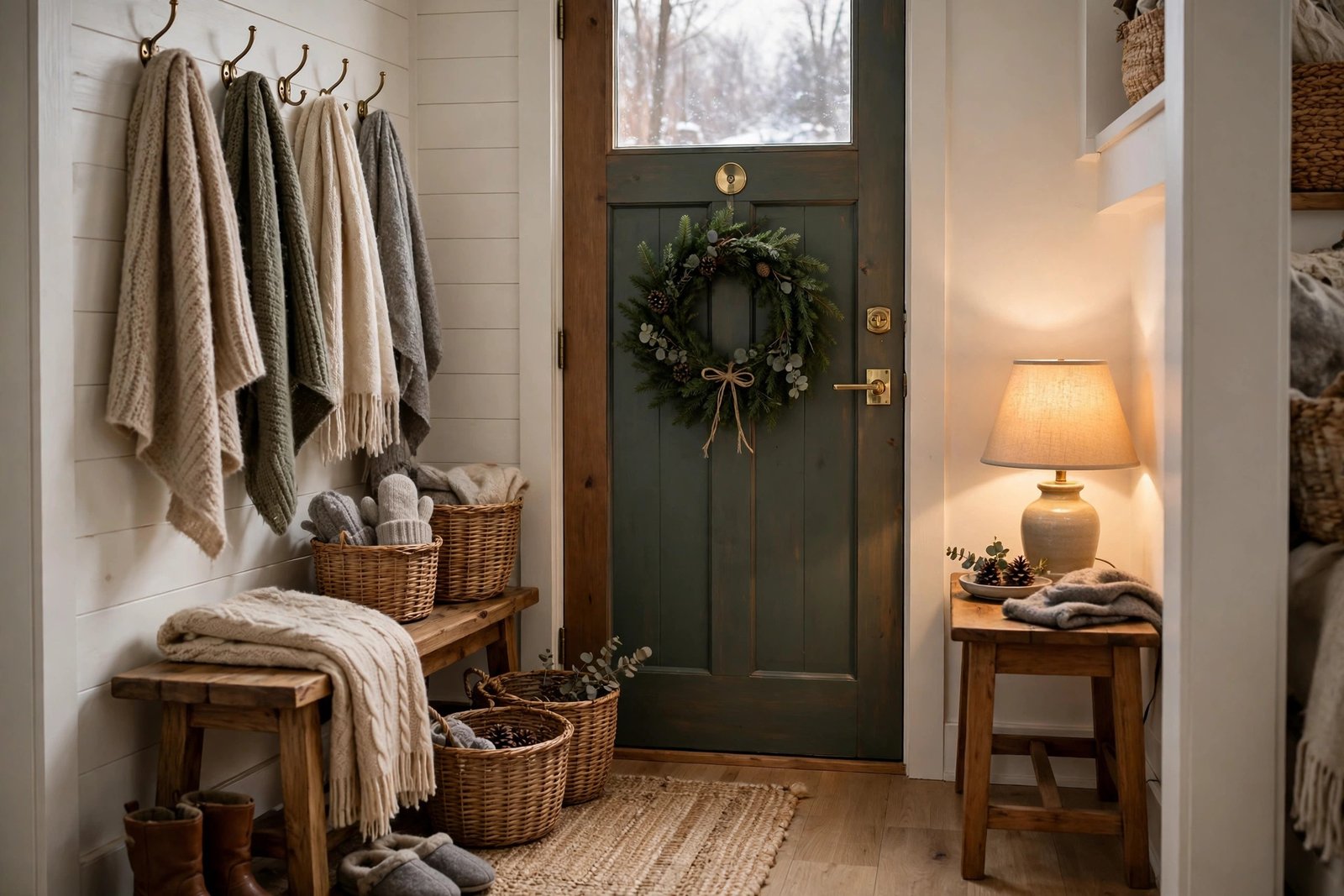
Start With the Mess: Winter-Proof Storage
Before a single decoration goes up, solve the wet-weather problem. A boot tray by the door — ideally a large, lipped tray that holds two or three pairs — stops mud and meltwater from travelling through the house. Next to it, a basket or crate for each family member’s everyday shoes keeps the floor clear without demanding perfect tidiness. Coat hooks at two heights (adult and child) beat a coat cupboard in winter, because wet coats need air to dry and nobody actually hangs a dripping coat inside a closed cupboard.
A bench or a sturdy console with a shelf underneath gives you somewhere to sit while pulling boots on and a place to stash bags, hats and gloves. Baskets on the shelf hide the clutter while keeping everything reachable. The materials matter: choose washable, wipeable surfaces for anything at floor level, and save the pretty fabrics for higher up where they stay dry. A washable runner rug in a dark, forgiving pattern protects the floor and adds instant warmth — and it can go straight in the washing machine when the season’s mud finally wins. For more storage thinking, see our entryway storage ideas and shoe rack designs for the home entrance.
Lighting: The Single Biggest Upgrade
Winter entrances are dark — you leave in the dark and come home in the dark — so lighting is the highest-impact change you can make. A single harsh ceiling light makes a hallway feel like a corridor; layered warm light makes it feel like a home. If you have space, a small table lamp on a console instantly softens the space. Wall lights flanking a mirror create a flattering glow and make the hallway feel wider. And a dimmer switch, if you can fit one, lets you drop the light to a welcoming level in the evening.
Choose warm-white bulbs (around 2700K) rather than cool daylight bulbs, which make winter hallways feel clinical. Battery-operated candles in lanterns by the door add a flickering warmth without any fire risk, and they are especially lovely on the darkest evenings. If your entrance has no natural light at all, a mirror opposite the door — or opposite the light source — bounces what light there is around the space and doubles the sense of depth. Our winter entryway decor ideas show how lighting and mirrors work together in real homes.
Textures and Colour for a Cosy Feel
Cosiness in an entrance comes from texture, not from buying more things. A chunky wool throw draped over the bench arm, a woven basket for scarves and gloves, a wooden tray for keys and post, and a plant or a bunch of evergreen stems in a vase — these four elements alone make a hallway feel lived-in and warm. Natural materials (wood, wool, rattan, greenery) read as warm; shiny, cold materials (chrome, glass, bare tile) read as cold, so lean toward the natural side in winter.
Colour should stay calm and warm: creams, soft browns, deep greens and warm greys, with one accent — a burgundy cushion, a mustard throw, a brass tray — to keep it from feeling flat. Avoid the temptation to paint a small dark hallway a bold colour in winter; it will feel smaller and darker. Instead, keep walls light and add colour through textiles you can swap in spring. A runner rug in a warm pattern, curtains or a fabric panel on a glass door, and cushions on the bench all add colour without commitment.
The Festive Transition: November to January
The smartest winter entrance decor is transitional — it works for the whole season, not just Christmas week. Start in November with evergreen stems, a simple wreath on the door, warm lighting and natural textures. These read as “winter” rather than “Christmas” and can stay up for months. In December, add the festive layer: a few baubles in a bowl, a garland along the console or stair rail, and fairy lights in a lantern or along the mirror frame. After Christmas, remove the baubles and lights but keep the evergreens, the wreath (swap to a plain winter one if you like) and the warm lighting — and the entrance still feels seasonal into January without looking like you forgot to take the decorations down.
The door itself deserves attention, since it is the first thing guests see. A good wreath is the single best investment: choose one with a natural, full look rather than a thin, sparse one, and hang it at eye level. For porch and outdoor ideas that pair with the indoor entrance, see our Christmas porch decor ideas. And keep the outside of the door practical too — a sturdy outdoor mat, a covered spot for parcels, and a light that actually works make winter arrivals far less miserable.
Small Entrance? Think Vertical and Reflective
Hooks, shelves and tall storage use wall space when floor space is tight. A rail of hooks beats a bulky cupboard.
A large mirror opposite light doubles brightness and depth. It is the cheapest way to enlarge a hallway.
A bench with storage inside gives seating, shoe space and a surface in a single footprint.
Rugs, baskets and trays at floor level should survive the washing machine or a wipe-down.
A lamp plus wall lights beats one ceiling light. Warm bulbs (2700K) flatter everyone.
An entrance holds coats, shoes and keys — not everything else. Move outgrown items weekly.
Frequently Asked Questions
How do I keep my entrance tidy in winter?
Give everything a home at the door: a boot tray, hooks at two heights, a basket per person for shoes, and a tray for keys. Tidiness in winter is about systems, not willpower.
What is the best rug for a winter entrance?
A washable runner in a dark, forgiving pattern. It protects the floor, adds warmth, and can go in the washing machine when mud wins.
How can I make a dark hallway feel warmer?
Layer warm lighting (lamps, wall lights, candles), add a mirror to bounce light, and use natural textures like wool, wood and greenery instead of cold, shiny surfaces.
When should I put up winter entrance decor?
Start in November with evergreens, warm lighting and natural textures, add festive touches in December, and remove only the Christmas-specific pieces in January — the winter base stays.
What if my entrance is tiny?
Think vertical: wall hooks, a slim console, a mirror and a bench with storage. One statement piece and ruthless editing make a small entrance feel generous.
Come Home to Warmth
Your entrance sets the tone for your whole home in winter. A boot tray that catches the mud, a lamp that glows when you walk in, a bench to sit on while you shake off the cold — these are small things, but they change how coming home feels every single day. Start with the practical pieces this week, add the warm light and textures, and let the festive touches follow naturally. By December, your entrance will be doing what it should: welcoming you home, mess and all.