
Electric Fireplace Ideas for Winter
There is a reason the fireplace remains the emotional centre of a winter home, even in houses that have never had a chimney. A flickering flame changes how a room feels at 6pm on a dark evening in a way that central heating alone never will. Electric fireplaces deliver that feeling without the chimney, the smoke, the ash or the building work — and modern flame effects are convincing enough that guests routinely ask when you had the fire installed.
The range is far wider than most people realise. Wall-mounted units that look like floating art, freestanding stoves with a traditional cast-iron feel, inserts that slot into an old fireplace opening, and full media-wall fireplaces that anchor a whole living room. This guide walks through each type, how to style it, what it actually costs to run, and the practical details — sizing, placement and safety — that make the difference between a fireplace that looks like a feature and one that looks like an appliance.
Key Takeaways
- Electric fireplaces need no chimney, flue or gas line — most plug into a standard socket.
- Choose the type by the room: wall-mounted for modern spaces, stove-style for character, inserts for existing fireplaces.
- Size the heater to the room: a typical 1.5–2kW unit suits rooms up to about 20 square metres as supplementary heat.
- Flame-only mode costs pennies and gives year-round ambience, even in summer.
- Style the mantel or surround, not just the fire — candles, greenery and art make it a focal point.
- Keep clearances, avoid extension leads for heaters, and never cover the unit while it runs.
Wall-Mounted Fireplaces: The Modern Statement
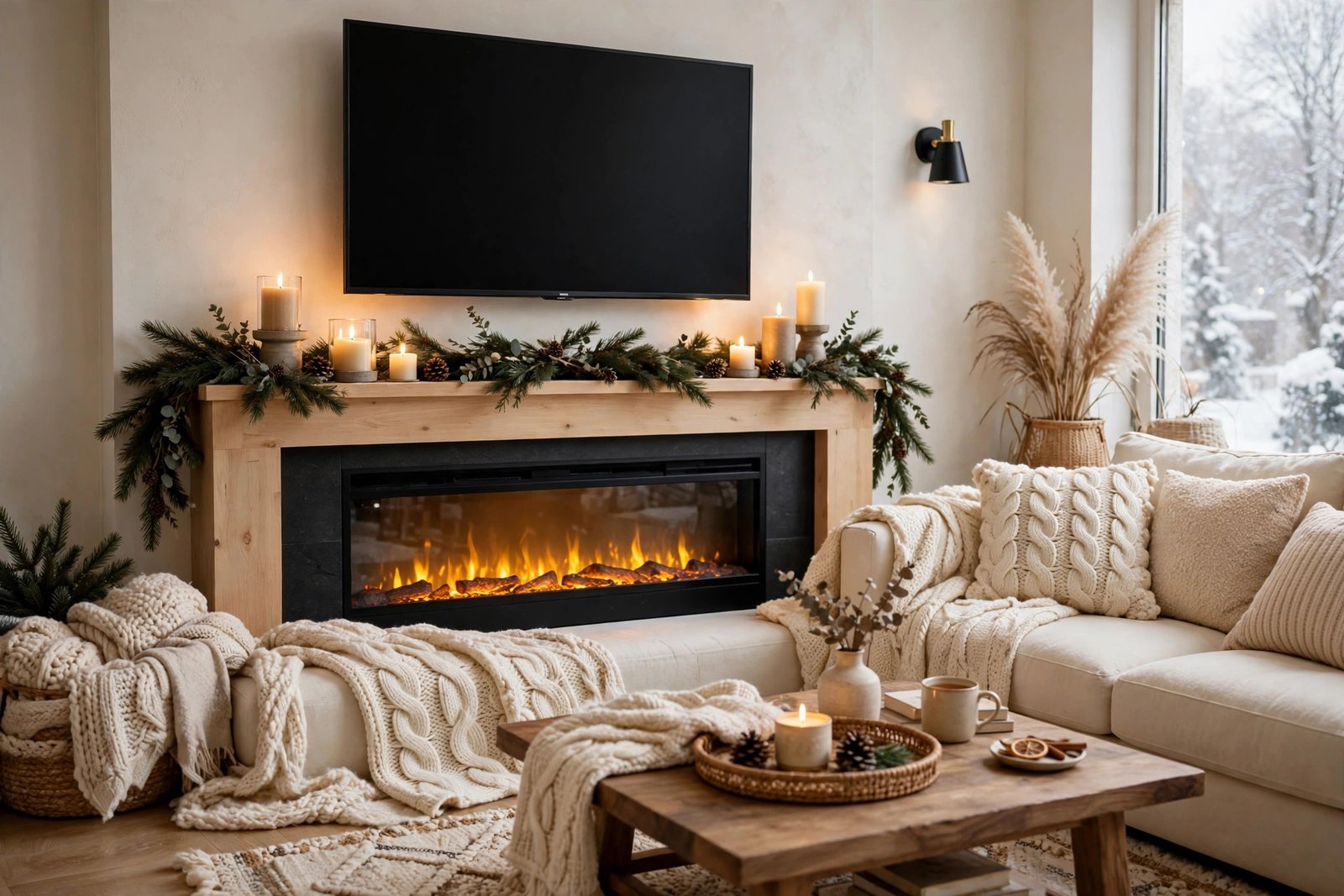
Wall-mounted electric fires are the most popular choice for contemporary homes, and for good reason. Slim, frameless or minimal-frame designs hang like a piece of art, work beautifully under a wall-mounted television, and free up floor space entirely — a real advantage in smaller living rooms. Linear models, often 50 to 72 inches wide, suit a media wall and create a long, low flame line that reads as architecture rather than appliance. Look for models with adjustable flame colour and brightness, because the ability to shift from a bright orange flicker to a soft blue or purple glow changes the mood completely.
Installation is usually straightforward: a wall bracket, a nearby socket, and a level. But plan the electrics first. A wall-mounted fire above a television needs careful heat management — most models direct heat from the front or bottom, but check the manufacturer’s clearance for the TV above. If you are building a media wall, our winter living room layering ideas show how to dress the whole wall with texture so the fire sits in a cosy composition rather than floating alone. Keep the fire at eye level from the sofa, not too high, or the flame line loses its intimacy.
Stove-Style and Freestanding Fires: Instant Character
If your home leans traditional, a stove-style electric fire is the shortcut to character. These freestanding units mimic cast-iron wood stoves, complete with a door, a flue-pipe look and a realistic log bed, and they sit happily in a corner, against a flat wall or inside an old fireplace recess. They are also the easiest option of all: unbox, position, plug in. No fitting, no wall fixings, and they move with you if you rearrange the room or move house.
Freestanding fires suit bedrooms, reading nooks and smaller living rooms particularly well, where a wall-mounted unit would dominate. Pair one with a chunky knit throw, a basket of logs (purely decorative — the irony is part of the charm) and warm lighting, and the corner becomes the room’s cosy heart. For bedroom-specific styling, our cosy winter bedroom ideas pair well with a small stove fire. Choose a model with a thermostat and timer so it warms the room before bedtime and switches off automatically.
Fireplace Inserts: Bringing a Dead Fireplace Back to Life
Many older homes have a fireplace opening that has been blocked up, boarded over or left with a draughty, unused grate. An electric insert is made for exactly this situation: it slots into the existing opening, fills it with flame and logs, and turns a dead feature into the room’s focal point again. Inserts come in sizes to fit standard openings, and many include a trim kit to cover gaps neatly. If the chimney is still open, fit a chimney balloon or cap above the insert to stop cold air pouring down.
Styling an insert is where the magic happens. Dress the mantel as you would a real fire: a mirror or artwork above, candlesticks and a garland at Christmas, a simple vase and books the rest of the year. Our Christmas mantel decor ideas are a perfect seasonal guide for this, and the broader winter home decor ideas show how to keep the mantel looking right through to spring. A surround in painted wood, stone-effect panels or simple plaster gives the insert the architecture it deserves — even a painted mantel shelf alone lifts the whole effect.
Running Costs, Heat Output and Safety
Running costs are the question everyone asks, and the answer is reassuring. In flame-only mode, most electric fires use very little electricity — roughly the equivalent of a couple of light bulbs — so you can run the ambience all evening for pennies. With the heater on, a typical 2kW unit at full power costs roughly what any 2kW heater costs, but most people use it as supplementary heat in one room, allowing the central heating to run lower elsewhere. A thermostat model that cycles on and off will use far less than one left on full power all evening.
Heat output is genuinely useful but limited: expect a 1.5–2kW electric fire to take the chill off a room of up to around 20 square metres, not to heat a whole open-plan floor. Safety is straightforward: plug the heater directly into a wall socket, never into an extension lead or multi-way adapter; keep curtains, throws and furniture at the manufacturer’s clearance distance; and never cover the unit. Electric fires produce no carbon monoxide and no real flame, which makes them a strong choice for homes with children, pets or rented accommodation where a real fire is impossible.
Styling Ideas for Every Room
Linear fire under the TV, flanked by shelving, with warm downlights and a low console beneath.
Small stove fire beside the bed, a knit throw and a candle on the nightstand for a hotel feel.
A wall-mounted fire on the dining wall makes winter dinners feel like an occasion, not a chore.
A compact insert or tabletop flame unit softens a workroom without taking floor space.
Garland, stockings and candles around an insert — festive without any fire risk near decorations.
A mirror above the fire doubles the flame visually and makes a small room feel larger.
The common thread is layering: the fire is the anchor, but throws, cushions, candles and warm-toned lighting do the rest. A bare electric fire in a bare room still looks like an appliance. The same fire, dressed with texture and light, looks like the heart of the home.
Frequently Asked Questions
Do electric fireplaces really heat a room?
Yes, as supplementary heat. A typical 1.5–2kW model comfortably warms a room up to about 20 square metres. For larger open-plan spaces, use it alongside central heating rather than instead of it.
Can I put a TV above an electric fireplace?
Usually yes, because electric fires direct heat forward or downward rather than straight up like a real fire. Check the manufacturer’s clearance guidance and choose a model designed for media-wall use.
How much does an electric fireplace cost to run?
Flame-only mode costs pennies per evening. With the heater on full, a 2kW unit costs roughly the same as any 2kW electric heater, but thermostat models cycle off and use considerably less.
Do I need a chimney or vent for an electric fireplace?
No. Electric fires produce no smoke, fumes or carbon monoxide, so no chimney, flue or vent is needed. Most models simply plug into a standard socket.
Are electric fireplaces safe around children and pets?
They are among the safest fireplace options: no real flame, no hot embers and no carbon monoxide. The glass front stays much cooler than a real fire, though the heater outlet should still be kept clear.
Can I use the flame effect without heat?
Yes — almost all modern models have a flame-only mode, so you can enjoy the ambience year-round, including on summer evenings, without heating the room.
Choose the Fire, Then Dress the Room
Start with the room and the type: wall-mounted for modern living rooms, stove-style for character and small spaces, an insert for a dead fireplace waiting to be revived. Then style around it with texture, candles and warm light, and let the flame do what it has always done — make winter evenings feel like home.
Measure your wall, check the socket position, and pick the flame you will actually enjoy looking at. That is the whole decision, and it is a pleasant one.