
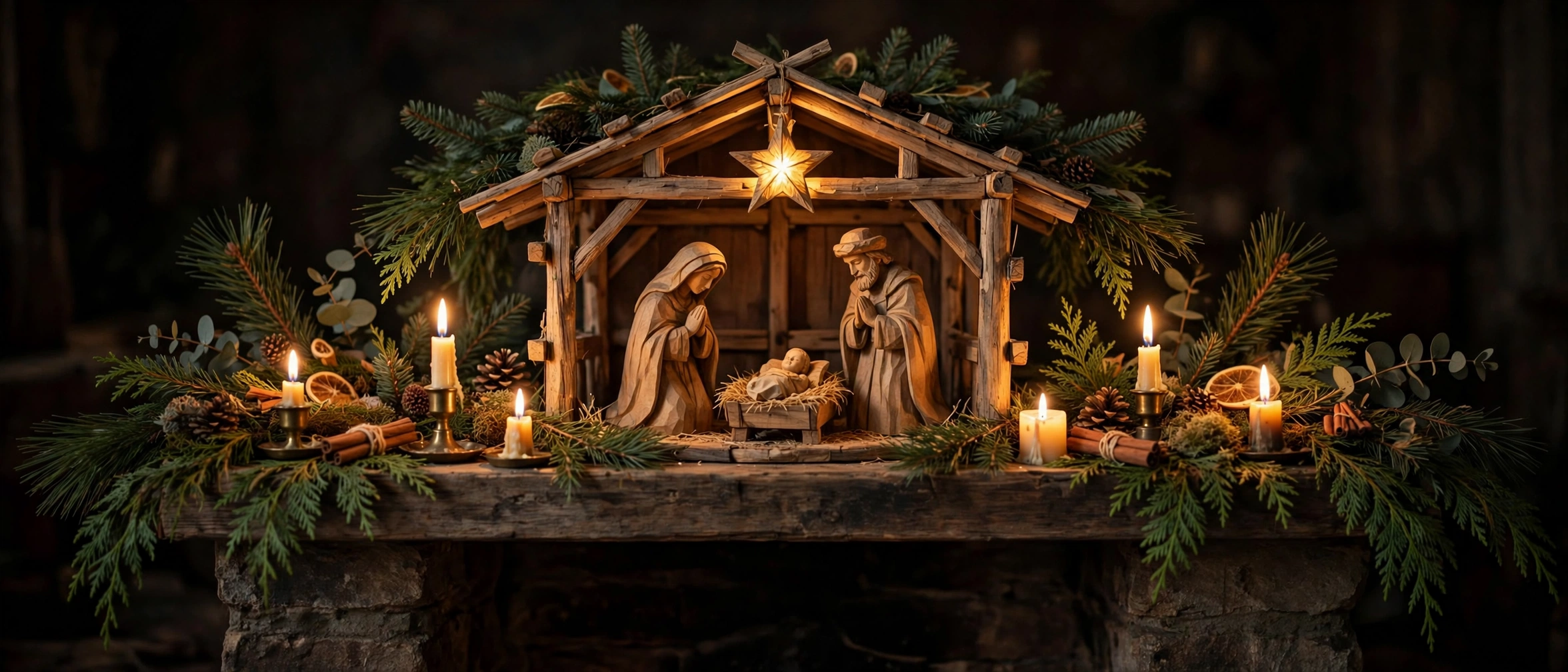
Behind the lights, the wrapping and the feasting, the nativity scene is the decoration that says what Christmas is actually about. A simple stable, a few figures, a star above — and the whole season has its centre. Christmas nativity decor suits every home, from a grand ceramic set on the mantel to a small wooden scene on a windowsill, and it is the decoration that families keep longest, often passing it down through generations.
A nativity display is also the calmest decoration in the house. While the tree sparkles and the presents pile up, the nativity sits quietly and asks for a moment of attention. This guide covers choosing a set, placing it well, lighting it gently, involving children, and the traditions — like adding the baby on Christmas Eve — that make a nativity scene a living part of the season rather than just another ornament. It pairs naturally with the warm, simple look of a Christmas mantel.
- Choose one set in one material and style — mixed sets look cluttered, not collected.
- Place the nativity at eye level where it can be seen, not hidden behind the tree.
- Light it softly with warm light, never with a bright spotlight.
- Keep figures in scale with each other, and give the scene space to breathe.
1. Choosing a Nativity Set
Nativity sets come in every material: carved wood, ceramic, resin, glass, olive wood, metal and even felt. Wood is the warmest and most durable choice for a family home — olive wood sets, often made in Bethlehem, carry a particular meaning and age beautifully. Ceramic sets look elegant on a mantel but chip easily, so they suit a home without small children or pets.
Choose one set and stick to it. A nativity made of mixed figures — a tall ceramic Mary, a small wooden Joseph, a plastic camel — looks accidental, however loved each piece is. Buy the figures as a set, or build a set slowly from one maker in one material. Size matters too: figures of 15 to 25 centimetres suit a mantel or sideboard, while smaller figures suit a shelf or a windowsill. Check the stable fits the figures before you buy — a stable that dwarfs its figures, or figures that cannot fit inside it, will always look wrong.
2. Where to Place the Nativity Scene
The nativity deserves a place of its own, not a corner of a crowded shelf. A mantel is the classic spot: centre the stable, arrange the figures in a loose semicircle, and give the scene the whole middle of the mantel. A sideboard, a console table or a deep windowsill all work, as long as the scene is at eye level when you walk into the room.
Keep it away from the tree if you can — the tree’s lights and baubles will drown a quiet nativity scene. Give it its own surface and its own light, and it becomes a second focal point in the room. If space is tight, a small nativity on the Christmas coffee table or on a bedside table works beautifully — a nativity does not need to be large to be meaningful.
3. Lighting the Scene Gently
Light is what makes a nativity scene feel sacred rather than decorative. A single warm tea light in a glass holder behind the stable, a string of warm fairy lights woven through the greenery at the base, or a small star-shaped light above the stable — one light source is enough. The scene should glow, not glare.
Battery lights are the safest choice, especially with wooden stables and straw. Never place a real candle inside or directly beside a wooden or straw stable, and never leave any flame burning near the scene unattended. A star above the stable — a small lit star, or a paper star on a stick — is the traditional finishing touch, and it gives children something to point at when they tell the story.
4. Building the Scene With Children
A nativity scene is one of the few Christmas decorations children can truly take part in. Let them place the figures — the shepherds here, the animals there, the wise men arriving from the far side of the mantel. A felt or wooden play nativity, kept low where small hands can reach it, lets children retell the story all December without breaking the good set.
Traditions make it memorable. Many families place the empty stable in early December, add Mary and Joseph during Advent, and place the baby in the manger on Christmas Eve — a small ceremony that children remember for years. The wise men can travel across the mantel through December, arriving on Epiphany in early January. These small rituals are what turn a decoration into a family tradition, and they cost nothing at all.
5. Styling Around the Scene
The nativity needs very little around it. A base of greenery — a few sprigs of pine or a small piece of hessian — grounds the stable. A scattering of straw or sand suggests the ground of Bethlehem. A few pine cones or a sprig of holly at the edges frame the scene without competing with it. That is enough; the figures are the decoration.
Keep the colours natural: wood, straw, cream, deep green and one warm metallic, usually gold for the star. Avoid bright colours, glitter and tinsel anywhere near the nativity — they belong on the tree, not on the stable. The restraint is the point: a quiet scene in natural materials stands out precisely because everything else in the house is sparkling.
6. Nativity Scenes for Small Spaces and Outdoors
A small home does not need a large set. A three-figure nativity — Mary, Joseph and the baby — on a windowsill is complete and beautiful, and a single-piece carved nativity fits on a bookshelf. Look for sets designed for small spaces: flat silhouette nativities that stand against a wall, or a small wooden scene in a box that opens like a book.
Outdoors, a simple illuminated nativity on the lawn or by the Christmas front door is a warm welcome. Choose weatherproof resin or metal figures, keep lights low and warm, and secure the figures against wind. An outdoor nativity should be simple and sturdy — three figures and a star read beautifully from the street, while a large, detailed set gets lost in the dark.
Caring for a Nativity Set
Wooden figures need only a soft dusting and a dry place to store. Ceramic figures should be wrapped individually in tissue, with the most fragile — usually the angels and the baby — wrapped twice. Check the stable’s joints each year, and keep the set away from damp lofts and hot attics, which crack wood and craze glaze.
A well-cared-for nativity set lasts for generations, which is exactly the point. It is the one Christmas decoration that is not about this year’s trend, and the one most likely to be unpacked by your grandchildren. Choose it slowly, place it with care, and let it be the quiet heart of your Christmas.
Frequently Asked Questions
Where is the best place for a nativity scene? At eye level on its own surface — a mantel, sideboard or deep windowsill — away from the tree so it has its own quiet focal point.
What material is best for a nativity set? Wood is the warmest and most durable for family homes; ceramic is elegant but fragile. Choose one material and one maker for a coherent set.
When should I put the baby in the manger? Many families place the baby on Christmas Eve as a small ceremony. The wise men traditionally arrive at Epiphany in early January.
How do I light a nativity scene safely? Use warm battery fairy lights or a tea light in glass placed behind the stable, away from wood and straw. Never put a naked flame inside a wooden stable.
A nativity scene asks very little — a stable, a few figures, a soft light — and gives back the reason for the whole season. Place it where you can see it, light it gently, and let it be the quiet centre of your Christmas.
1 thought on “Christmas Nativity Decor Ideas for a Meaningful Home”