
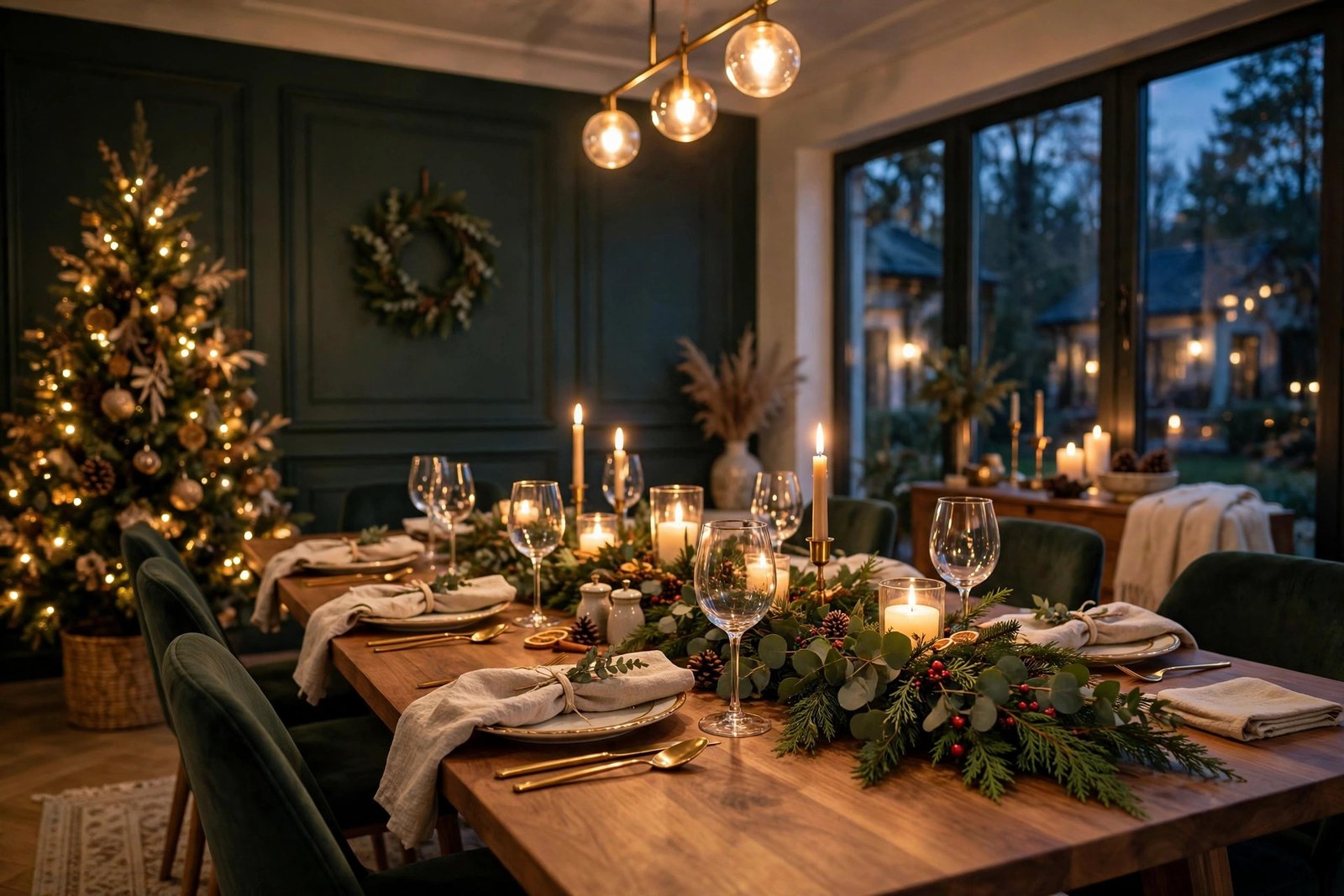
Christmas Dining Room Decor Ideas for a Festive Table
The dining room works harder at Christmas than any other room, and it gets the least decorating attention. We lavish effort on the tree and the mantel, then eat Christmas dinner at a table with a single candle and a paper tablecloth. It deserves better — and it does not need much. A dining room decorated for the season, not just for the day, makes every December meal feel like an occasion.
This guide covers the table, the sideboard, the walls and the lighting, with ideas that stay up all month, survive family meals, and work in rooms that double as everyday eating spaces.
Key Takeaways
- Decorate the room for the season, and dress the table for the meal — the two jobs are different.
- Keep centrepieces low (under 30cm) so guests can see each other across the table.
- One hero element per surface: a centrepiece on the table, a display on the sideboard, a wreath on the wall.
- Candlelight is non-negotiable at Christmas dinner; use glass holders for safety near greenery.
The Table: Layers, Not Clutter
Start with a cloth or runner in a colour that echoes your tree — cream linen with a burgundy or green runner is the safest festive base. Add placemats only if they earn their place; a charger plate under each setting looks smarter than a placemat and is easier to clean. Napkins matter more than people think: cloth napkins, folded simply and tied with ribbon or a sprig of rosemary, lift the whole table for almost no money.
Cutlery and glasses should be the best you own, polished and counted before guests arrive. Nothing kills a festive table faster than hunting for a missing fork while the turkey cools. If you are planning the full Christmas menu alongside the room, our Christmas breakfast recipes show the same relaxed-but-special approach for the morning table, and our Thanksgiving table decor ideas use the same layering method for the autumn gathering.
Centrepieces That Survive Dinner
The best centrepieces are low, narrow and flame-safe. A greenery runner down the middle of the table with candles in glass holders and a few baubles is the classic for a reason: it looks abundant, leaves room for serving dishes, and does not block conversation. A row of small vases with single stems, a wooden board with candles and pinecones, or a collection of jars with fairy lights all work the same way.
Avoid tall candelabras unless your table is very wide, avoid anything that sheds (glitter, loose pine needles near food), and avoid scented candles at the table — they compete with the food. Save the scented candles for the sideboard, where they can be admired without being smelled over dinner.
The Sideboard and Walls
The sideboard is your display surface and your serving station, so it needs to do both. Keep one end clear for serving dishes and drinks, and style the other end: a mirror or framed print with a small wreath hung on it, a pair of candlesticks, a bowl of baubles or a stack of vintage books tied with ribbon. A wreath on the wall or on a mirror instantly says Christmas without taking any table space.
Wall decor for December can be as simple as swapping one framed print for a festive one, hanging a paper star in a window, or draping a short garland along a picture rail. The dining room does not need a tree of its own — a small potted tree or a vase of branches on the sideboard gives the scent and the shape without crowding the room.
Lighting: The Secret Ingredient
Dining rooms are often over-lit, and Christmas dinner under a bright ceiling light feels like a canteen. Dim the main light, or switch it off entirely, and rely on candles and a low lamp. If your room has a chandelier, hang a few small baubles or a short greenery swag from it for December — it becomes a decoration in its own right.
Fairy lights have a place here too: along a window frame, inside a glass cloche on the sideboard, or woven through the sideboard display. Warm white only; coloured lights belong on the tree, not at the dinner table. For the wider lighting picture, see our Christmas window decor ideas, which balance light across a whole room.
Place Settings and Small Details
Place cards are the detail guests actually keep. Hand-written cards, a sprig of greenery tucked behind each one, or a small cracker at each setting cost little and make people feel expected rather than merely invited. For children, a small activity or a chocolate at their place keeps them happily seated while adults talk.
Think about the chair backs too: a small wreath, a bow or a sprig tied to each chair transforms the room from behind, which is how it is usually seen from the doorway. Two or three decorated chairs (the hosts’ and the guest of honour’s) are enough; decorating every chair looks fussy.
Keeping It Up All Month
A dining room decorated only for Christmas Day is a lot of work for one meal. Design it to last: greenery that survives (faux or hardy fresh), candles you can light nightly, a sideboard display that does not need daily tidying. Then, on the day itself, you only add the table dressing — cloth, napkins, centrepiece — and the room is already festive.
After Christmas, remove the table dressing and the most obviously festive pieces, but leave the greenery and candles until New Year. The room will still feel special for those in-between days, when a quiet family meal deserves a little atmosphere of its own.
Frequently Asked Questions
How do I decorate a dining room I also eat in every day?
Keep the room’s permanent decor festive but practical (sideboard display, wall wreath, candles) and add table dressing only for special meals.
What is the safest candle setup for a dining table?
Candles in glass holders, away from greenery and napkins, never left burning unattended, and extinguished before guests leave the table.
Can I use a Christmas centrepiece with a small table?
Yes — go narrow and low. A single row of small vases or a slim greenery runner suits a small table better than one big arrangement.
Should the dining room match the living room theme?
Echo it, don’t copy it. Share one or two colours or materials, but let the dining room have its own character — it will feel designed, not duplicated.