
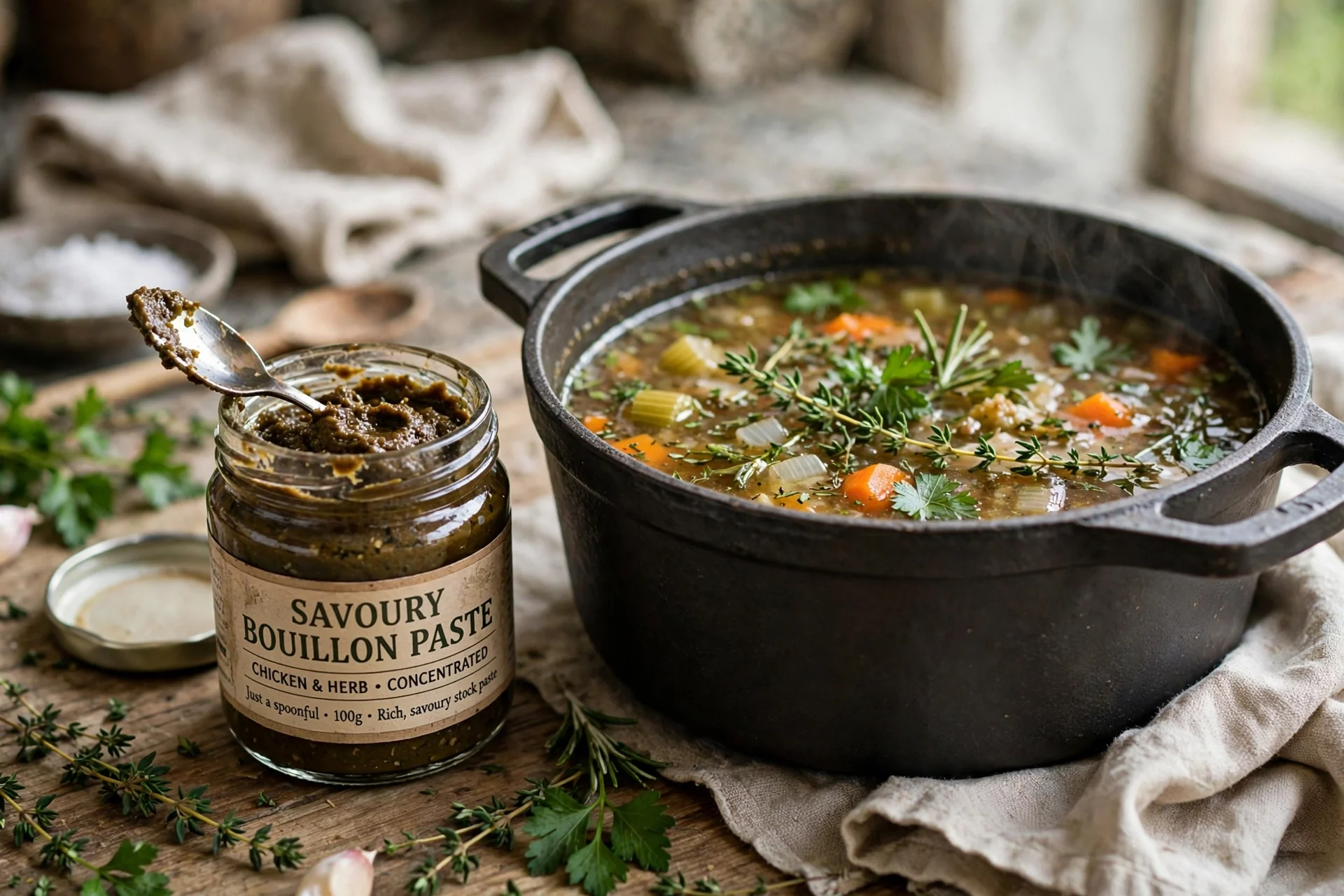
Ask any home cook what their secret weapon is and a surprising number will point to a small glass jar in the fridge. Better Than Bouillon is a concentrated paste that turns into stock with hot water, and it has quietly become one of the most-loved pantry staples in home cooking. It makes soups taste like they simmered all day, it fixes bland gravy in seconds, and one jar lasts for months. If you have never used it, here is how it works, which flavours to buy first, and where it beats the stock cubes and cartons you are used to.
- Better Than Bouillon is a concentrated paste: 1 teaspoon plus 1 cup of hot water makes 1 cup of stock.
- Chicken is the best first flavour; roasted beef and vegetable are the next two to try.
- It tastes richer than stock cubes because it is made from real meat, vegetables, and seasonings.
- An opened jar keeps in the fridge for months — far longer than a carton of stock.
- Use it anywhere you would use stock, plus as a seasoning rubbed into meat or stirred into grains.
What Is Better Than Bouillon?
Better Than Bouillon is a paste, sold in small glass jars, made from roasted meat or vegetables, salt, and seasonings, concentrated down until a single teaspoon carries the flavour of a whole cup of stock. You stir it into hot water and it dissolves into a rich, savoury broth. It was first made in the US and is now sold in most big supermarkets and online, in flavours including roasted chicken, roasted beef, vegetable, garlic, mushroom, and ham.
The name is a claim, and for most home cooks it holds up. Stock cubes are mostly salt and flavouring pressed into a hard block. Cartons of stock are mostly water, which is why they taste thin and why they go off within days of opening. The paste sits in between: concentrated enough to taste like something, convenient enough to use every day, and cheap per cup once you do the maths. One jar makes about 38 cups of stock, which works out far cheaper than buying cartons. If you cook rice often, try using it there too — our how to cook rice guide covers the basics, and a teaspoon of chicken paste in the cooking water turns plain rice into something worth eating on its own.
How to Use Better Than Bouillon
The basic ratio is simple: 1 teaspoon of paste to 1 cup (8 ounces) of hot water. Stir until it dissolves. That is your stock. Use it in any recipe that calls for stock or broth: soups, stews, risottos, gravies, sauces, and braises. It dissolves into hot liquid easily, and it also works stirred into cold water if you give it a good whisk — though hot is faster.
Where it really shines is as a seasoning, not just a stock. Rub a little onto chicken or roast beef before cooking and it forms a savoury crust. Stir a teaspoon into mashed potatoes, cooked grains, or steamed vegetables and they taste seasoned rather than plain. Add it to the water when you boil pasta and the pasta itself picks up flavour. The one thing to watch is salt: the paste is salty, so taste before you add extra salt to the dish. If you reduce a sauce made with it, the salt concentrates, so season at the end. For a big roast, our how to cook a turkey in the oven guide pairs beautifully with a spoonful of the roasted chicken flavour in the basting liquid.
Which flavour should you buy first?
Start with roasted chicken. It is the most versatile flavour by a long way — it works in soups, rice dishes, chicken recipes, vegetable dishes, and anywhere a recipe calls for chicken stock. Roasted beef is the second jar to buy: it is deeper and richer, made for beef stews, gravy, and anything with mushrooms or red wine. Vegetable is the third, and it is the one to keep if you cook for vegetarians or want a neutral base that does not taste of meat.
After those three, the fun ones are worth trying. Garlic adds a warm, savoury depth to pasta sauces and roasted vegetables. Mushroom is excellent in risotto and gravy. Ham is niche but brilliant in bean soups and split pea soup. There are also low-sodium versions of the main flavours, which are worth buying if you like to control the salt yourself. Avoid the temptation to buy every flavour at once — start with chicken, use it for a month, and you will know exactly which jar to add next.
Better Than Bouillon vs Stock Cubes and Cartons
Against stock cubes, the paste wins on flavour. Cubes are convenient and cheap, but they taste one-dimensional — mostly salt, with a hint of whatever flavour is on the box. The paste tastes rounder, meatier, and more like something you made yourself. Against cartons, the paste wins on shelf life and cost. An opened carton of stock lasts about a week in the fridge. An opened jar of paste lasts for months, and you only make as much as you need, so nothing goes to waste.
Against homemade stock, the paste loses — but that is not a fair fight. Homemade stock is better, and it also takes four hours and a pile of bones. For a Tuesday night, the paste is the right tool. Keep a jar of chicken and a jar of beef in the fridge and you will cook better food with less effort, which is the whole point of a pantry staple. And if you like baking as well as cooking, our Christmas cookie baking guide is a good reminder that the best kitchens run on a few reliable staples, not a cupboard full of gadgets.
Frequently Asked Questions
Does Better Than Bouillon need to be refrigerated?
Yes, once opened. Keep the jar in the fridge and it will last for months. Unopened jars can be stored in the pantry.
Is Better Than Bouillon gluten-free?
Most flavours are, but check the label — formulations vary by flavour and region. The roasted chicken, beef, and vegetable flavours are generally gluten-free.
Can I use it instead of stock cubes?
Yes, in any recipe. Use 1 teaspoon of paste per cup of water where the recipe calls for a stock cube dissolved in a cup of water. Taste before adding extra salt.
How long does an opened jar last?
Months in the fridge. The high salt content preserves it well, but use a clean spoon each time and keep the lid on tight.
Is it vegetarian?
The vegetable flavour is. The chicken, beef, and ham flavours are not. Check the label for your specific flavour.
Better Than Bouillon earns its place in the fridge the honest way: it makes everyday food taste better, it costs very little per use, and it never goes off before you finish it. Buy the chicken first, learn the teaspoon-per-cup ratio, and your soups, rice, and gravies will never be bland again.