
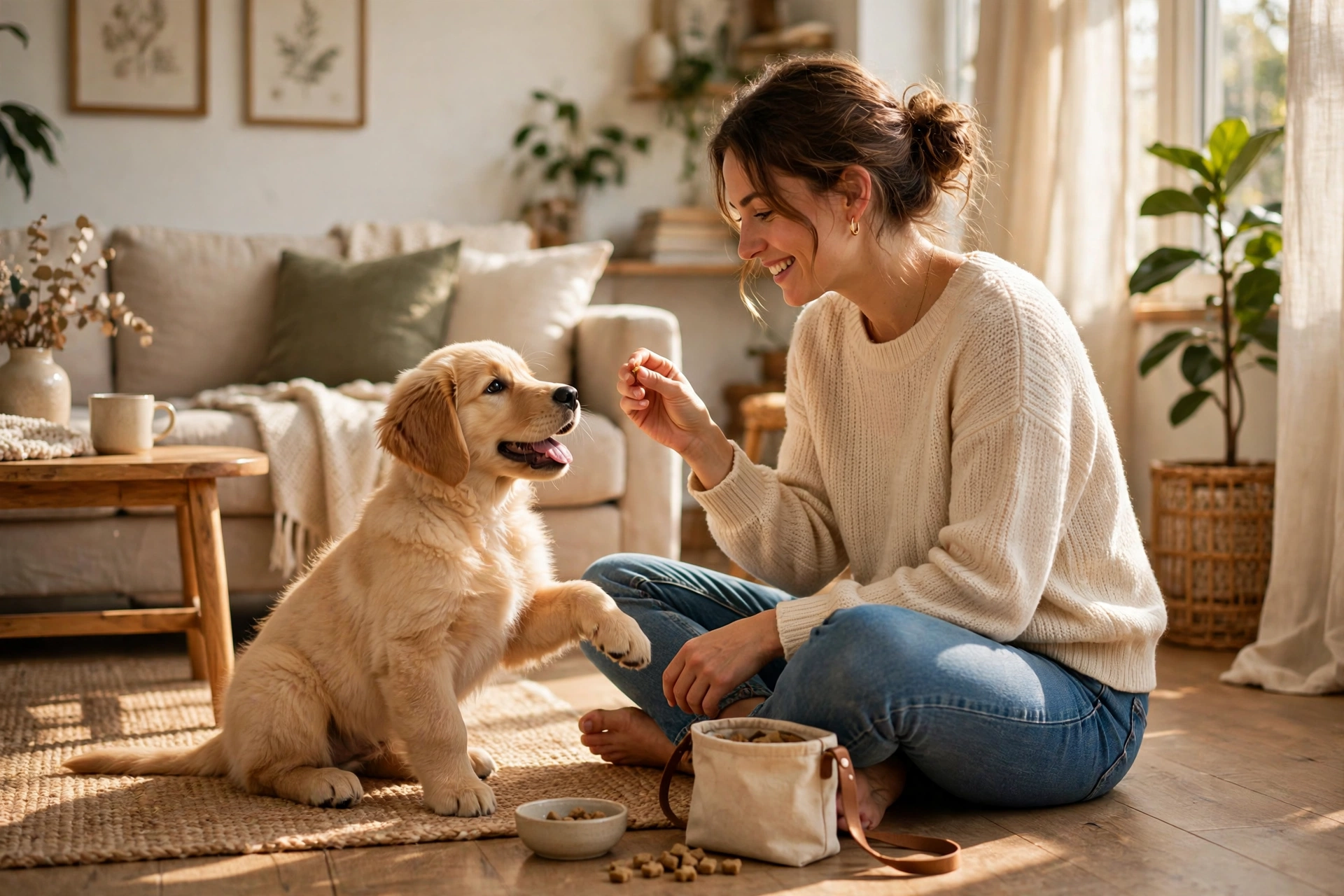
Good dog training tips are the difference between a dog you enjoy living with and a dog who runs your house. The good news is that dogs want to learn, and training is mostly about timing, consistency and rewards — not dominance, not punishment, and not expensive equipment. This guide covers 20 basics every owner needs: the core commands, house training, loose-leash walking, recall, and the mistakes that slow training down.
- Train in short sessions — 5 to 10 minutes, two or three times a day — and always end on a success.
- Reward the behaviour you want within seconds, with a treat, praise or play. Timing is everything.
- Be consistent: everyone in the house must use the same words and the same rules.
- Never punish a dog for something it did minutes ago — it cannot connect the punishment to the act.
Dog Training Tips: The Foundations
Before any command, get the foundations right. First, choose a marker word — “yes!” works well — and say it the instant your dog does something right, followed by a treat. The marker tells the dog exactly which moment earned the reward. Second, pick high-value treats: small, soft, smelly pieces your dog loves, cut into pea-sized bits so you can reward often without overfeeding. Third, train in a quiet room with few distractions, and add distractions gradually. A dog that sits perfectly in the kitchen may not sit at the park — that is normal, and it is why you practise in harder places step by step. Fourth, keep sessions short. Five focused minutes beats thirty distracted ones. And fifth, end every session with something easy and a reward, so your dog finishes happy and keen for the next one.
20 Dog Training Tips Every Owner Needs
The Core Commands
1. Sit: hold a treat above the nose and move it back over the head — the bottom goes down naturally. Mark and reward.
2. Stay: ask for a sit, show a flat palm, wait two seconds, then reward. Build the time slowly.
3. Come (recall): the most important command for safety. Practise in the garden with a long line, and make coming to you the best thing in the world — never call your dog to scold it.
4. Down: lure from a sit with a treat moving down to the floor between the paws.
5. Leave it: hold a treat in a closed fist; when the dog stops sniffing and looks away, mark and reward with a different, better treat.
6. Drop it: trade the object for a treat, every time. Never chase a dog to take something — chasing is a game, and the dog will always win.
House Training and Daily Life
7. Toilet training: take the puppy out after every meal, nap and play session, and reward immediately after it goes outside. Never punish an accident indoors — just clean it up and take the dog out sooner next time.
8. Crate training: make the crate a happy place with meals, chews and a comfy bed inside. Never use the crate as a punishment.
9. Loose-leash walking: reward the dog for walking beside you, and stop or change direction when the lead goes tight. Pulling must never get the dog where it wants to go.
10. Greeting people calmly: reward four paws on the floor. Ask visitors to ignore jumping and only give attention when the dog is calm.
11. Alone time: build up time alone gradually, starting with a few minutes, so the dog learns that you always come back.
12. Chewing: give the dog appropriate chews and rotate them. If it chews something it should not, swap it for a toy — do not chase.
Socialisation and Behaviour
13. Socialise early: expose a puppy to different people, dogs, sounds and places before 16 weeks, in a positive way. A well-socialised dog is a confident dog.
14. Handle the paws, ears and mouth: touch them gently and reward, so vet visits and grooming are stress-free.
15. Teach a settle: reward the dog for lying calmly on a mat. This is the command that makes restaurants, family visits and home working possible.
16. Manage barking: work out why the dog barks — boredom, fear, excitement — and address the cause, not just the noise.
17. Play as a reward: a game of tug or fetch is a powerful reward, and it builds your bond.
18. Be patient with adolescents: dogs between 6 and 18 months often “forget” their training. It is normal — keep practising and stay calm.
19. Train the whole family: everyone must use the same words and rules, or the dog gets confused.
20. Know when to get help: a good trainer or behaviourist is worth the money for fear, aggression or separation anxiety. Asking for help is good ownership, not failure.
Common Dog Training Mistakes
The most common mistakes are all avoidable. Repeating a command five times teaches the dog to ignore the first four. Training when you are frustrated teaches the dog that training is stressful. Using punishment for fear-based behaviour makes the fear worse. Inconsistency — sometimes allowing the dog on the sofa, sometimes not — confuses the dog completely. And expecting too much too soon sets both of you up to fail. Dogs learn in small steps, and every small step deserves a reward. If you are setting up a home for a new puppy, our home decor ideas guide has pet-friendly room ideas, and our things to draw guide keeps the kids entertained while you train.
How Long Does Dog Training Take?
The basics — sit, stay, come, toilet training — usually take a few weeks of daily practice. Reliable recall and loose-leash walking take months, because they depend on distractions and real-world practice. And training never truly ends: dogs need ongoing practice to keep their skills sharp, just like people. The good news is that training becomes part of daily life rather than a chore — a few minutes during a walk, a quick practice before dinner, a reward for calm behaviour at the door. And when your dog masters a new trick, celebrate it — our happy birthday images are perfect for marking a gotcha day or a training milestone. The result is a dog that is a pleasure to live with, and a bond that gets stronger every day.
What are the best dog training tips for beginners?
Short sessions, instant rewards, one command at a time, and consistency from the whole family. Start with sit, recall and toilet training.
How long should a dog training session be?
5–10 minutes, two or three times a day. Short, focused sessions work far better than long ones.
What is the most important dog command?
Recall (“come”) — it keeps your dog safe. Practise it often and always reward it generously.
Should I punish my dog for bad behaviour?
No — punishment creates fear and confusion. Redirect to the right behaviour and reward that instead.
When should I start training my puppy?
From the day it comes home, usually around 8 weeks. Start with toilet training, name recognition and gentle socialisation.