
Bedroom Storage Ideas for Small Rooms That Actually Give You Space Back
A small bedroom does not have to feel cramped, but it does punish every wasted inch. When floor space is tight, clutter has nowhere to hide: a chair becomes a wardrobe, the floor becomes a drawer, and the room slowly stops feeling like a place to rest. The good news is that most small bedrooms are not short of space at all. They are short of planned storage. The walls, the bed, the door, and the awkward corners all hold storage potential that a standard dresser and a single closet rail never use.
This guide covers bedroom storage ideas for small rooms that work in real homes, not just in showroom photos. You will learn how to audit what you actually own, use vertical wall space properly, turn the bed into your biggest storage asset, organize a small closet so it holds twice as much, and keep the whole system working with a routine that takes minutes a week. Every idea here is renter-friendly where it matters, and none of them requires knocking down a wall.
Key Takeaways
- Start by decluttering: storage only works once you know exactly what needs a home.
- Use vertical space first — tall shelving, over-door racks, and wall hooks beat another floor-standing unit.
- Your bed is the largest storage asset in the room: drawers, lift-up ottomans, and under-bed bins reclaim dead space.
- A small closet holds far more with a second rail, shelf dividers, and slim matching hangers.
- Give every category one labeled home so tidying takes minutes, not a weekend reset.
- Keep daily-use items within arm’s reach and seasonal items high, low, or out of the room.
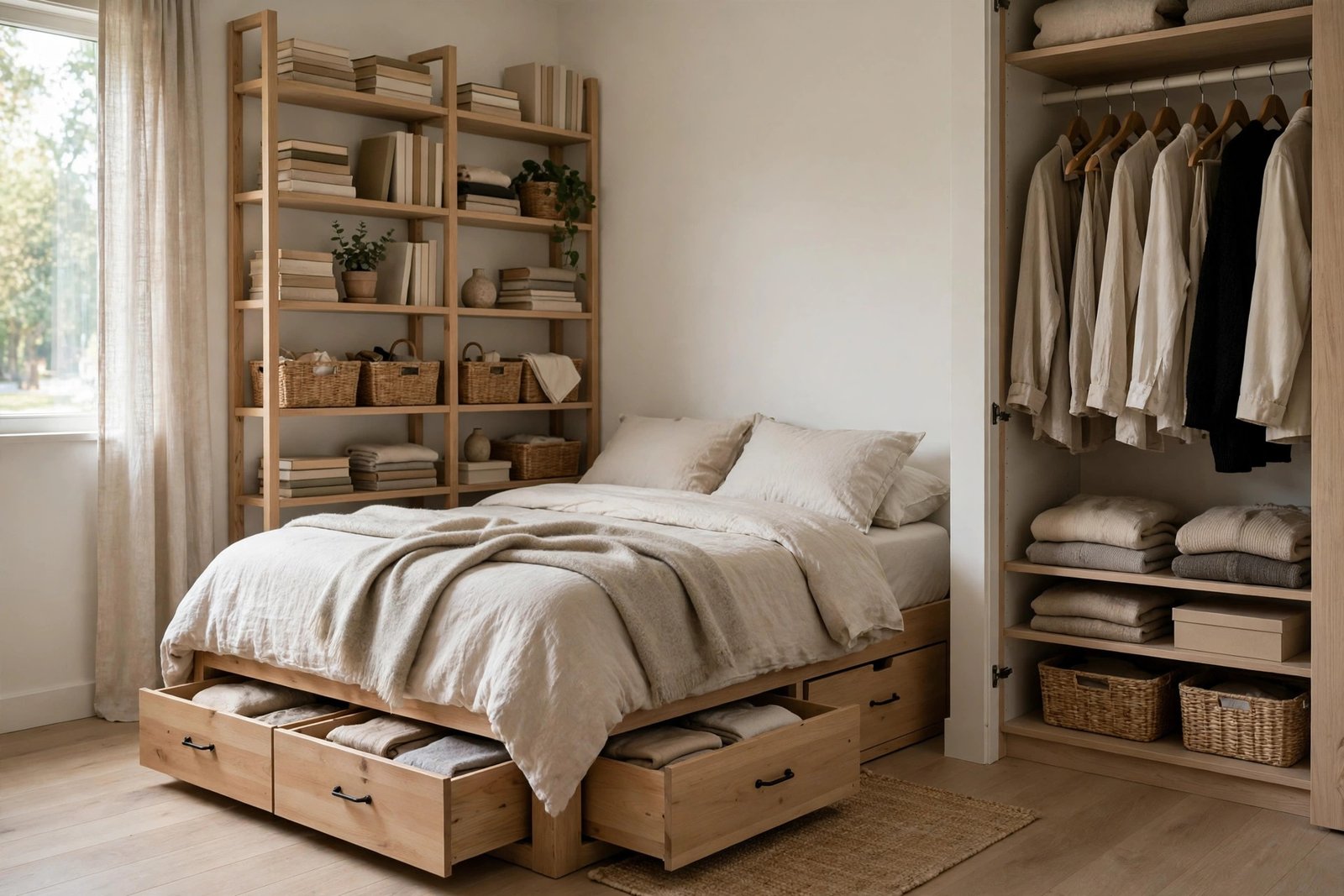
Step One: Audit Before You Buy Anything
The most common mistake in small bedrooms is buying storage before knowing what needs storing. A beautiful basket set will not help if your real problem is forty pairs of shoes, or a closet full of clothes you never wear. Spend one honest hour on an audit first. Take everything out of one zone at a time — the closet, then the dresser, then the surfaces — and sort into keep, relocate, and let go. Be ruthless about duplicates, worn-out items, and anything you have not used in a year. Storage bought for things you should have removed is just tidier clutter.
Next, count what remains by category: everyday clothes, work clothes, shoes, bedding, books, chargers and tech, bags, and seasonal items. This list is your storage shopping list. Shoes need a rack or a row of bins, not a deep drawer. Bedding needs large, flat space, which is exactly what the area under the bed provides. Small items like chargers and jewelry need shallow trays and hooks, not a big box where they disappear. When each category has a measured home, you stop buying generic containers and start buying the right container once.
Finally, measure before you buy: ceiling height, under-bed clearance, closet depth, and unused wall width. Most small-bedroom storage failures come from guessing — bins that do not fit under the bed, or shelves that block a door swing.
Go Vertical: Walls, Doors, and the Space Above Your Head
Floor space is the scarcest resource in a small bedroom, but wall space is usually abundant and almost always underused. The strip of wall above a dresser, beside a door, or over the bed can hold shelving that stores books, baskets, and folded items without touching the floor at all. Tall, narrow bookcases fitted into otherwise dead corners work the same way, and they draw the eye upward, which makes the room feel taller. Keep the top shelves for things you reach for rarely, and the shelves at eye level for daily items, so vertical storage stays convenient rather than decorative.
Doors are the second overlooked surface. An over-door rack on the bedroom door or the closet door holds shoes, bags, scarves, or cleaning supplies, and it costs nothing in floor space. Adhesive or screw-in hooks on the inside of the closet door handle belts, necklaces, and tomorrow’s outfit. Even the back of the bedroom door can carry a full-length mirror with a jewelry cabinet behind it, combining two functions in a few inches of depth. Just check that hooks and racks do not stop the door closing or damage a rented door — felt pads and removable hooks solve most of that.
One caution: vertical storage only helps if it stays organized. Use matching baskets or fabric bins on open shelves so contents read as one calm surface, label the bins, and apply the one-in-one-out rule: when something new arrives, something old leaves. For broader principles, see our guide to storage ideas for small spaces.
Make the Bed Work Harder: Under-Bed and Headboard Storage
The bed occupies more floor area than anything else in the room, and the space beneath it is often completely wasted. If your bed sits on a frame with at least six inches of clearance, shallow rolling bins underneath can hold out-of-season clothes, spare bedding, or shoes. Choose clear or labeled bins with lids so dust stays out and you can find things without dragging every bin out. If your bed sits directly on the floor, bed risers can create that clearance cheaply — just check the frame stays stable and the new height still feels comfortable to get into.
For a bigger upgrade, consider a storage bed. Drawer beds put two to four deep drawers where dead space used to be, and ottoman lift-up beds reveal the entire under-bed area in one motion, which is ideal for bulky items like winter duvets and spare pillows. They cost more than a basic frame, but in a small room they can replace a whole dresser, which is a trade worth making. If a new bed is not in the budget, a headboard with shelving or a slim shelf above the bed replaces a nightstand without eating floor space.
Keep under-bed storage seasonal and intentional. It is the worst place for things you need daily, because retrieving them means crouching and sliding bins. Daily clothes belong in the closet or dresser; under the bed belongs to the bulky, the seasonal, and the spare. Our guide to how to store winter clothes covers how to pack those seasonal items so they come back out fresh instead of musty.
Double Your Closet Without Renovating It
Most small closets fail not because they are small, but because they use only one rail and one shelf. A standard hanging rail leaves a dead zone below short clothes — shirts, folded trousers, and jackets — that is easily a second rail’s worth of space. Adding a lower tension rod or a freestanding double-hang unit instantly doubles hanging capacity for short items, while long items like dresses and coats keep their full-length section at one end. This single change is the highest-impact closet upgrade there is, and it costs very little.
Above the rail, shelf dividers stop stacks of folded jumpers from toppling sideways, and small fabric bins corral accessories and gym kit. On the closet floor, a shoe rack or clear shoe boxes ends the pile by the door, and a hanging shoe organizer handles overflow. Switch to slim, matching velvet hangers: they take less width, grip clothes, and make the closet look calmer.
Finally, organize by use, not just by color. Keep work clothes together, everyday clothes together, and occasion clothes at the far end. Put the items you reach for most at eye level and in the front, and move anything you wear less than once a month to the top shelf or under the bed. If your closet is truly tiny, our guide to how to organize a small closet walks through a complete small-closet layout, and small closet organization ideas has more layout inspiration for awkward spaces.
Choose Furniture That Stores and Serves
In a small bedroom, every piece of furniture should earn its footprint twice. A nightstand with a drawer beats a nightstand that is just a surface. A bench at the foot of the bed with storage inside gives you a seat for putting on shoes and a home for blankets, and a desk that folds down from the wall gives you a workspace that disappears when the workday ends.
This principle also applies to the pieces you already own. A dresser top is not a storage surface; it is a display surface that should hold only a lamp, a small tray for daily jewelry, and perhaps a plant. The moment a dresser top becomes a dumping ground, the room looks cluttered no matter how organized the drawers are. Use drawer dividers inside dressers so small items do not migrate into a tangled layer at the bottom, and fold clothes vertically — standing up like files — so you can see everything in a drawer at a glance instead of digging through a stack.
When you do add furniture, favor pieces that fit the room’s proportions. A tall, narrow dresser often serves better than a wide, low one, because it uses vertical wall space and leaves more floor visible — and visible floor is what makes a room feel bigger. That is also why murphy bed ideas for small spaces appeal to studio owners: folding the bed away returns the entire floor during the day.
Keep It Working: The Ten-Minute Weekly Reset
Return clothes to hangers or the laundry basket, clear surfaces, and put tomorrow’s outfit on one hook.
If shoes, chargers, or bags have no fixed spot, they will live on the floor. Label the spot and use it.
Once a week, return strays to their homes, wipe surfaces, and empty any bin that has become a junk drawer.
Rotate seasonal clothes between closet and under-bed storage in spring and autumn, and declutter as you swap.
Every new item replaces an old one. This single rule stops a small bedroom from slowly refilling.
Nothing lives permanently on the floor except furniture. Visible floor is what makes the room feel spacious.
Design your system to be easy, not willpower-dependent: put the laundry basket where clothes actually come off, and keep a small donation bag in the closet so letting go takes seconds. The goal is not a showroom — it is a room where everything has a home and the floor is clear.
Frequently Asked Questions
What is the best bedroom storage for a very small room?
Start with under-bed storage and a double-hang closet, then add wall shelving. Those three changes use space you already have — under the bed, inside the closet, and on the walls — without taking a single extra inch of floor.
How can I add storage to a rented bedroom?
Use freestanding and removable options: rolling under-bed bins, over-door racks, tension rods for a second closet rail, adhesive hooks, and leaning shelves. Avoid drilling where your lease forbids it, and use felt pads to protect doors and floors.
Is a storage bed worth it in a small bedroom?
Usually yes, because it can replace a dresser. Drawer beds suit daily items, while lift-up ottoman beds suit bulky seasonal bedding. Measure your clearance and ceiling height first, and choose the style that matches what you actually need to store.
How do I stop my small bedroom from looking cluttered?
Use matching bins on open shelves, keep dresser tops nearly clear, fold drawer clothes vertically so you can see them, and keep the floor visible. Visual calm comes from consistency — one bin style, one hanger style �� more than from owning less.
Where should seasonal clothes go in a small bedroom?
Under the bed in lidded bins, or on the closet’s top shelf in labeled containers. Wash and dry items before packing them, use cedar or lavender instead of mothballs, and rotate them back in during your twice-yearly seasonal swap.
Start With One Zone This Weekend
You do not need to reorganize the whole bedroom in a day. Pick the zone that frustrates you most — usually the closet or the under-bed space — audit it, give every category a home, and add one storage piece that fits your measurements. The next zone gets easier once you know your categories and habits.
A small bedroom rewards planning more than spending. Use the walls, use the bed, double the closet, and keep the floor clear, and the room you already have will feel noticeably larger — not because it changed size, but because everything in it finally has somewhere to belong.