
How Often Should You Change Your AC Filter? The Complete Homeowner Guide
Your air conditioner filter is one of the smallest parts of your cooling system, yet it has an outsized effect on comfort, energy bills, and indoor air quality. Ask any HVAC technician what the single most neglected maintenance task is, and the answer is almost always the same: the filter. So how often should you change your AC filter? The short answer is every one to three months for most homes, but the honest answer is that it depends on your filter type, your household, your pets, and how hard your system runs. This guide walks you through the real schedule, the signs that a filter is overdue, and how to pick the right replacement so your system breathes easily all year.
Key Takeaways
- Most homes should change the AC filter every 1 to 3 months; basic fiberglass filters need monthly changes, while pleated filters last up to 90 days.
- Homes with pets, allergies, smokers, or heavy summer use should check monthly and change more often.
- A clogged filter raises energy bills, weakens airflow, and can freeze coils or overheat the system.
- Always match the exact filter size printed on the old filter frame and note the airflow arrow direction before installing.
- When in doubt, check monthly and replace when the filter looks grey and dusty rather than following the calendar blindly.
The Standard Schedule: Every 1 to 3 Months
The widely quoted rule of every 90 days applies to standard one-inch pleated filters in an average home without pets or allergy concerns. If your home uses basic fiberglass panel filters, the cheapest kind sold in multipacks, the interval shrinks to every 30 days because those thin filters load up with dust quickly and offer very little surface area for trapping particles. Thicker media filters, the four- or five-inch cartridges found in many modern air handlers, can last six to twelve months because their deep pleats hold far more dust before airflow drops. Your system manual or the filter packaging will state a recommended interval, and that number is a good starting point, but your home is not a laboratory. A filter in a dusty renovation zone or a home near a busy road will clog faster than the same filter in a quiet, carpet-free apartment.
Seasonal use matters just as much as the calendar. In climates where the air conditioner runs nearly every day through a long summer, a filter that would last three months in spring may be spent in six weeks. Conversely, during mild months when the system barely runs, the same filter can safely stay in place longer. That is why technicians recommend checking the filter monthly even if you only replace it quarterly. A quick visual check takes thirty seconds: slide the filter out, hold it up to the light, and if you can barely see light through it, it is time for a new one. This simple habit is the backbone of sensible HVAC maintenance, and it prevents most of the airflow problems that lead to expensive service calls.
What Changes Your Filter Schedule
Several household factors can cut a filter’s life in half or double it. Pets are the biggest one: a single dog or cat sheds hair and dander that a filter catches constantly, and multiple pets can clog a standard pleated filter in as little as three to four weeks during shedding season. Allergies and asthma in the household are another reason to change more often, since a loaded filter stops trapping new particles effectively and lets allergens circulate. Smokers, wood-burning fireplaces, candles burned daily, and recent construction or renovation work all add particles that shorten filter life. On the other hand, a small household without pets, with hard floors instead of carpet, and with windows kept closed will find filters last toward the longer end of the range.
Your home’s location plays a role too. Homes in dusty, dry regions, near farmland, or beside unpaved roads pull in more outdoor particulate. High pollen seasons in spring and autumn load filters faster, and wildfire smoke events can saturate a filter in days. If anyone in the home notices more dust settling on furniture, a musty smell when the system starts, or sneezing that improves when away from home, the filter is a prime suspect. These signals matter more than any printed schedule, and they are worth acting on immediately rather than waiting for the next scheduled change.
Signs Your AC Filter Is Overdue
A clogged filter rarely announces itself with a single dramatic symptom. Instead, it shows up as a cluster of small annoyances. Airflow from vents feels weaker than usual, some rooms cool unevenly, and the system runs longer cycles to reach the thermostat setting. Energy bills creep upward because the blower motor works harder to push air through a restricted filter. In more serious cases, restricted airflow can cause the evaporator coil to freeze over, which produces the classic symptom of warm air blowing from the vents even though the system is running. Dust buildup on vent covers and a thin grey film appearing on surfaces faster than usual are also telltale signs.
Some homeowners discover the problem only when a technician points to a filter so clogged it has bowed inward from suction pressure. At that stage the system has been straining for weeks. Regular checks prevent this entirely. Keep a spare filter on the shelf so a dirty one never stays in place while you wait for a shopping trip. The cost of a filter is a few dollars; the cost of a frozen coil or a burned-out blower motor runs into hundreds.
Filter Types and How Long Each Lasts
Fiberglass panel filters
These flat, low-cost filters protect the equipment from large dust particles but do little for air quality. Change them every 30 days without exception. They are best suited to rental properties or systems where the owner wants the absolute minimum cost and is willing to change filters frequently.
Pleated filters (one inch)
The most common residential choice, pleated filters offer a good balance of filtration and airflow, with MERV ratings typically between 8 and 13. Change them every 60 to 90 days in an average home, or monthly in homes with pets or allergies. Higher MERV ratings trap smaller particles but also restrict airflow more, so do not jump to the highest rating without checking that your system can handle it.
Deep media filters (four to five inches)
These thick cartridges sit in a dedicated filter cabinet and last six to twelve months thanks to their huge surface area. They cost more upfront but need changing far less often, making them popular in newer installations and in homes where occupants want better filtration without monthly chores.
Washable and electrostatic filters
Reusable filters can be washed, dried, and reinstalled, typically every one to three months between cleanings. They save money over time but must be completely dry before reinstallation, and their filtration performance varies. If you choose washable, follow the manufacturer’s cleaning instructions exactly and inspect the frame for damage at each wash.
How to Change an AC Filter Step by Step
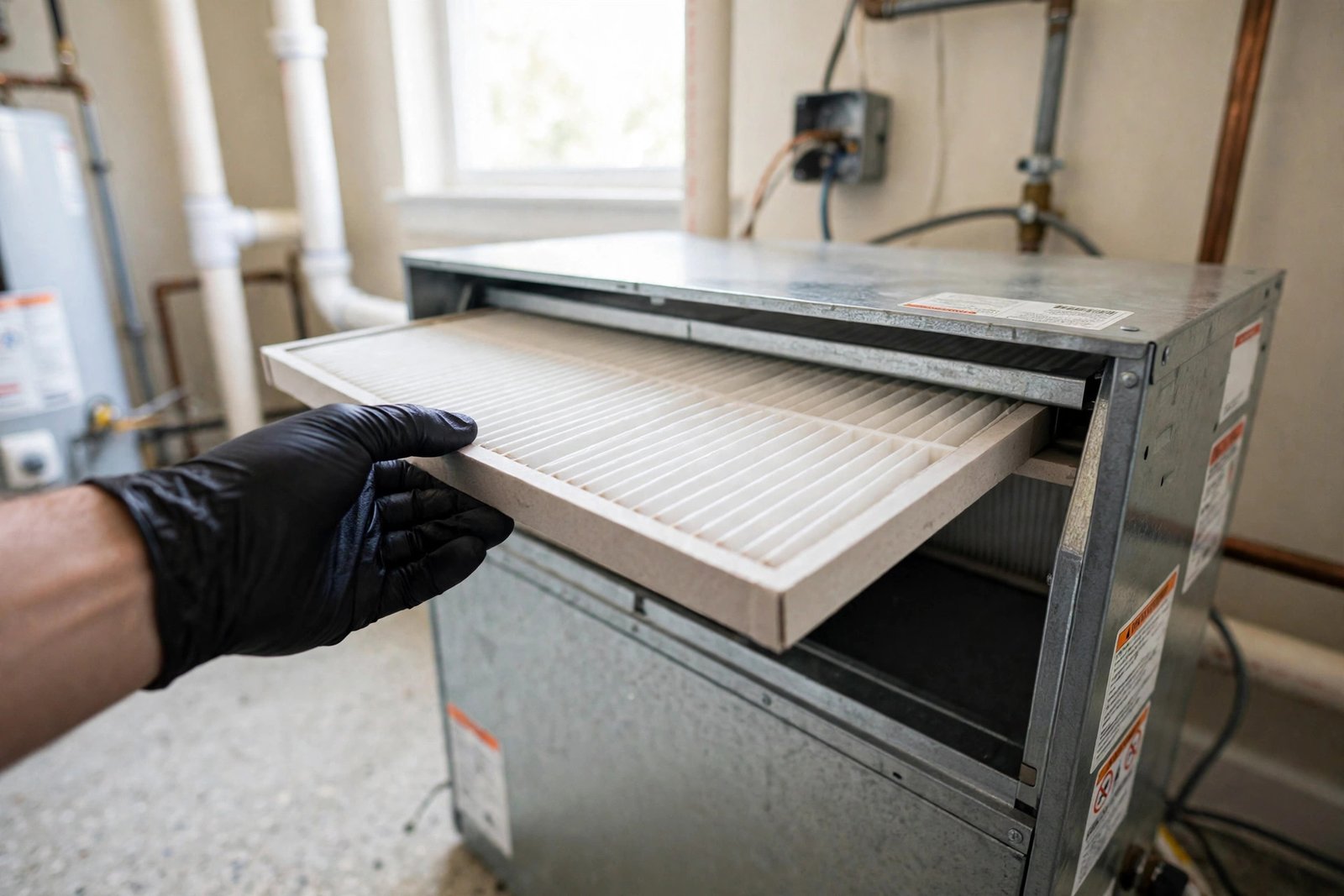
Changing a filter is a five-minute job that needs no tools in most homes. First, turn the system off at the thermostat so dust is not pulled in while the slot is open. Locate the filter slot, which is usually in the return air grille in a wall or ceiling, or in the air handler cabinet itself. Slide the old filter out and note its exact size printed on the frame, for example 20x25x1, plus the direction of the airflow arrow. Vacuum loose dust from the slot if needed, slide the new filter in with the arrow pointing toward the blower or furnace, and close the grille or cabinet door. Turn the system back on and write the date on the new filter frame with a marker so you always know when it went in.
One common mistake is installing the filter backwards. The arrow must point in the direction of airflow, toward the equipment, not toward the room. A backwards filter still catches dust, but it can restrict airflow more and may not seat properly. Another mistake is buying the wrong size: a filter that is even slightly too small lets unfiltered air bypass around its edges, defeating the purpose entirely. When in doubt, bring the old filter to the store or photograph its size label before shopping.
Buy filters in multipacks and store them flat in a dry closet. You will never skip a change because the shelf is empty.
Check on the first of every month and replace only when dirty. Checking monthly is the habit that matters most.
During heat waves, check every two to three weeks. Heavy runtime clogs filters much faster than mild-weather use.
A clean filter protects the evaporator coil. Combine filter checks with the seasonal tasks in a full cooling routine, including tips for keeping your house cool without overworking the AC.
Does a Higher MERV Rating Mean Longer Life?
Not necessarily. MERV, or Minimum Efficiency Reporting Value, measures how well a filter captures particles of different sizes. A MERV 13 filter traps far more fine dust, pollen, and smoke than a MERV 8 filter, but its denser media also loads up faster and creates more resistance to airflow. In a system designed for it, that trade-off is worthwhile, especially for allergy households. In an older system with a weaker blower, a very high MERV filter can starve the system of air, raising energy use and risking coil freezing. The best filter is the highest MERV rating your system manufacturer approves, changed on schedule, not the highest rating on the shelf used indefinitely.
If you are unsure what your system supports, check the equipment manual or ask a technician during the next service visit. Many manufacturers specify a maximum MERV rating for their units. Staying within that limit while changing on time beats any premium filter left in place too long. Remember that no filter, however good, replaces ventilation and source control: reducing dust at its source, vacuuming with a sealed HEPA vacuum, and keeping pets groomed all extend filter life and improve air quality together.
Seasonal Filter Calendar for Busy Households
A practical yearly rhythm looks like this. In spring, change the filter before cooling season begins and check again after the first heavy pollen weeks. Through summer, inspect monthly and expect to replace every four to eight weeks if the system runs daily. In autumn, change the filter at the start of heating season and check after leaf and harvest dust peaks. Through winter, a two- to three-month interval is usually fine unless the home has pets or a fireplace in daily use. This rhythm keeps the system protected without wasting filters that still have life left, and it ties filter changes to the seasonal transitions homeowners already notice.
Frequently Asked Questions
Can I run my AC without a filter for a few days?
You should not. Running without a filter lets dust coat the evaporator coil and blower, reducing efficiency and potentially causing damage that costs far more than a filter. If you are out of filters, buy a basic one immediately rather than running unfiltered.
How do I know my filter size?
The size is printed on the frame of your current filter, such as 16x25x1 or 20x20x1. The numbers are length by width by thickness in inches. Measure the slot if the label is missing, and round to the nearest standard size.
Does changing the filter really lower my energy bill?
Yes, when the old filter is clogged. A restricted filter forces longer run times and harder blower work. Studies and technician experience consistently show that a clean filter restores normal airflow and stops the energy penalty of a dirty one.
What if my filter looks clean after three months?
If it genuinely looks clean and air passes through easily, leaving it a little longer is reasonable in a low-use, pet-free home. Still, inspect it monthly and replace it at six months at the latest, since trapped particles you cannot see still accumulate.
Should I change the filter before a technician visit?
It is helpful but not required. A fresh filter gives the technician accurate airflow readings and shows that basic maintenance is current, which can speed up diagnosis of any other issue.
The honest answer to how often you should change your AC filter is simple once you know your home: check monthly, replace every one to three months for standard filters, and sooner whenever pets, allergies, dust, or heavy summer use demand it. That small, regular habit protects your comfort, your energy bill, and the equipment itself. Mark the date on the filter frame, keep spares on the shelf, and your air conditioner will repay the attention with steadier cooling and fewer surprises.