
Laminate vs. Vinyl Plank Flooring: Which Is Better for Your Home?
Laminate vs. vinyl plank flooring is one of the most common decisions in a home renovation, and the honest answer is that neither wins everywhere. Laminate looks and feels more like real hardwood, costs slightly less, and resists scratches from pets and furniture. Vinyl plank — usually called luxury vinyl plank, or LVP — is fully waterproof, quieter underfoot, and survives kitchens, bathrooms, and mudrooms where laminate would swell and fail. The right choice depends less on which floor is “better” in general and more on which room you are flooring, how much water that room sees, and how long you expect the floor to last.
In this guide we compare laminate and vinyl plank head to head on cost, durability, water resistance, appearance, comfort, installation, and maintenance, with real price ranges and room-by-room recommendations. By the end you will know exactly which floor belongs in your living room, your kitchen, and your basement — and when mixing the two is the smartest move of all.
Key Takeaways
- Laminate wins on realistic wood looks and scratch resistance; vinyl plank wins on waterproofing and quiet comfort.
- Laminate costs $2–$6 per square foot for materials; vinyl plank costs $2.50–$7 per square foot.
- Vinyl plank is the only safe choice for bathrooms, laundry rooms, and below-grade basements.
- Laminate suits dry living areas and bedrooms, especially in homes with pets, thanks to its tough wear layer.
- Both are DIY-friendly floating floors, but vinyl plank is more forgiving over imperfect subfloors.
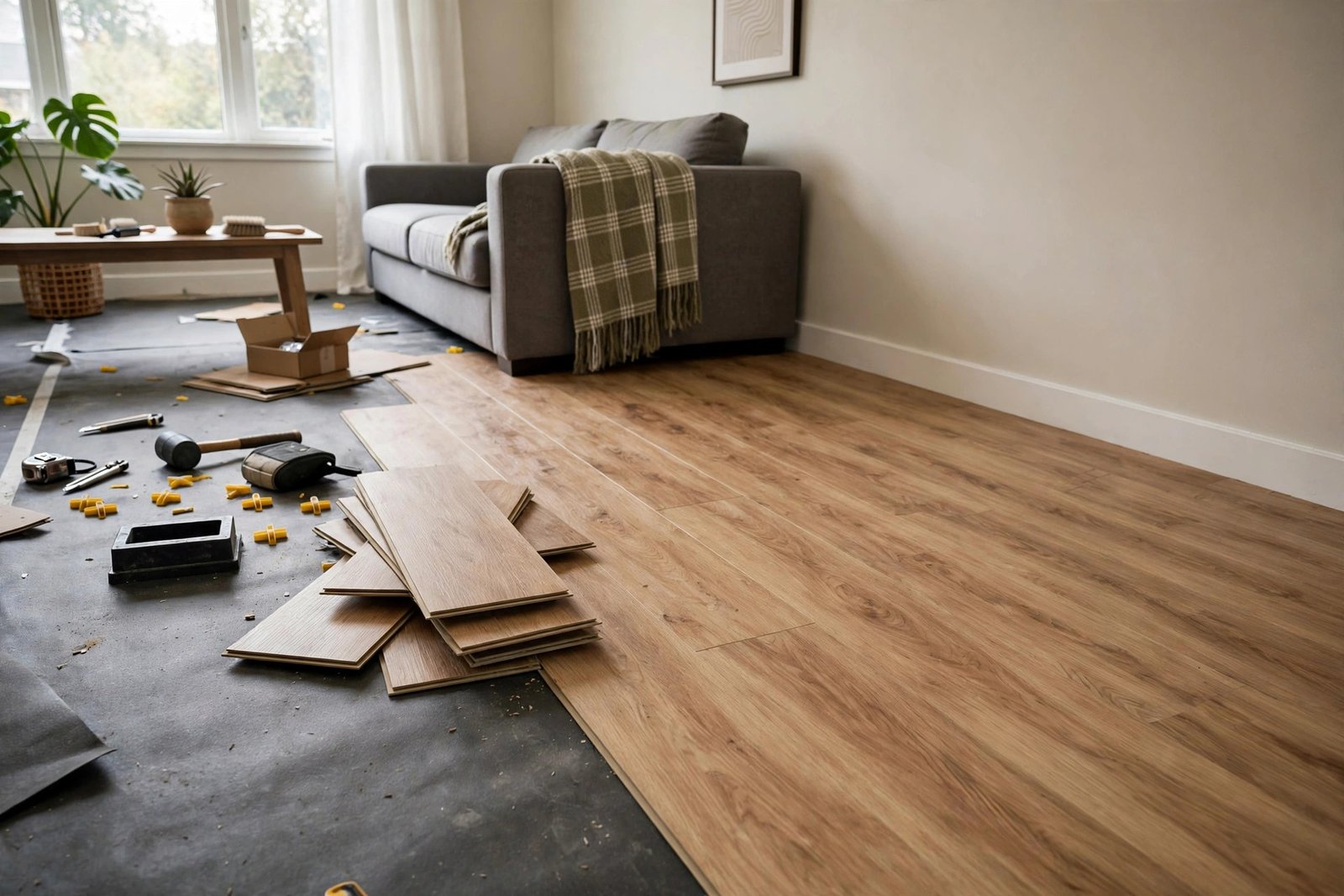
What Laminate and Vinyl Plank Actually Are
Laminate flooring is built in four layers: a stabilizing backing, a high-density fiberboard (HDF) core, a photographic image layer that mimics wood or stone, and a clear melamine wear layer on top. That HDF core is the key to understanding laminate: it is essentially compressed wood fiber, which is why it is rigid, stable, and realistic underfoot — and why it swells irreversibly when water soaks into it. Modern laminate planks are typically 8–12 mm thick, with an AC durability rating from AC3 for residential use up to AC5 for heavy commercial traffic.
Vinyl plank is made from PVC, not wood. Luxury vinyl plank has a rigid core — either stone plastic composite (SPC) or wood plastic composite (WPC) — topped with a printed design layer and a clear polyurethane wear layer, usually 12–28 mil thick. SPC cores are denser, thinner, and more dent-resistant; WPC cores are slightly softer and warmer underfoot. Because there is no wood fiber to absorb water, a vinyl plank can sit in a puddle for days and emerge unchanged. That single difference drives most of the decision between the two floors.
Cost Comparison: Materials and Installation
For materials alone, laminate runs $2–$6 per square foot, with most good residential options at $2.50–$4. Vinyl plank runs $2.50–$7 per square foot, with most quality SPC products at $3–$5.50. Installation adds $3–$7 per square foot if you hire a professional, or nothing but your weekend if you install it yourself — both floors use click-lock floating systems that a careful DIYer can lay at roughly 150–250 square feet per day after the first room.
Do not forget the extras. Underlayment costs $0.30–$0.80 per square foot for laminate, while many vinyl planks come with attached underlayment and need none. Baseboards, transition strips, and stair nosing add $2–$5 per linear foot. For a 400-square-foot living room, a realistic all-in DIY budget is $1,400–$2,400 for laminate and $1,600–$2,800 for vinyl plank; professional installation brings both to roughly $2,800–$5,000. If you are still learning the basics, our guide on how to install laminate flooring walks through measuring, acclimation, and the first three rows, which are where most DIY mistakes happen.
Durability: Scratches, Dents, and Daily Life
For scratch resistance, laminate has the edge. Its melamine wear layer is harder than vinyl’s polyurethane coating, so dog claws, dragged chairs, and toy cars mark laminate less. That is why laminate remains popular in living rooms and hallways of pet-owning households. Vinyl plank, especially products with a 20-mil wear layer or thicker, is still very durable, but a sharp grit trapped under a chair leg can scratch it, and heavy furniture can dent WPC cores more easily than SPC or laminate.
For water resistance, the result reverses completely. A spilled glass wiped up within minutes will not harm either floor, but a leaking dishwasher, a pet accident left overnight, or a bathroom splash zone will swell laminate’s HDF core at the joints, creating raised, peaking seams that cannot be sanded flat. Vinyl plank simply does not care. This is also why laminate is a poor choice below grade: concrete basement slabs transmit moisture even without a visible leak. For rooms where water is a question, not a certainty, vinyl plank is the safe answer every time.
Appearance and Feel Underfoot
Ten years ago laminate looked obviously fake; today, high-definition printing and embossed-in-register texture — where the surface texture follows the printed grain — make good laminate nearly indistinguishable from oak at normal viewing distance. Vinyl plank has closed much of the same gap, with beveled edges and varied plank patterns, but at close range its repeating print patterns can be easier to spot, and cheaper vinyl can look plasticky in bright, raking light. Underfoot, laminate feels harder and slightly hollow, with a click sound unless good underlayment is used; vinyl plank feels softer, warmer, and quieter, particularly WPC products with cork backing. If you love the look of real wood elsewhere in the house, compare these options with engineered wood vs. solid wood to understand where each material genuinely earns its price.
Room-by-Room Recommendations
For living rooms, bedrooms, and home offices — dry rooms where looks and scratch resistance matter most — laminate is an excellent choice, especially in the 10–12 mm range with an AC4 rating. For kitchens, bathrooms, laundry rooms, mudrooms, and basements, choose vinyl plank without hesitation; its waterproof core removes the one risk that ruins laminate. For hallways and entryways, either works, but if wet shoes and umbrellas are a daily reality, vinyl plank’s waterproofing tips the balance.
For rental properties and homes with young children, vinyl plank usually wins on practical grounds: spills, accidents, and wet feet are not emergencies, and a damaged plank can be replaced individually if the floor is a glue-down or loose-lay type. For a formal living room or a master bedroom where you want the most convincing wood look on a moderate budget, laminate wins. Many homeowners now mix the two: laminate upstairs in bedrooms, vinyl plank downstairs in the kitchen and living areas, with a matching oak tone so the transition between rooms looks intentional rather than patched.
Installation and Maintenance Compared
Both floors install as floating click-lock systems over an existing subfloor, but vinyl plank is more forgiving. Laminate requires a flat subfloor — within 3/16 inch over 10 feet — and a 48-hour acclimation period in the room before installation, plus a 1/4- to 3/8-inch expansion gap around all walls. Vinyl plank, particularly SPC, tolerates slightly uneven subfloors better and usually needs only 24 hours of acclimation. Neither floor should be installed over carpet, and both need a moisture barrier over concrete. A common DIY mistake is skipping the expansion gap; floors that buckle in summer almost always trace back to a wall that was fitted too tightly.
Maintenance is simple for both, with one important difference. Sweep or vacuum weekly, damp-mop with a well-wrung mop and a pH-neutral cleaner, and never steam-mop laminate — steam forces moisture into the joints. Vinyl plank tolerates damp mopping generously and even wet mopping, though standing water should still be wiped up. For long-term care, felt pads under furniture legs, doormats at entries, and keeping pet nails trimmed protect both floors equally. Our guide to how to clean hardwood floors without damaging them covers the same gentle-cleaning principles that keep any wood-look floor looking new for years.
Choose AC4 laminate or 20-mil vinyl for busy homes. A thin wear layer is a false saving.
Cuts, mistakes, and future repairs all come from the same box. Ten percent spare is the standard.
View planks in your own light, next to your furniture, before committing to 400 square feet.
Fix squeaks and level dips before laying anything. No floor hides a bad subfloor.
A 1/4-inch gap, hidden by baseboards, prevents summer buckling on both floor types.
If mixing floors, pick the same oak tone family so transitions look deliberate.
Resale Value, Lifespan, and Environmental Notes
Lifespan for quality laminate is 15–25 years in residential use; quality vinyl plank lasts 15–30 years, with SPC often outlasting laminate in wet-prone homes. Neither adds as much resale value as genuine hardwood, but both beat worn carpet decisively, and a fresh, consistent wood-look floor photographs well in listings. On environmental impact, laminate’s wood-fiber core is renewable and recyclable in some programs, while vinyl is a plastic product with a larger manufacturing footprint — though its longer life in wet rooms offsets that when it prevents an early replacement. Look for FloorScore or GREENGUARD certification on either product to keep indoor VOC emissions low, and let a new floor air out with ventilation for a few days after installation.
Frequently Asked Questions
Can laminate flooring go in a kitchen?
It can, but it is risky. Minor splashes are fine if wiped up quickly, but a dishwasher or fridge leak can ruin laminate. In kitchens, waterproof vinyl plank is the safer long-term choice.
Is vinyl plank flooring waterproof or just water-resistant?
The planks themselves are waterproof — SPC and WPC cores do not absorb water. The floor as a system is water-resistant, because water can still seep through seams to the subfloor if left standing.
Which is better for dogs: laminate or vinyl plank?
For scratch resistance, laminate wins. For accidents and wet paws, vinyl plank wins. In most dog-owning homes, vinyl plank’s waterproofing matters more day to day.
Can I install laminate or vinyl plank over tile?
Yes, if the tile is flat, firmly bonded, and the grout lines are shallow. Deep grout lines should be skim-coated flat first, or the planks will flex and their joints will fail early.
Which floor is quieter?
Vinyl plank, especially WPC with cork backing, is noticeably quieter and softer underfoot than laminate, which can sound hollow without quality underlayment.
The Bottom Line: Laminate vs. Vinyl Plank
Choose laminate for dry living areas where the most convincing wood look and the toughest scratch resistance matter most. Choose vinyl plank for kitchens, bathrooms, basements, and any home where water, pets, or kids make spills a daily event. When in doubt, let the room decide: dry room, laminate; wet-prone room, vinyl plank. Get samples of both, lay them in your own light, spill a glass of water on each, and the right answer for your house will be obvious.