
Bathroom Storage Ideas for Small Bathrooms That Actually Work
A small bathroom forgives nothing. There is no spare cupboard to absorb the overflow, no countertop that stays clear for long, and every bottle, towel, and cleaning product competes for the same few square feet. The result in most tiny bathrooms is familiar: a crowded sink edge, a shower ledge full of half-empty bottles, and a cupboard under the sink so chaotic that nobody opens it unless they have to.
The fix is not a bigger bathroom. It is using the surfaces small bathrooms waste: the wall above the toilet, the inside of the cabinet door, the back of the door itself, the vertical strip beside the mirror, and the dead space above the door frame. These bathroom storage ideas for small bathrooms are built around that principle — storage that works in a room as small as 3 to 5 square metres, much of it renter-friendly, all of it measured so it fits before you buy. Whether you share one bathroom between a family or you are squeezing a routine into a studio flat, this guide covers over-toilet storage, vanity organisation, shower storage, door-back solutions, and the renter-safe options that leave no holes behind.
Key Takeaways
- Think vertically: in a small bathroom, wall space above eye level is the most underused storage in the house.
- Zone your storage by routine — morning items at the mirror, shower items in the shower, spares elsewhere.
- Measure the gap above the toilet and the depth of your vanity before buying any unit or organiser.
- Decant daily products into matching bottles: it halves visual clutter even before you add a single shelf.
- Renters can get most of this storage with adhesive, tension, and over-door solutions — no drilling required.
Start With a Ruthless Clear-Out
Before adding storage, remove what does not belong. Empty the vanity, the medicine cabinet, and every shelf, and sort everything into four groups: used daily, used weekly, spares and refills, and expired or empty. Expired sunscreen, dried-out nail polish, hotel toiletries from three years ago, and the six half-used conditioners from a phase you no longer have — all of it goes. In a small bathroom, every item you remove is storage you do not have to buy, and most tiny bathrooms lose 20 to 30 percent of their clutter in this one step.
Over-Toilet Storage: The Biggest Win in a Small Bathroom
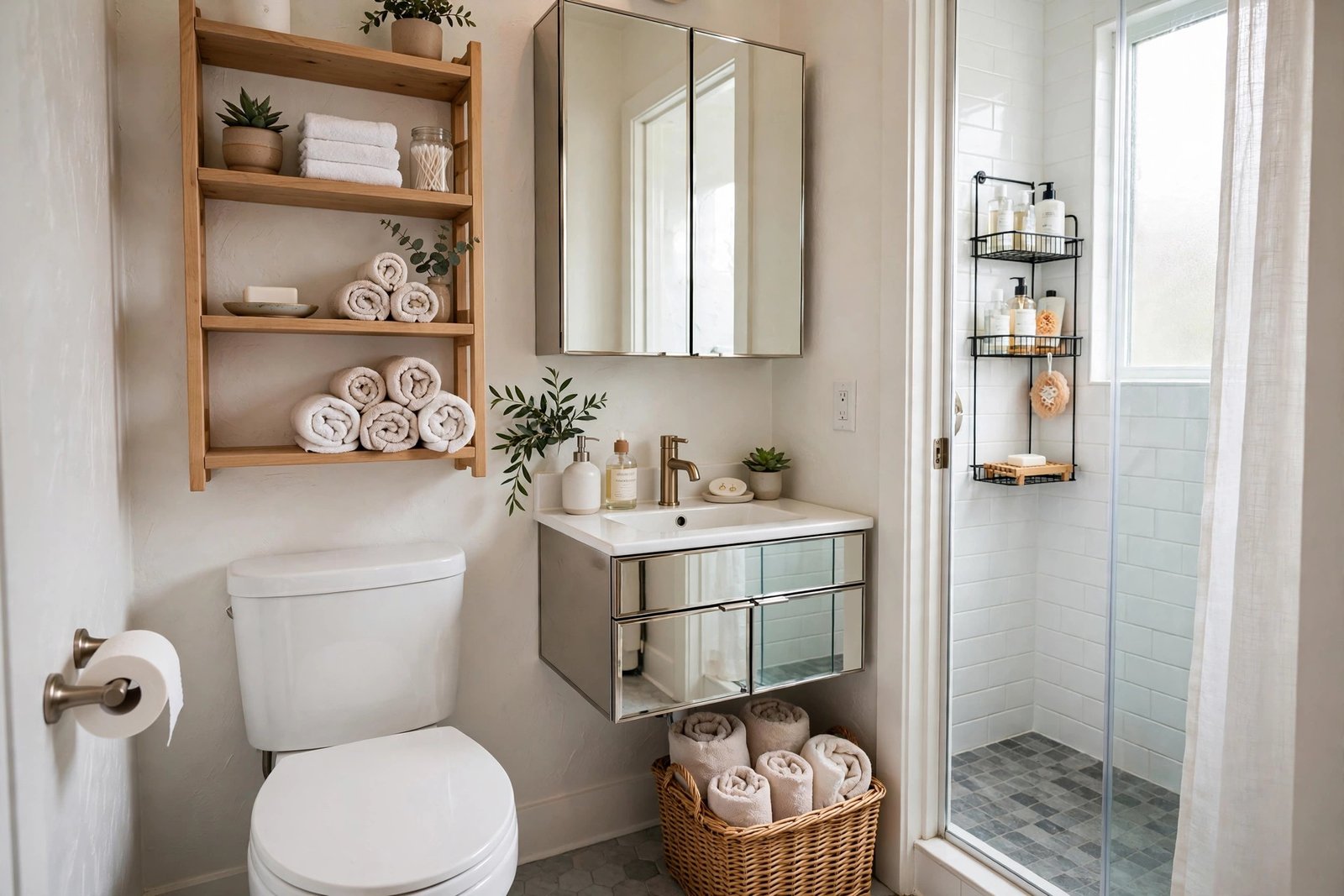
The wall above the toilet is the single largest unused surface in most small bathrooms. A toilet is typically 40 to 45 centimetres wide and 65 to 70 centimetres deep, and the wall above it is empty from about 80 centimetres up to the ceiling. That is a full column of storage doing nothing, and it sits exactly where a standing adult can reach without a step stool.
Over-Toilet Shelving Units and Cabinets
A freestanding over-toilet unit — two legs that stand either side of the toilet with shelves above the cistern — is the fastest transformation available. Standard units are 60 to 75 centimetres wide and 25 to 30 centimetres deep, with two or three shelves, and they cost $30 to $90. Before ordering, measure three things: the width of your toilet plus clearance (you need at least 5 centimetres either side of the cistern), the height from the floor to the top of the cistern (the bottom shelf must clear it, usually 80 to 90 centimetres), and the distance to any light fitting or extractor fan above. If your bathroom has a boxed-in cistern or a wall-hung toilet, a freestanding unit may not fit — in that case, use floating shelves instead, mounted at 140, 170, and 200 centimetres from the floor, which gives you the same storage without the legs.
Floating Shelves Above the Toilet
Vanity Storage: Making the Sink Area Work Harder
The vanity is where mornings happen, and in a small bathroom it is usually a pedestal sink with no storage at all, or a small cabinet whose interior is one dark cavern. Both can be fixed without replacing the sink.
Under-sink organisation starts with working around the pipes. A U-shaped under-sink shelf or a pair of stackable bins either side of the trap uses the space the pipes leave free, and a small turntable (lazy Susan) 25 centimetres across turns the dark back corner into something you can actually reach. Hang a small adhesive hook or a mini rail on the inside of the cabinet door for cleaning cloths or a hairdryer — the door is free storage that most people never use. If your under-sink area is damp, which many are, choose plastic or coated-metal organisers over wood or cardboard, and keep a moisture absorber in the cabinet to protect both the organisers and the products.
On top of the vanity, less is more. A small bathroom counter — often just 45 to 60 centimetres wide — should hold only what you use every single morning: soap, toothbrush holder, and one tray for the two or three products you reach for first. A small tray, about 25 by 18 centimetres, corrals those items into one visual block so the counter reads as tidy even when it is full. Everything else — the weekly products, the styling tools, the spares — goes in the cabinet or on the wall. And consider the mirror: a mirrored medicine cabinet 40 to 60 centimetres wide and 12 to 15 centimetres deep replaces a flat mirror with storage for a dozen small items, right at eye level, with no extra wall space used. It is the single best upgrade for a bathroom with a pedestal sink, and surface-mounted versions install in under an hour.
Shower Storage That Survives Water and Steam
Shower storage fails in predictable ways: suction cups fall off, metal caddies rust, and bottles migrate to the floor of the shower where they get kicked over. The solution is to match the caddy to the shower, not the other way round.
For a standard shower over a bath, a hanging caddy that hooks over the shower head pipe or the bath edge works well and costs $10 to $25 — but choose one with a rust-proof coating and drainage holes, and hang it where the spray does not hit it directly, or every bottle fills with water. For a walk-in shower with a glass screen, an over-door or tension-pole caddy is better: a tension pole that wedges between floor and ceiling in the corner holds three or four shelves, needs no drilling, and can be moved when you move house. Expect $25 to $50 for a sturdy stainless or aluminium pole. Avoid suction-cup shelves on textured tiles — they grip smooth tile and glass well, but textured or matte tiles defeat the seal, and the shelf will fall at 2 a.m. with a crash that wakes the house.
Door-Back and Forgotten-Space Storage
The back of the bathroom door is a full storage wall that costs nothing to use. An over-door rack with hooks holds towels, a dressing gown, and a hanging organiser with clear pockets for small items — cotton pads, hair accessories, travel toiletries — and it installs in seconds with no tools. Choose a rack with flat hooks that let the door close properly; thick round hooks stop the door latching and drive everyone mad. If two people share the bathroom, give each person a hook: shared towel hooks are how towels end up on the floor.
Beyond the door, hunt for the forgotten spaces. The wall strip beside the mirror, often just 20 to 30 centimetres wide, fits a narrow vertical shelf or a magnetic strip for bobby pins and tweezers. The top of the door frame supports a slim shelf for spare towels or toilet rolls, if the ceiling height allows it and the items are light. A towel ring on the wall beside the sink frees the towel rail for bath towels, and a small stool or step with storage inside doubles as a seat for children and a home for cleaning supplies. Even the side of a vanity unit can hold a slim adhesive caddy for a hairdryer or straighteners. Small bathrooms reward the person who measures every blank wall, because blank walls are the only space left. The same “use the forgotten space” thinking transforms other cramped rooms, too — see our storage ideas for small spaces for the whole-house version of this approach, and our small closet organisation ideas for the bedroom equivalent.
Renter-Friendly Bathroom Storage: No Holes, No Problems
Renters face one extra constraint: the deposit. Every storage idea above has a no-drill version, and knowing which is which saves real money at move-out. Adhesive hooks and shelves (rated and tested for weight) cover towels, light baskets, and toothbrush holders. Tension rods fit inside a shower, under a sink, or across a window recess for hanging spray bottles by their triggers — a genuinely clever use of a $5 rod. Over-door racks and over-toilet units need no fixing at all. Magnetic strips stick to the side of a metal medicine cabinet for pins and clips. If you are styling the room as well as organising it, our bathroom decor ideas show how storage and style can share the same shelves.
Small-Bathroom Storage by Budget
You do not need to spend much to transform a small bathroom. At under $30, you can add an over-door rack, a shower caddy, and a set of adhesive hooks — enough to clear the sink edge and the shower floor entirely. At $30 to $100, add an over-toilet unit or two floating shelves plus matching baskets and a mirrored cabinet organiser, which is where the room starts to feel genuinely organised rather than just tidied. At $100 to $300, you are into a mirrored medicine cabinet, a proper vanity organiser set, and a tension-pole shower system — the full upgrade, still far cheaper than any renovation, and all of it removable if you move.
Daily items at the mirror, shower items in the shower, spares out of the way. Wrong-zone storage gets abandoned fast.
An over-door rack adds a full storage wall with no drilling — perfect for towels and small-item organisers.
Matching pump bottles halve visual clutter and stop the mismatched-bottle chaos on every shelf.
Check cistern width and height before ordering over-toilet storage — a unit that does not clear the cistern is useless.
Test one adhesive hook for a week before trusting it with glass, and remove strips with the pull tab, never by yanking.
3 Mistakes That Keep Small Bathrooms Messy
Storing spares where dailies belong. When the mirror cabinet is full of refills, the daily products end up on the counter, and the counter stays crowded. Spares go high or far; dailies go at eye level.
Buying storage before clearing out. New baskets filled with expired products are still clutter, just in nicer containers. Clear out first, count what remains, then buy to that count.
Ignoring steam and damp. Wood organisers warp, cardboard dissolves, and uncoated metal rusts in a steamy bathroom. Choose plastic, coated metal, or sealed bamboo, and ventilate the room after showers.
Frequently Asked Questions
What is the best storage for a very small bathroom with no vanity?
A mirrored medicine cabinet for daily items, an over-toilet unit or floating shelves for the rest, and an over-door rack for towels. Together they replace a vanity’s storage without using any floor space.
How do I add bathroom storage without drilling holes?
Use over-door racks, freestanding over-toilet units, tension-pole shower caddies, and adhesive hooks or shelves rated for the weight. Test adhesives for a week before trusting them with heavy or glass items.
Where should I store cleaning products in a small bathroom?
On the highest shelf or in a closed, labelled bin under the sink, away from toiletries and out of children’s reach. Never store them above food-adjacent items like toilet paper if a leak could drip down.
How can I keep a small bathroom counter clear?
Limit the counter to what you use every morning — soap, toothbrush holder, and one small tray. Move everything else into the cabinet, onto the wall, or behind the mirror, and enforce a one-in-one-out rule for new products.
What size over-toilet unit fits a standard toilet?
Most standard toilets suit a unit 60 to 75 centimetres wide and 25 to 30 centimetres deep, but measure first: allow 5 centimetres clearance either side of the cistern and make sure the bottom shelf clears the cistern top, usually 80 to 90 centimetres from the floor.
Start With the Toilet Wall
A small bathroom gets organised in one afternoon, not one renovation. Clear everything out, keep only what you use, put an over-toilet unit or shelves on the wall everyone ignores, organise the vanity around your morning routine, and give the door a job. Do that, and the sink edge stays clear — not because you tried harder, but because everything finally has a place that makes sense.