
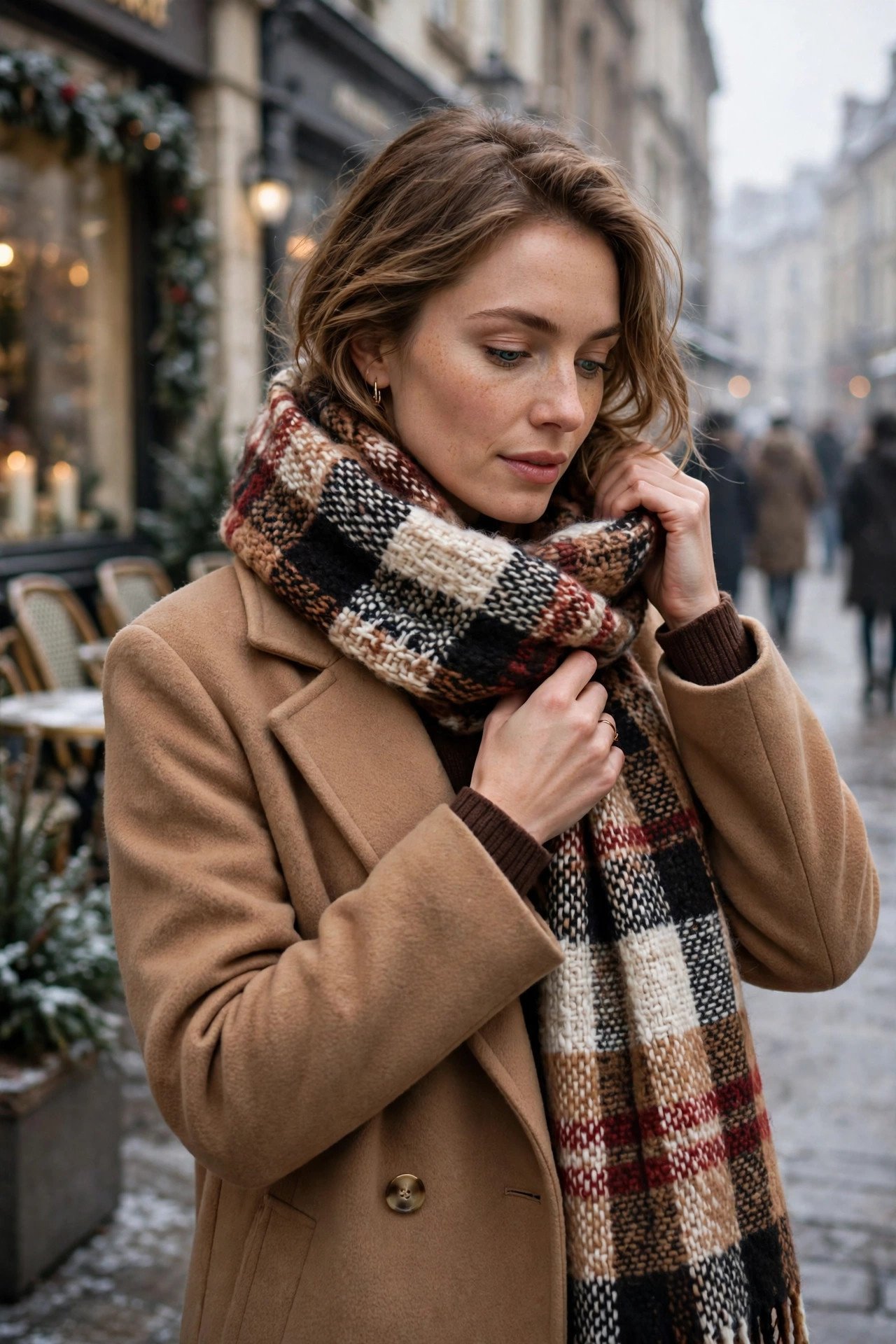
Winter Scarf Styling Ideas: 12 Ways to Wear One Scarf
A scarf is the most underrated item in a winter wardrobe. It is warm, it is cheap compared with a coat, and it can change an outfit completely — yet most people wear theirs the same way every day: looped once, tucked in, forgotten. With a few simple techniques, one good scarf becomes five different looks, and a plain coat becomes a different coat every time you change the scarf.
This guide covers scarf types, twelve styling methods, colour pairing, and the practical rules for keeping scarves looking good all winter.
Key Takeaways
- Invest in one great scarf (wool or cashmere blend, large enough to wrap twice) rather than five thin ones.
- Match the scarf’s weight to your coat: chunky scarf with a chunky coat, fine scarf with a tailored coat.
- Let the scarf be the colour pop in a neutral outfit, or the neutral anchor in a colourful one — not both.
- Learn three knots well (loop, drape, wrap) and you have covered 90 percent of winter days.
Choosing the Right Scarf
Size matters most. A scarf that is too small cannot wrap properly and just sits on your chest like a bib; a large scarf (at least 180cm long, and wide enough to fold) can be looped, draped, wrapped and worn as a shawl. Wool and cashmere blends are warmest and drape best; acrylic scarves are cheaper but pill quickly and do not breathe. A plaid or checked scarf is the most versatile pattern, while a solid colour in camel, burgundy, forest or grey goes with everything.
For a winter wardrobe built around coats, our camel coat outfit ideas for winter show how one coat and several scarves create a week’s worth of outfits, and our women’s winter wardrobe essentials capsule guide and leather boots outfit ideas for winter complete the cold-weather capsule.
The Classic Styles
The once-around loop is the everyday default: drape the scarf around your neck, loop one end through, adjust. It is warm, quick and works with every coat. The drape — scarf simply hung around the neck with both ends forward — is the elegant option for indoors or mild days, and it shows off a beautiful scarf best. The double wrap — wound twice around the neck with ends tucked in — is the warmest style and the one for genuinely cold days.
The Parisian knot (fold the scarf in half, loop the folded end through, pull the loose ends through the loop) looks polished and stays put in wind. The blanket wrap — a large scarf worn open over the shoulders like a shawl — doubles as an extra layer indoors and looks wonderful over a plain coat. The belted scarf — draped over the shoulders and belted at the waist over a coat — is a fashion-forward look that turns a scarf into a cape.
Colour Pairing Made Simple
The easiest rule: if your coat is neutral (black, camel, grey, navy), your scarf can be any colour — this is where a red, mustard or plaid scarf earns its keep. If your coat is colourful, your scarf should be neutral. If both are patterned, keep one pattern small and the other large, or the outfit becomes visual noise.
Seasonal colour works too: burgundy and forest scarves feel festive in December, cream and camel scarves feel fresh in January, and a plaid scarf works all winter long. A scarf is also the cheapest way to try a trend colour — butter yellow, for example — without committing to a coat in that colour. For trend colours in full outfits, see our butter yellow outfit ideas.
Scarves With Different Coats
A tailored coat (a camel coat, a peacoat, a wool wrap coat) suits a finer scarf, draped or knotted neatly — bulk ruins the tailored line. A puffer or parka suits a chunky knit scarf, wrapped warmly, because the coat is already bulky and the scarf just adds warmth. A leather jacket suits a light silk or fine wool scarf, draped loosely, for contrast between tough and soft.
For evening, a fine scarf in silk or a shimmer fabric worn as a wrap over a dress or blazer adds warmth without a coat, and looks far more elegant than a cardigan. Keep evening scarves narrow and light; a chunky knit scarf over an evening dress looks like you forgot your coat.
Men’s Scarf Styling
Men’s scarf rules are simpler: one scarf, worn simply, in a good material. The once-around loop and the drape are the two styles most men need. Colours should be muted — grey, navy, charcoal, burgundy, camel — and patterns should be subtle (a quiet plaid or a herringbone). A good wool scarf with a good coat is one of the most quietly stylish combinations in men’s winter fashion, and it costs a fraction of a new coat.
Avoid novelty scarves, football scarves (outside a match), and anything with a logo. A scarf’s job in a men’s outfit is to add warmth and a touch of colour, not to be the conversation piece.
Care and Storage
Wool and cashmere scarves should be hand washed cold or dry cleaned, dried flat (never hung wet, which stretches them), and stored folded, not hung. Pilling is normal with wool — a fabric shaver or a gentle comb removes it in seconds. At the end of winter, wash scarves before storing them; moths love dirty wool and will find it in a drawer within weeks.
A scarf collection does not need to be large: three good scarves — one neutral, one patterned, one colourful — cover almost every winter outfit. Buy the neutral first, the patterned second, and the colourful one when you know which colour you actually reach for.
Frequently Asked Questions
How long should a winter scarf be?
At least 180cm for wrapping styles. Shorter scarves only really work as a simple drape, and they slip off easily in wind.
Can I wear a scarf indoors?
A light scarf, yes — as a shawl or a drape over a dress or blazer. A chunky knit scarf indoors just makes you overheat.
What is the warmest scarf material?
Cashmere and merino wool are warmest for their weight. Chunky knit wool is warmest overall, but bulkier. Avoid thin acrylic for very cold days.
How do I stop a scarf slipping off?
Use a knot rather than a drape in wind, tuck the ends into your coat, or use a scarf ring or a small brooch to pin the loop in place.