
How Long Do Air Conditioners Last? Realistic Lifespans and When to Replace
An air conditioner is one of the most expensive systems in your home, and the question of how long it will last comes up every time it falters on a hot day. The honest answer is a range, not a single number: most central air conditioners last 15 to 20 years, ductless mini-splits last 15 to 25 years, and window or portable units last 8 to 12 years. But those ranges hide a lot of variation. A well-maintained unit in a mild climate can outlive its expected lifespan by years, while a neglected unit in a harsh climate can fail well before it.
This guide explains what those numbers really mean, what shortens or extends an air conditioner’s life, the warning signs that replacement is approaching, and how to decide between one more repair and a new system. If your unit is aging and your repair bills are climbing, this is the framework for making that decision with confidence instead of under pressure in the middle of a heatwave.
Key Takeaways
- Central air conditioners typically last 15 to 20 years; mini-splits 15 to 25; window units 8 to 12.
- Maintenance is the biggest controllable factor: clean filters, clean coils, and annual servicing add years.
- Climate, usage, sizing, and installation quality matter as much as the brand on the unit.
- Frequent repairs, rising energy bills, and uneven cooling signal a unit near the end of its life.
- Use the 5,000 rule: age multiplied by repair cost over 5,000 usually means replace, not repair.
- Replacing before a total failure lets you choose the right system instead of accepting whatever is available.
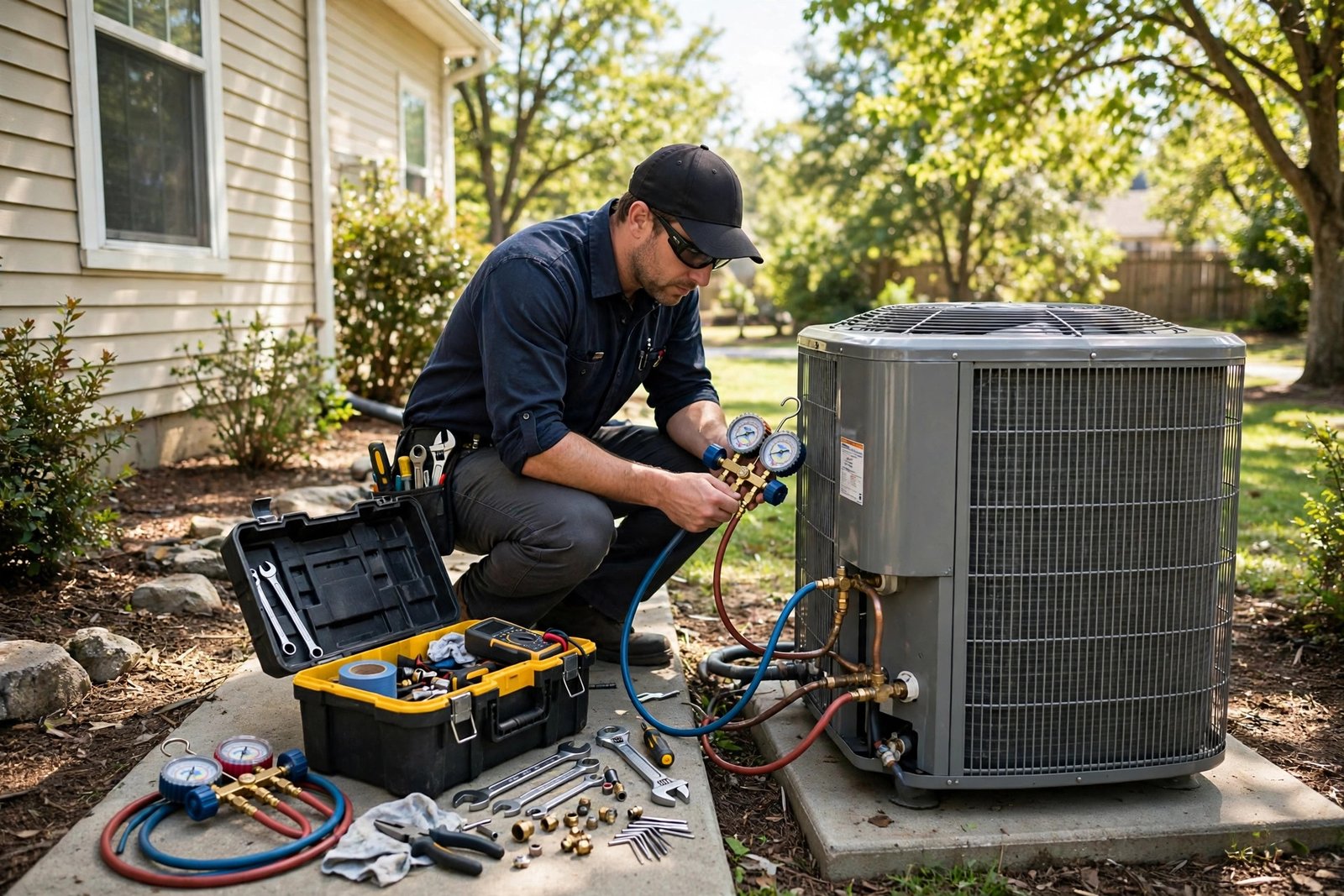
Average Lifespans by System Type
Central split systems — the most common type, with an outdoor condenser and an indoor evaporator coil connected to ductwork — are built to last 15 to 20 years. That figure assumes reasonable maintenance and a climate that is not extreme year-round. In very hot regions where the system runs most of the year, 12 to 15 years is a more realistic expectation, while in mild climates with short cooling seasons, 20 to 25 years is achievable. The compressor is usually the component that defines the system’s life: when it fails out of warranty on an old unit, replacement of the whole system is normally the sensible choice.
Ductless mini-splits often last longer, typically 15 to 25 years, because they have no ductwork losses, their inverter compressors run at variable speeds rather than constantly cycling on and off, and each indoor head can be serviced independently. Window and portable units sit at the other end: 8 to 12 years for window units and often less for portables, because they are exposed to weather, harder to service, and built to a lower price point. Heat pumps, which provide both heating and cooling, work year-round and therefore accumulate wear faster; expect 15 to 20 years, with the heating workload shortening life in cold climates. For context on how the rest of your home’s equipment compares, see our guide to how long home appliances last.
One important nuance: the indoor and outdoor parts of a system do not always age together. A condenser replaced after storm damage may be newer than the evaporator coil it is paired with, and mismatched components can reduce efficiency. When a technician quotes a repair, ask about the age of both halves of the system, not just the part that failed. A new compressor in a 19-year-old system still leaves you with a 19-year-old coil, blower, and refrigerant circuit.
What Shortens an Air Conditioner’s Life
Neglected maintenance is the leading killer. A clogged filter forces the blower to work harder and can freeze the evaporator coil; dirty condenser coils trap heat and make the compressor run hotter; a blocked condensate drain can flood the air handler and corrode components. None of these failures happen overnight. They accumulate silently over seasons until a hot week exposes them all at once. The cheapest life-extension strategy in existence is regular filter changes and an annual service visit — see our HVAC maintenance guide for the full routine.
Incorrect sizing is the second major factor, and it is set at installation, not by the homeowner afterward. An oversized unit short-cycles, switching on and off rapidly, which wears the compressor and leaves humidity uncontrolled. An undersized unit runs continuously on hot days, never quite reaching the set temperature, and wears out from sheer hours of operation. Both problems feel like “the AC is struggling” but have opposite causes, which is why a proper load calculation matters when a system is replaced. If your unit has always cycled oddly or never quite cooled the house, sizing may have been wrong from day one.
Climate and environment add further stress. Coastal homes face salt corrosion on outdoor coils. Homes near construction or dusty roads clog coils faster. Units installed in direct sun, without airflow clearance, or buried in shrubs run hotter and less efficiently. Refrigerant issues matter too: older systems using phased-out refrigerants become expensive to repair as supplies shrink, and a slow leak that is topped up year after year without being found will eventually starve and damage the compressor. Finally, power quality counts — frequent surges and brownouts stress control boards and compressors, so a surge protector on the outdoor unit is cheap insurance in storm-prone areas.
Warning Signs Your Air Conditioner Is Nearing the End
Age alone is not a death sentence, but age plus symptoms is. The clearest warning is repair frequency: if you have called a technician twice in one season, or repairs are becoming an annual event, the system is telling you its components are wearing out together. A single failed capacitor is normal wear; a failed capacitor, a leaking coil, and a noisy blower in the same year is a pattern. Track your repair spending — when cumulative repairs approach a significant fraction of replacement cost, the money is better spent on a new system.
Energy bills are the second signal. A system that cools the same house with steadily rising electricity use is losing efficiency, often because coils are fouled, refrigerant is low, or the compressor is weakening. Compare bills year over year for similar weather, not month to month. Uneven cooling is a third sign: rooms that used to cool evenly now stay warm, or the system runs for hours without reaching the thermostat setting. That can indicate duct problems or low refrigerant, but on an old unit it often means the system can no longer deliver its rated capacity. Strange noises — grinding, screeching, or loud rattling from the outdoor unit — and persistent musty or burning smells also warrant prompt professional inspection, not another season of hoping.
Two specific checks help separate a dying system from a fixable problem. First, if the unit is not cooling at all, work through basic diagnostics before assuming the worst — our guide to why your AC is not cooling covers the common causes. Second, if the system has simply stopped responding, how to reset your air conditioner explains the safe reset steps. If those checks do not restore normal cooling, and the unit is over 15 years old, a replacement conversation is overdue.
Repair or Replace: A Practical Decision Framework
The HVAC industry uses a rough guide called the 5,000 rule: multiply the unit’s age in years by the quoted repair cost. If the result exceeds 5,000, replacement is usually the better investment; below it, repair usually makes sense. A 200-dollar repair on a 10-year-old unit scores 2,000 — repair it. A 900-dollar compressor repair on a 16-year-old unit scores 14,400 — replace it. The rule is not gospel, but it forces the right comparison: repair cost against remaining life, not against zero.
Layer three more considerations on top of it. First, efficiency: a new system with a higher SEER2 rating can cut cooling costs by 20 to 40 percent compared with a 15-year-old unit, so the payback period matters, especially in hot climates. Second, refrigerant: if your old system uses a phased-out refrigerant, every future leak repair will be more expensive and harder to source. Third, comfort: if the old system never cooled evenly or controlled humidity well, a correctly sized replacement solves problems that no repair can. Get at least two or three quotes for replacement, and ask each contractor for a load calculation rather than a like-for-like size swap.
Timing matters too. Replacing during the shoulder seasons — spring or autumn — gives you time to compare quotes, choose the right system, and schedule installation without urgency pricing. Replacing during a heatwave means accepting the first available crew and unit. If your system is over 15 and showing symptoms, start getting quotes before it fails. Our guide to HVAC replacement cost breaks down what a new system typically costs and which factors move the price.
How to Make Your Air Conditioner Last Longer
Clean filters protect the blower and coils. Check monthly in cooling season and replace when dirty, not on a fixed date alone.
A yearly professional service catches low refrigerant, worn capacitors, and dirty coils before they become failures.
Maintain two feet of clearance around the condenser, clear leaves and debris, and hose the coils gently each spring.
Avoid extreme setpoints and constant on-off cycling. A steady, moderate setting reduces compressor wear.
Leaky ducts make the system run longer for the same cooling. Sealing them cuts runtime and wear together.
A rattling fan, a dripping drain, or weak airflow is cheaper to fix this month than after it damages the compressor.
One habit deserves special mention: do not ignore the condensate drain. A clogged drain trips the safety switch and shuts the system down on the hottest day, and standing water corrodes the air handler. Pouring a cup of diluted vinegar down the drain line a few times a season, if your unit has an accessible clean-out, prevents the algae buildup that causes most clogs. And if you are comparing system types for a replacement, our comparison of heat pumps versus furnaces explains how year-round heating and cooling workloads affect lifespan.
Frequently Asked Questions
How long do air conditioners last on average?
Central air conditioners last 15 to 20 years, ductless mini-splits 15 to 25 years, and window units 8 to 12 years, assuming reasonable maintenance. Hot climates, heavy use, and neglected servicing shorten those ranges.
Can an air conditioner last 30 years?
Rarely, and usually at the cost of efficiency. A few well-maintained units reach 25 years or more, but by then they use far more electricity than a modern system and rely on parts and refrigerants that may be hard to find.
Is it worth repairing a 15-year-old air conditioner?
Small, cheap repairs can be worth it, but major repairs usually are not. Apply the 5,000 rule — age multiplied by repair cost — and factor in efficiency gains and refrigerant availability before committing to an expensive fix.
What is the first part of an air conditioner to fail?
Capacitors and contactors are the most common early failures and are relatively cheap to replace. Compressor failure is the most expensive and, on an old unit, is usually the point where replacement makes more sense than repair.
Does running my AC less make it last longer?
Moderate use helps, but the bigger factors are maintenance, correct sizing, and avoiding short-cycling. A system that runs steadily at a reasonable setpoint often lasts longer than one that is constantly switched on and off.
Know Your Unit’s Age — Then Plan, Don’t Panic
Find your unit’s age today: the manufacture date is on the rating plate of the outdoor condenser. If it is under 10 years old and well maintained, your job is simply to keep maintaining it. If it is 15 or older, start planning — get a service visit, ask for an honest assessment, and gather replacement quotes while you still have a working system.
Air conditioners rarely fail without warning. Rising bills, frequent repairs, and uneven cooling are the warnings. Heeding them early turns an emergency replacement into a planned upgrade — and a planned upgrade is almost always cheaper, better sized, and far less stressful.