
Linen Closet Organization Ideas: Neat Shelves, Fresh Towels, Zero Avalanches
The linen closet is the smallest room in the house with the biggest chaos-to-size ratio. Open the door and a tower of towels leans out; pull one from the middle and the whole stack collapses. Sheets migrate between sets, pillowcases vanish, and the good guest towels end up buried under a pile of frayed beach towels nobody has used in two years. It is not a storage problem. It is an organization problem, and it is fixable in a single afternoon.
The secret is treating the linen closet like a small shop: everything visible, everything labelled or obvious, everything stored in a way that survives being used by people who are not you. Fold consistently, sort by household member or room, use bins for the small stuff, and keep the inventory honest. These linen closet organization ideas cover the full system — from the great clear-out to the folding method that actually holds a stack together.
Key Takeaways
- Start with a full clear-out: keep only linens you actually use, and set a realistic number per bed.
- Store each sheet set inside its own pillowcase so sets never separate again.
- Fold towels uniformly and file them upright or stack them low and wide, never high and narrow.
- Use labelled bins for washcloths, hand towels, and small items that slide off shelves.
- Put everyday linens at eye level and guest or seasonal linens up high.
- Add a scent sachet and good airflow to keep the closet smelling fresh between uses.
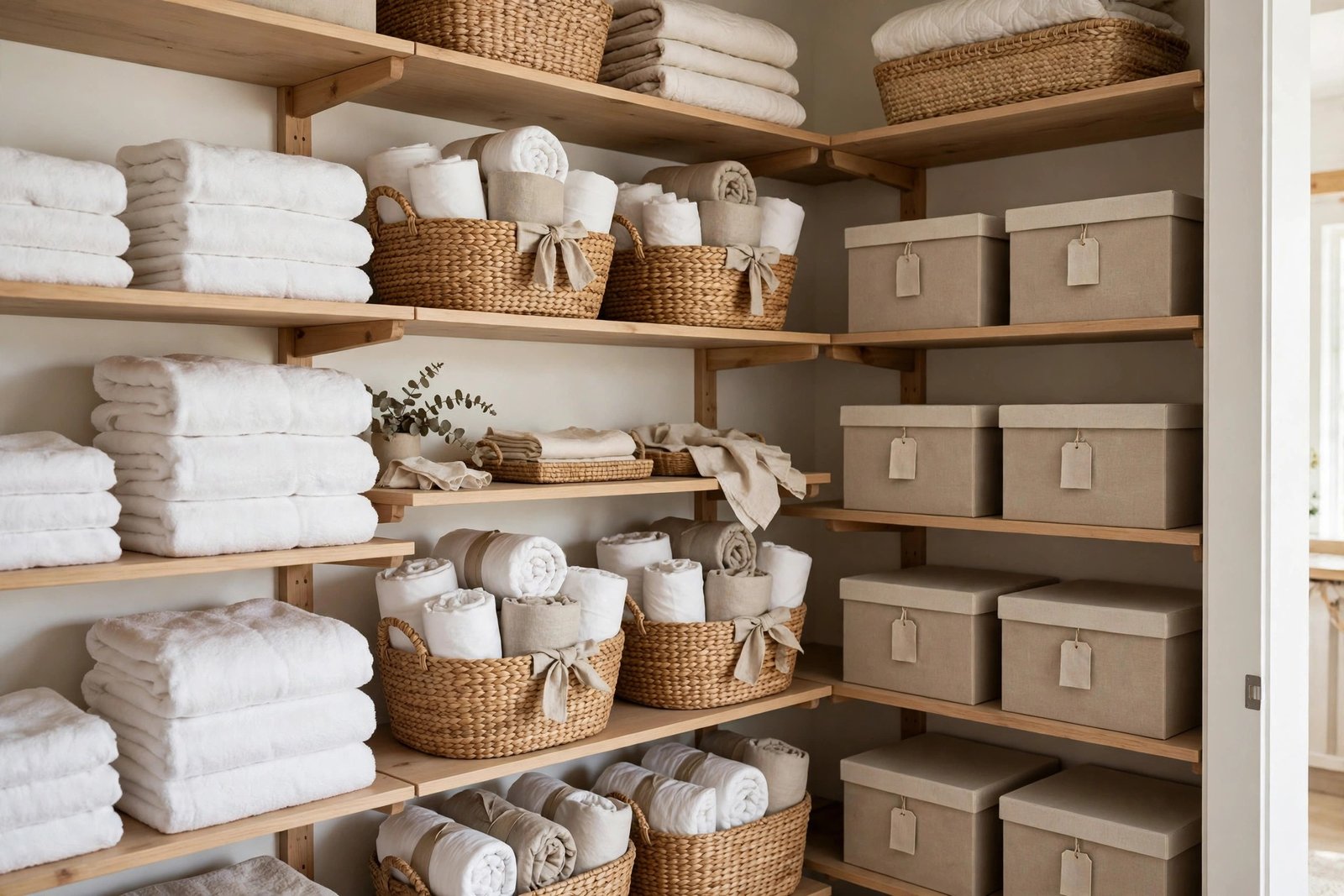
Step 1: The Great Linen Clear-Out
Empty the closet completely and sort everything into three piles: keep, donate, and discard. Discard anything stained, torn, or threadbare — towels that no longer dry properly are rags, not towels. Donate clean, usable extras to a shelter or animal charity, which always welcomes old towels and bedding. What remains should be a realistic inventory: two to three sheet sets per bed, two bath towels per person plus a couple of spares, and one set of guest linens if you host regularly.
The number matters because linen closets fail by overfilling. A closet stuffed to the edges cannot stay organized, because every retrieval disturbs the stack. If you keep only what fits comfortably on the shelves with breathing room, the system maintains itself. Be especially honest about the beach towels, the novelty hand towels, and the single pillowcases without partners — they are the clutter that eats the shelves.
Step 2: Fold So Stacks Stay Standing
Inconsistent folding is the hidden cause of linen avalanches. When towels are folded to different sizes, stacks lean, slide, and topple. Pick one fold for bath towels — thirds lengthwise, then halves — and use it every time, so every towel is the same size and stacks sit square. For hand towels and washcloths, use the same method at a smaller scale, and keep each size in its own stack.
For sheet sets, the pillowcase trick changes everything: fold the fitted sheet, flat sheet, and one pillowcase neatly, then slide the whole set inside the second pillowcase. The set stays together forever, you can see at a glance which bed it belongs to if you label the pillowcase or sort by size, and the stack stays uniform. Fitted sheets are the only tricky part — lay the sheet flat, tuck the corners into each other, and fold it into a rectangle like a flat sheet, rather than wrestling it into a ball.
Step 3: Sort by Room, Person, or Size
Decide on one sorting logic and stick to it. Sorting by room works well for most homes: one shelf or bin for the main bedroom, one for the kids’ rooms, one for guests. Sorting by size works if your beds differ — all queen sets together, all twin sets together. Sorting by person works in a shared house where everyone manages their own linens. Mixing logics is what creates confusion, so pick one and label accordingly.
Within each group, order the stack by use: the set currently on the bed goes at the back or bottom, and the freshly laundered set goes on top, so rotation happens naturally. If you keep spare blankets and quilts in the closet too, store them in breathable cotton bags or vacuum bags on the highest shelf, where their bulk does not crowd the everyday towels. Weighted blankets deserve their own spot — they are heavy and will crush anything beneath them.
Step 4: Bins, Baskets, and Shelf Dividers
Bins are what make a linen closet survive real life. Washcloths, hand towels, and small items slide off open shelves constantly; in a labelled bin, they stay put and can be pulled out like a drawer. Choose bins that fit your shelf depth, leave a finger gap on each side, and label them clearly: “Washcloths”, “Hand Towels”, “Guest”, “Table Linens”. Woven baskets look warm and natural, but plastic bins wipe clean and hold their shape better under weight — pick based on how humid your closet gets.
Shelf dividers are the other unsung hero. A simple vertical divider stops a tall stack of towels from leaning into the next stack, and it lets you keep categories separate without adding a single bin. If your shelves are deep, add a shelf riser or a small stackable shelf to create a second level for hand towels above the bath towels. And use the door: hooks or an over-door rack hold ironing supplies, a lint roller, or a small bag of sachets without taking shelf space.
Keeping Linens Fresh and the Closet Smelling Good
Never store a towel that is even slightly damp. Musty smells start in the closet and are hard to wash out later.
Leave a small gap between stacks and the wall, and avoid packing shelves solid. Air circulation prevents that stale closet smell.
Lavender sachets or cedar blocks keep linens fresh for months. Avoid spraying perfume directly onto stored fabric.
Put freshly laundered linens at the bottom of the stack so older sets get used first and nothing sits untouched for a year.
Blankets and quilts going away for the season should be freshly washed and stored in breathable bags, not plastic.
Every spring and autumn, pull everything out, check for wear, and let go of what has become a rag. Ten minutes keeps the system honest.
Small Closets and No Closet at All
If your linen closet is tiny — a single narrow cupboard or a shelf above the washing machine — the same ideas scale down. Roll towels instead of stacking them: rolled towels fit into baskets, cubbies, and narrow shelves that stacks cannot, and they look tidy in an open basket in the bathroom itself. Vacuum bags compress bulky quilts and out-of-season bedding to a fraction of their size, freeing the shelf for everyday towels.
If you have no linen closet at all, distribute the system: a basket on top of the wardrobe for each bed’s spare set, a bathroom shelf or ladder for everyday towels, and a labelled box under the bed for guest linens. The principle stays the same — one home per category, uniform folding, and an honest inventory. Related organization wins elsewhere in the home follow the same logic, from small closet organization ideas to walk-in closet organization ideas, and keeping towels fresh starts with knowing how often to wash bath towels.
Seasonal Rotation: Swapping Linens Through the Year
A linen closet that never changes with the seasons slowly fills with things you do not need right now. In summer, heavy flannel sheets, thick blankets, and winter duvets take up prime shelf space while the light cotton sheets you actually want sit buried behind them. Twice a year — once when the weather turns warm and once when it turns cold — swap the seasonal stock: move the out-of-season bedding to the highest shelf or into vacuum bags, and bring the in-season sets down to eye level where they are easy to grab.
Seasonal rotation is also the ideal moment for the closet’s twice-yearly review. Wash everything before it goes into storage, check elastic on fitted sheets, and retire anything that has gone thin or lost its softness. Summer brings its own items too: beach towels and picnic blankets deserve a labelled bin of their own during the warm months, then move to backstock when autumn arrives. Treating the linen closet as a living system that changes with the year, rather than a static cupboard, keeps it from slowly filling up — and it means you are never digging past a winter duvet to reach a summer sheet on the hottest night of the year.
Frequently Asked Questions
How many sheet sets should I keep per bed?
Two to three sets per bed is the sweet spot: one on the bed, one in the wash, and one spare in the closet. More than that fills the shelves without adding any real convenience.
What is the best way to fold a fitted sheet?
Hold it lengthwise, tuck the top corners inside the bottom corners so all four corners meet, lay it flat, fold the elastic edges inward to make a rectangle, then fold it like a flat sheet. It takes practice but becomes quick.
Should towels be rolled or folded in a linen closet?
Folded and stacked works best on standard shelves, because stacks are stable and easy to count. Rolled towels work better in baskets, cubbies, and narrow spaces where stacks would topple.
How do I stop my linen closet smelling musty?
Store only fully dry linens, leave airflow around the stacks, and add lavender sachets or cedar blocks. If the smell persists, check for damp in the closet itself — a leak or condensation problem will defeat any sachet.
Where should I store extra blankets?
On the highest shelf in breathable cotton storage bags, or vacuum-sealed if space is tight. Keep them out of the everyday towel zones so their bulk does not crowd daily use.
Bringing It All Together
A linen closet that works is not about expensive baskets or perfect folding videos. It is about an honest inventory, one consistent fold, one sorting logic, and bins for the small stuff that otherwise slides everywhere. Clear it out, fold everything the same way, sort by room or size, and give every category a labelled home.
Do it once, properly, on a quiet afternoon, and the daily ritual changes: you open the door, take what you need, and close it again — no avalanche, no mystery pillowcase, no digging. That is the whole point of organization, and the linen closet is the easiest place in the house to prove it.