
Where to Install Smoke Detectors in a House: The Room-by-Room Guide
Most house fires do not announce themselves politely. They start quietly — a forgotten pan, a faulty charger, a smouldering socket — and the difference between a frightening story and a tragedy is usually measured in minutes. Smoke detectors exist to buy those minutes, but only if they are in the right places. A detector in the wrong room, or one mounted in a dead-air corner, may stay silent while smoke fills the hallway your family needs to escape through.
The rules are simpler than most people expect: every level, every bedroom, outside every sleeping area, and in the main living spaces — mounted on the ceiling, away from kitchens and bathrooms, and interconnected so that when one sounds, they all sound. This guide walks you through the placement room by room, explains the spots to avoid, and covers the testing and replacement routine that keeps the whole system trustworthy.
Key Takeaways
- Install a smoke detector on every level, inside every bedroom, and outside each sleeping area.
- Ceiling mounting is best; smoke rises, and a wall-mounted detector must sit near the ceiling.
- Keep detectors at least 3 metres from cookers and away from bathrooms and draughty vents.
- Interconnected alarms — wired or wireless — warn the whole house at once, even from a distant room.
- Test monthly, change batteries yearly unless sealed, and replace the whole unit every 10 years.
- Never paint over a detector or cover it to stop nuisance alarms; fix the placement instead.
The Golden Rule: Every Level, Every Bedroom, Every Escape Route
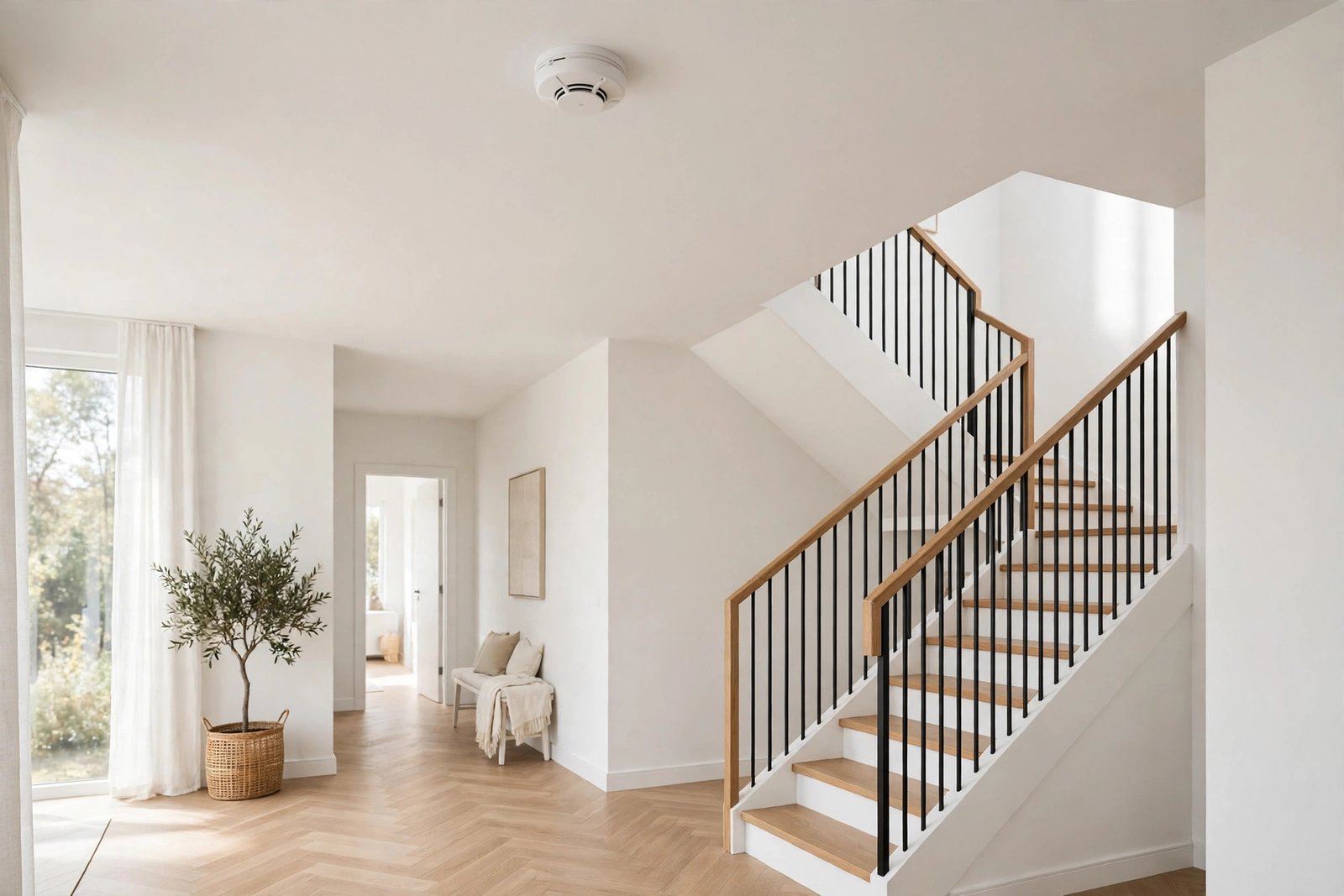
Start with the structure of the house. You need at least one smoke detector on every level, including the basement and any finished attic. Then add one inside every bedroom, because closed doors slow smoke reaching a hallway alarm, and a fire that starts in a bedroom itself may not trigger a distant detector until it is far too late. Finally, place one outside each sleeping area — in the hallway or landing that bedrooms open onto — so the alarm sounds on the escape route itself.
For larger homes, add detectors in the main living areas: the living room, family room, and any room with a fireplace, wood stove, or a large number of electrical devices. As a rough guide, no point in a room should be more than about 9 metres from a detector, and long hallways over 12 metres need a detector at each end. If you are counting up how many you need, our guide to how many smoke detectors you need in your home walks through the calculation room by room.
Ceilings, Walls, and the Dead-Air Trap
Smoke rises, so the ceiling is almost always the right place. Mount the detector in the centre of the ceiling where possible, or at least 10 centimetres away from any wall or light fitting. The spot where a wall meets the ceiling is a dead-air zone where smoke does not circulate well, and a detector tucked into a corner may respond minutes later than one a short distance out — minutes your family may not have.
If ceiling mounting is genuinely impossible, a wall mount is acceptable, but position the top of the detector between 10 and 30 centimetres below the ceiling, never lower. On a pitched or cathedral ceiling, mount the detector within about 90 centimetres of the peak, but not in the peak itself, where another dead-air pocket forms. In a room with beams, mount the detector on the flat ceiling between beams rather than on the beam, unless the beams are deeper than the spacing rules allow — in that case, treat each beam bay as its own space.
Room by Room: Where Detectors Belong
Bedrooms
One detector inside every bedroom, on the ceiling, away from the door’s draught path. Children, older adults, and heavy sleepers benefit most from an alarm that sounds in the room itself, and modern interconnected units will also trigger the hallway alarms at the same time.
Hallways and Landings
This is the backbone of the system. Place detectors on the landing at the top of the stairs and in the hallway outside bedroom doors, so that smoke from any room must pass an alarm on its way to the stairs. In a two-storey house, the upstairs landing detector is arguably the most important alarm in the home.
Living Rooms and Family Rooms
Install a detector in any living space, especially rooms with fireplaces, candles, or heavy electrical use. Keep it away from the fireplace itself and from air vents, which can push smoke away from the sensor.
Basements and Attics
Basements need a detector on the ceiling at the bottom of the stairs, because fires in basements are often discovered late and smoke travels up the stairwell quickly. A finished attic used as a bedroom or office follows the bedroom rules; an unfinished storage attic benefits from a heat detector instead, since dust and temperature extremes cause nuisance alarms in smoke detectors.
Garages and Utility Rooms
Standard smoke detectors do not belong in garages, where car exhaust and dust trigger constant false alarms. Use a heat detector there instead, mounted on the ceiling, and place a smoke detector in the room adjoining the garage, such as the hallway or utility room door.
Where NOT to Put a Smoke Detector
Kitchens are the classic mistake. A detector in the kitchen will sound every time someone sears a steak, which trains the household to ignore it or, worse, to remove its battery. Keep smoke detectors at least 3 metres from cookers and ovens; kitchens are better protected by a heat detector, which responds to a rapid temperature rise rather than to cooking smoke. The same logic applies to bathrooms: steam sets off smoke detectors, so keep them well away from bathroom doors and never inside the bathroom itself.
Other spots to avoid include unheated porches and garages where extreme cold affects the sensor, dusty workshops, rooms with a strong draught from a vent or fan, and the peak of a pitched ceiling. Also never place a detector behind a curtain, inside a cupboard, or anywhere furniture blocks the airflow to it. If your kitchen layout makes the 3-metre rule hard, a photoelectric detector placed just outside the kitchen door is usually the best compromise.
Ionisation, Photoelectric, or Dual-Sensor?
There are two main sensor types, and they catch different fires. Ionisation detectors respond fastest to fast, flaming fires with little visible smoke, while photoelectric detectors respond fastest to slow, smouldering fires that produce large amounts of smoke — the kind that starts in upholstery or bedding while people sleep. Because you cannot predict which kind of fire your home might face, the safest choice is a dual-sensor alarm in bedrooms and hallways, or a mix of both types across the house.
Interconnection matters just as much as sensor type. When alarms are interconnected — by wire or by wireless radio link — one detector’s alarm triggers all of them, so a fire in the basement wakes someone sleeping two floors up. Most modern battery alarms offer wireless interconnection without any rewiring, and it is one of the most valuable upgrades you can make to an older system. Pair your smoke coverage with carbon monoxide protection as well: our carbon monoxide detector placement guide explains where those alarms belong, since carbon monoxide is invisible and odourless and needs its own detector.
Testing, Batteries, and Replacement
Press the test button on every alarm once a month. It takes two minutes and confirms the sounder, battery, and circuitry all work.
Unless your alarm has a sealed 10-year battery, change the batteries at least once a year — pick a memorable date and do them all at once.
A chirping alarm needs a battery, not silence. Disabling even one unit breaks the interconnected chain for the whole house.
Vacuum around the alarm’s vents every six months to remove dust that can cause false alarms or slow the sensor.
Sensors degrade with age. Check the manufacture date on the back and replace the whole unit after a decade, even if it still tests fine.
Alarms only help if everyone knows what to do. Run a family escape drill twice a year, including a night-time drill.
Special Cases: Split Levels, Studios, and Hearing-Impaired Residents
Not every home fits the standard two-storey pattern, and detector placement should adapt to the layout rather than follow a template blindly. In a split-level home, treat each half-level as its own level: a detector belongs on each distinct floor area, including the short flight of stairs between them, because smoke can pool on a half-landing that a distant alarm never samples. In a studio or open-plan apartment, one detector may technically cover the space, but two are wiser — one near the sleeping area and one near the kitchen end, placed far enough from the cooker to avoid nuisance alarms while still covering the cooking zone.
Homes with residents who are deaf or hard of hearing need a different kind of alarm, not just more of the same. Strobe-light smoke alarms, bed shakers that vibrate the pillow, and wearable vibrating pagers all exist for this purpose, and they should be interconnected with the rest of the system so the whole household is alerted together. If anyone in the home sleeps with the bedroom door closed, place an interconnected alarm inside that room as well as in the hallway — closed doors delay smoke and sound alike. Finally, remember that rented homes deserve the same coverage: landlords in many areas are legally required to provide working alarms, but tenants should still test them monthly and report faults immediately rather than assuming someone else is checking.
Frequently Asked Questions
Should smoke detectors go inside the kitchen?
No. Keep smoke detectors at least 3 metres from cookers to avoid nuisance alarms from cooking. Use a heat detector in the kitchen itself and a smoke detector just outside the kitchen door.
Can I put a smoke detector in the bathroom?
No, steam from showers causes false alarms. Place the detector in the hallway outside the bathroom instead, well away from the door.
Do smoke detectors need to be interconnected?
It is strongly recommended, and required by code in many new builds. Interconnected alarms ensure a fire anywhere in the house alerts everyone, including people sleeping far from the fire’s origin.
How high on the wall can a smoke detector go?
The top of a wall-mounted detector should be 10 to 30 centimetres below the ceiling. Lower than that, and smoke may take much longer to reach it.
Why does my smoke detector beep randomly?
A single chirp every minute or so usually means a low battery. Frequent false alarms point to dust, steam, a draught, or an alarm past its 10-year life — check placement and age before replacing it.
Bringing It All Together
Good smoke detector placement is a simple system: every level, every bedroom, outside every sleeping area, on the ceiling, away from kitchens and bathrooms, and interconnected throughout the house. Walk your home with this guide in hand, note any gaps, and fill them before the weekend is over — a detector costs less than a takeaway dinner and protects everything you own.
Then make the system part of your home’s routine: test monthly, replace batteries yearly, and replace units every ten years. Smoke detectors are one part of a wider safety net that also includes solid locks and a sensible approach to improving home security with better locks. Do the walk-through today, while you are thinking about it — it is the rare safety job that takes an afternoon and protects you every night.