
Dressing Table Design Ideas for Small Bedrooms: Smart, Stylish and Space-Saving
A dressing table is often the first thing crossed off the list when a bedroom is small. It feels like a luxury, something that belongs in a large master suite, not in a room where the bed already fills most of the floor. But getting ready every morning without a proper place — balancing make-up on a windowsill, perching on the bed with a hand mirror — is a daily frustration, and it usually ends with clutter spread across every surface. The good news is that a small bedroom does not need a big dressing table. It needs a clever one.
Modern dressing table design for small bedrooms is all about using dead space: a wall that holds nothing, a corner that fits nothing else, the inside of a wardrobe door, or a tabletop that folds away when you are done. This guide covers the designs that actually work in small rooms — wall-mounted, corner, fold-down, mirror-storage and multi-use tables — plus the measurements, lighting and storage rules that keep a small dressing area tidy instead of turning it into another cluttered surface.
Key Takeaways
- Use dead space: walls, corners and wardrobe doors are better dressing-table sites than open floor.
- A wall-mounted or floating table uses almost no floor space and makes the room feel larger.
- Corner tables fit where nothing else does, and fold-down tables disappear completely when not in use.
- Mirror storage — a mirrored cabinet or a mirror with shelves — doubles storage without a bigger footprint.
- Good lighting matters more than size: bright, even, front-facing light beats a large table in dim light.
- Keep only daily items on the surface; everything else belongs in drawers, trays or vertical storage.
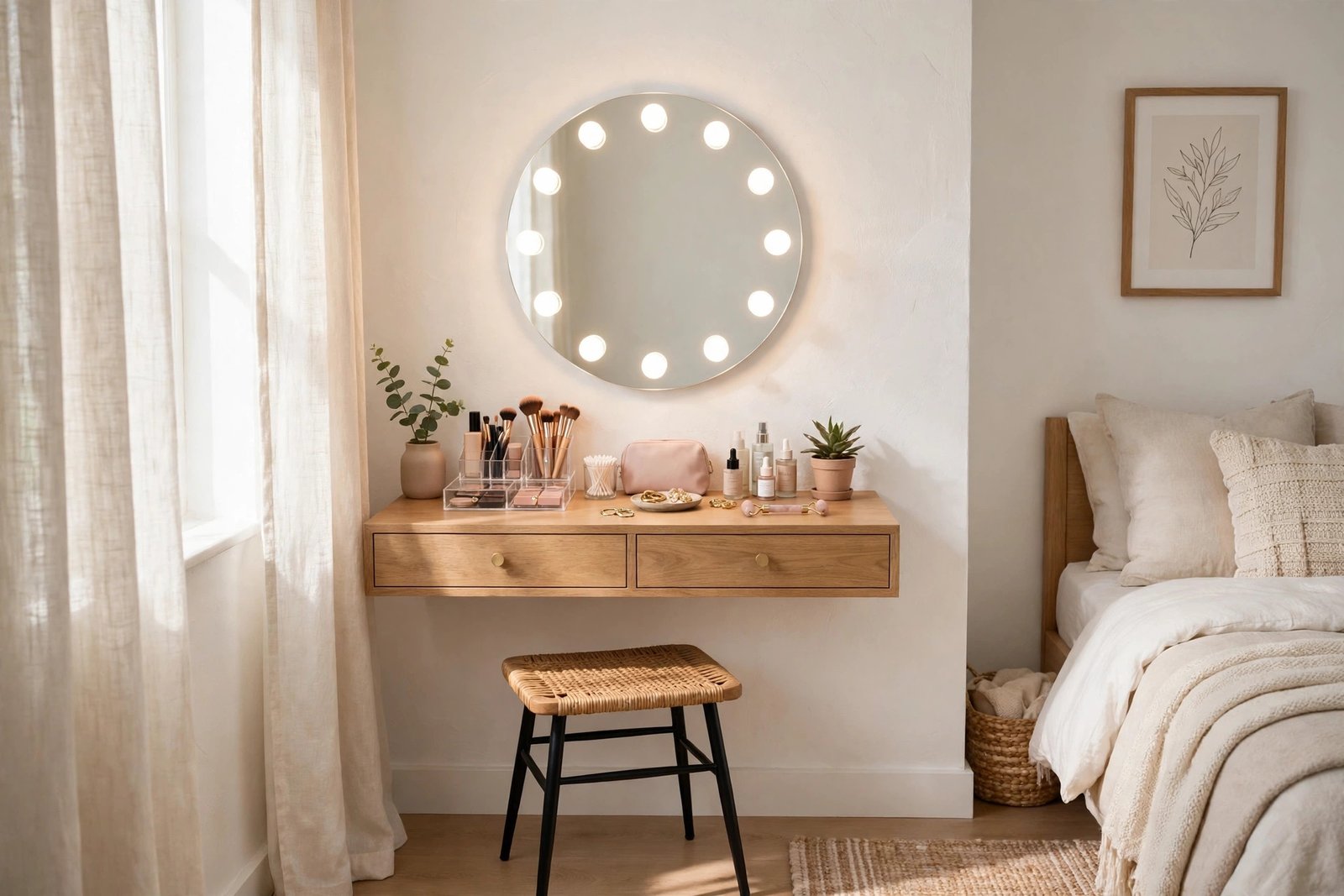
Start With Measurements, Not Furniture
Before you browse a single table, measure the space you actually have, including the details people forget. You need a width of at least 60 to 75 centimetres for a comfortable dressing area — enough for a mirror, a few daily items and room to rest your elbows. Depth matters more than width in a small room: 35 to 45 centimetres is ideal, and anything deeper than 50 centimetres will eat into your walking space. Check the height too: a tabletop at 72 to 76 centimetres suits a standard chair or stool, and you need about 60 centimetres of clear knee space underneath if you want to sit comfortably.
Then walk the room and look for dead space rather than empty floor. The wall beside a wardrobe, the strip of wall between a door and a corner, the space under a window, and the inside of a wardrobe door are all candidates. Measure the clearance for opening doors and drawers nearby, and check where the nearest power socket is — a dressing table without a socket nearby means trailing cables or a battery lamp, neither of which is ideal. Note the natural light too: a table facing or beside a window gives you the best daylight for getting ready, while a table facing away from the window will need stronger artificial light. Planning around these constraints first means every design below can be judged against your real room, not a showroom. For the same small-space thinking elsewhere in the home, see our space-saving furniture ideas for small homes.
Wall-Mounted and Floating Dressing Tables
A wall-mounted dressing table is the single best solution for most small bedrooms, because it removes the legs and the bulk that make a room feel crowded. A simple floating shelf or a shallow wall-mounted desk, fixed at the right height, gives you a full dressing surface while the floor underneath stays clear, which visually enlarges the room and makes cleaning easier. Pair it with a stool that slides completely underneath, and the whole set-up disappears into the wall when you are not using it.
The key to making a floating table work is fixing and storage. It must be screwed into wall studs or solid masonry, not just plasterboard plugs, because it will carry the weight of a mirror, daily items and your arms leaning on it. Add storage around it rather than on it: a small wall shelf above for perfumes, a magnetic strip or hooks for jewellery, and a narrow drawer unit beside it if you have the width. A floating table also suits renters less well than freestanding options, so if you cannot drill, look for a narrow console table with open legs instead — the same visual lightness, without the fixing. A similar approach works well for study areas, as shown in our study table design ideas for small rooms.
Corner, Fold-Down and Hidden Designs
Corners are the most wasted space in small bedrooms, and a corner dressing table turns that waste into a useful station. A triangular or L-shaped corner table fits where a rectangular table cannot, tucks neatly beside a wardrobe, and leaves the main wall free for the bed or storage. Look for designs with a corner mirror — either a single angled mirror or two mirrors meeting at the corner — which gives a surprisingly good view, and add a small corner shelf above for items you reach for daily.
Fold-down tables are the most radical space-savers. A wall-mounted cabinet that folds down into a tabletop and folds back up into a mirror or a picture frame gives you a full dressing station that occupies zero floor space when closed. Inside, shallow shelves and hooks hold daily items, so opening it in the morning reveals everything in one place. They work best for people with a compact routine — a few essentials rather than a large collection — and they are excellent in studio flats and guest rooms. A third hidden option is the wardrobe dressing table: a pull-out shelf or a dressing section built into a wardrobe, with a mirror on the inside of the door. It keeps everything out of sight, which is ideal if you prefer a bedroom that looks completely uncluttered. Beds that hide away use the same logic; see our Murphy bed ideas for small spaces.
Mirror Storage: Double the Function in the Same Footprint
In a small bedroom, the mirror is not just for looking in — it is a storage opportunity. A mirrored wall cabinet, like a bathroom cabinet adapted for the bedroom, hides shelves behind a full-length or half-length mirror and keeps daily items within arm’s reach without a single drawer. A mirror with built-in side shelves or a shelf along the bottom does the same job more openly, giving you a place for perfumes and small jars while keeping the tabletop clear.
Tri-fold mirrors are another smart choice: they give you side views for hair and earrings, fold flat against the wall when not in use, and can hide shallow shelving behind the centre panel. If you prefer a simple round or arched mirror, add storage around it instead — a narrow ledge shelf beneath it, small baskets on the wall beside it, or a hanging organiser on the back of the bedroom door for less-used items. The rule is simple: every item should have a home that is not the tabletop. The moment the tabletop becomes storage, the dressing area stops working, however beautiful the table is. For more storage principles that work in tight rooms, see our small closet organisation ideas and storage ideas for small spaces.
Lighting and Seating: The Details That Make It Work
Lighting decides whether a dressing table is a pleasure or a frustration, and in a small bedroom it is often neglected. The ideal is bright, even light that falls on your face from the front, not from above or behind you, which casts shadows. A mirror with built-in lights, a pair of small wall sconces either side of the mirror, or a portable ring light all achieve this. Aim for daylight-white bulbs, around 4000 to 5000 Kelvin, which show colours accurately — warm yellow light makes make-up look different outdoors, which is a common morning surprise.
Seating matters just as much and is just as often an afterthought. A backless stool tucks fully under the table and is the best choice for the smallest rooms; a small chair with a low back is more comfortable for longer routines but needs more clearance. If you have room for a chair with storage — a seat that lifts to reveal a compartment — it can hold hair tools or less-used items and earn its footprint. Keep the seat light enough to move easily, because in a small bedroom you will pull it out and push it back every day, and a heavy chair quickly becomes an obstacle rather than a help. The same lighting and organisation logic applies in compact bathrooms; see our guide to how to organise a small bathroom.
Keeping a Small Dressing Table Tidy
Keep out only what you use every day; seasonal or occasional items go in a drawer or box elsewhere.
One small tray corrals bottles and jars into a single, tidy group instead of a scattered surface.
Wall shelves, hooks and hanging organisers store more than any tabletop without using floor space.
When a new product arrives, remove an old one; a small surface cannot absorb endless additions.
Spend five minutes each week clearing the surface, wiping the mirror and returning strays to their homes.
Use a cable clip or a small basket to keep hair-tool cables off the surface and out of sight.
Frequently Asked Questions
What size dressing table fits a small bedroom?
Aim for 60 to 75 centimetres wide and 35 to 45 centimetres deep, with a tabletop height of 72 to 76 centimetres. Wall-mounted and corner designs fit where a standard table cannot.
Is a wall-mounted dressing table a good idea?
Yes, for most small bedrooms: it uses no floor space, makes the room feel larger, and pairs with a stool that slides underneath. It must be fixed into studs or masonry, not plasterboard alone.
What is the best lighting for a dressing table?
Bright, even, front-facing light in daylight white, around 4000 to 5000 Kelvin. A lit mirror, wall sconces either side of the mirror, or a ring light all work well.
How do I keep a small dressing table from getting cluttered?
Keep only daily items on the surface, use trays and vertical storage, follow a one-in-one-out rule, and do a five-minute weekly reset to return everything to its place.
Can a dressing table fit in a room with a wardrobe and a double bed?
Usually, yes — by using dead space. A wall-mounted table beside the wardrobe, a corner table, or a dressing section inside the wardrobe itself all fit without moving the bed.
What chair is best for a small dressing table?
A backless stool that slides fully underneath is best for the smallest rooms. A small chair with storage under the seat is a good upgrade if you have a little more clearance.
A Dressing Table That Fits Your Room, Not Just Your Wish List
A small bedroom does not mean giving up a dressing table. It means choosing smarter: measure first, use dead space, pick a floating, corner or fold-down design, and let the mirror do double duty as storage. Add good front-facing light and a stool that tucks away, and the whole station can occupy less space than a bedside table.
Start by measuring your best wall or corner tonight. Once you know the width and depth you have, the right design usually picks itself — and your mornings will be calmer for it.